
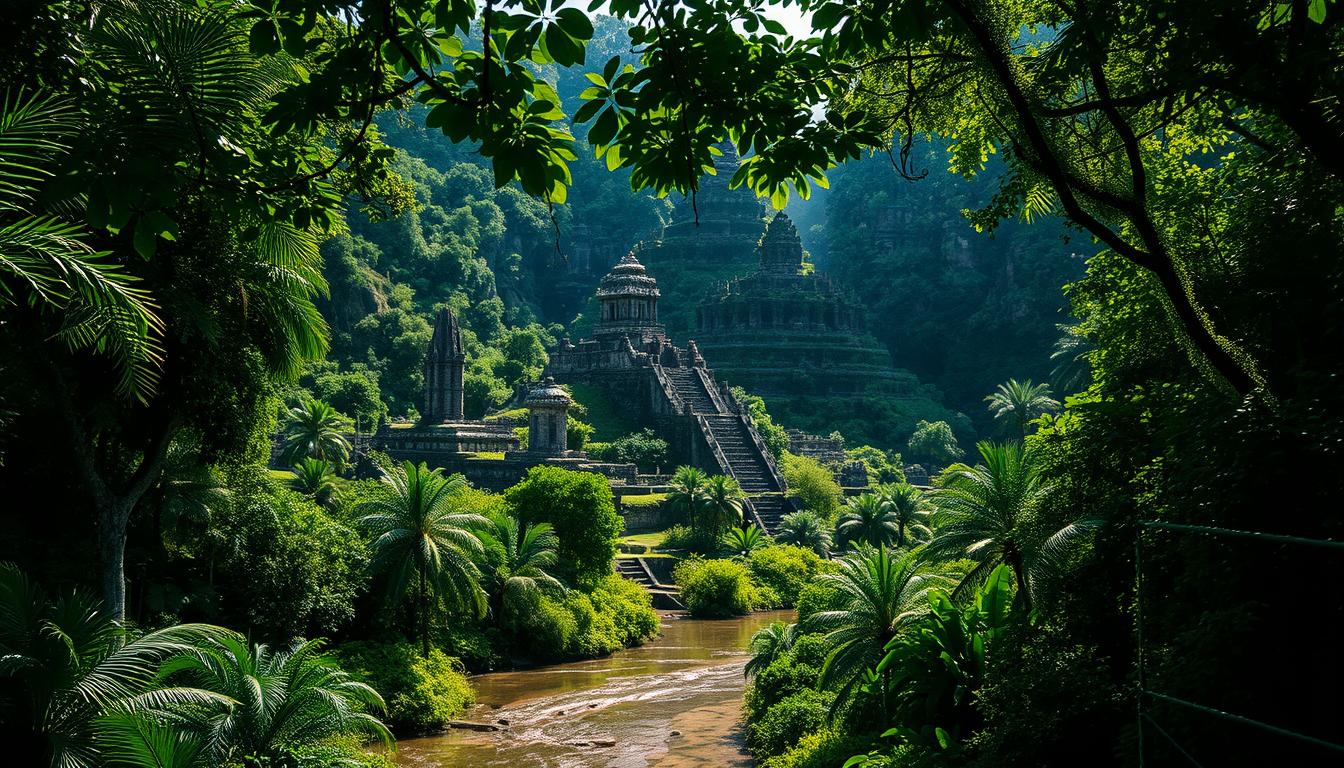
Hidden deep in the jungle, ancient cities are coming back to life. Tools like LIDAR are uncovering these lost places. For example, the Maya city Valeriana in Mexico’s Campeche region was found recently.
This city, hidden for 1,000 years, is massive. It covers 123 acres and has a 82-foot-tall pyramid. It shows that these ancient societies were much more advanced than we thought.
Archaeologists used LIDAR to find Valeriana’s causeways and ceremonial centers. It was a key city during the Classic period. Nearby, three other Maya cities were found in the last decade, showing they were connected.
Teams have been studying these cities for over 25 years. They learned how these communities adapted and eventually disappeared. Discoveries in Mexico and Honduras are changing how we see ancient America.
These finds tell us more than just about old buildings. They reveal stories of collapse and survival. As technology uncovers these secrets, we learn that history’s biggest mysteries are often hidden in today’s forests.
The Allure of Ancient Jungle Cities
For centuries, mysterious ruins hidden in tropical forests have fascinated people. The study of these ancient cities changes how we see history. Places like the Casarabe civilization, active from 500–1400 C.E., show dense jungles once had thriving societies.

“Discovering so many Maya cities via LiDAR means there are more than we can study,” says archaeologist Mr. Auld-Thomas. This flood of data overturns old beliefs.
Professor Marcello Canuto says, “The Tropics were seen as places where civilizations died. Now, we see them as cradles of complex cultures.” Jungle archaeology reveals the Casarabe’s monumental platforms and pyramids. These cover areas larger than 30 soccer fields.
LiDAR scans show networks of canals and terraces, changing how we think about history. Once thought uninhabitable, these areas had cities with advanced layouts. Each discovery through lost city exploration changes our view, showing jungles were home to innovators, not isolated groups. As technology improves, more ancient cities will be found, changing our understanding of human history.
Notable Jungle Cities Around the World
Deep in Mexico’s jungles, the Mayan ruins of Valeriana show a vast ancient city. It covered 16.6 square kilometers and was home to 30,000–50,000 people. Advanced LiDAR scans found pyramids, plazas, and structures as big as Calakmul’s. These jungle metropolises thrived in dense forests, hiding their secrets for centuries.

In Ecuador’s Amazon basin, the Upano region has Amazon ancient settlements from 2,500 years ago. It has over 6,000 raised platforms and a 25km road network. Researchers say these findings change Amazon history, with populations reaching hundreds of thousands. LiDAR surveys across 300 square kilometers showed terraces and canals that supported communities for a thousand years.
Angkor Wat’s fame grows with LiDAR discoveries of hidden pyramids and vast canals. Beyond the temple, cities like Preah Khan of Kompong Svay reveal Angkor’s true size—a medieval megacity. These finds show jungle jungle metropolises were more connected and advanced than thought.
From Mexico’s Maya heartlands to Cambodia’s temple complexes, these sites show ancient ingenuity. Each jungle metropolises tells a story of adaptation, proving forests once hosted thriving civilizations.
Techniques Used in Rediscovering Ancient Cities
Lidar archaeology has changed the game for finding lost civilizations hidden by jungles. It uses laser pulses from planes to see through thick vegetation, showing buried structures in 3D. In Guatemala’s jungles, a 2018 lidar survey found 60,000 Maya structures in just two weeks. This would have taken decades to do on foot.
These archaeological technologies uncover terraces, roads, and entire urban layouts hidden for centuries.

Laser mapping spots patterns we can’t see. For example, the 10km-long SKBR complex in South Africa was found using this method. It’s three times bigger than Mesopotamia’s Ur.
But, jungle excavation is also key. Teams go to sites to check findings, digging test pits to confirm structures. “Without ground checks, we might mistake natural rock formations for walls,” says Dr. Emily Carter, who worked on the Amazon’s Sangay site.
“Lidar’s data revealed a road network spanning six miles in Sangay. But it took shovels and brushes to uncover its 2,500-year-old pottery.”
Lidar archaeology has its limits. It can’t see deep underground or tell organic materials apart. Also, big surveys cost millions, needing partnerships between governments and universities. Yet, these tools open new doors: 90% of Amazonian history is waiting to be found.
As technology gets better, the mystery of ancient jungles fades, revealing the truth.
The Impact of Rediscovered Cities on Archaeology
Rediscovering these cities has led to archaeological paradigm shifts. Sites like the Amazon’s 2,500-year-old network show advanced pre-Columbian urbanism. Over 6,000 earthen mounds and 24 earthworks in the Amazon suggest sophisticated ancient urban planning.
These findings upend myths of isolated tribes. They prove these regions hosted populations as large as Roman London’s peak of 10,000 to 30,000 people.
“It changes the way we see Amazonian cultures,” says researcher Antoine Dorison. “They built complex societies with engineered landscapes.”

Historical population estimates have skyrocketed. Maya cities, once thought to hold 5 million people, now suggest populations nearing 15 million. Such numbers highlight the civilization complexity of these societies.
LiDAR scans in Guatemala’s Maya Biosphere uncovered 60,000 new structures. This shows cities twice the size of England’s medieval towns. “When droughts hit, densely packed communities collapsed because their systems couldn’t adapt,” explains archaeologist David Auld-Thomas.
These discoveries force a reevaluation of how climate shaped societal survival.
These findings rewrite history. By studying 10,000-year-old platforms and 2,000-year-old settlements, experts now see jungles as cradles of civilization, not barriers to progress. The evidence reshapes our understanding of human ingenuity in environments once dismissed as uninhabitable.
Environmental Challenges in Jungle Regions
Archaeologists find ancient cities face tropical climate challenges. These challenges shaped ancient civilizations and threaten today’s jungle preservation efforts. The Maya cities collapsed due to severe droughts that disrupted farming.
“Climate change was a major factor,” say experts. They note how densely populated areas like Tikal’s 200 sq km urban network couldn’t adapt to drying conditions.
“The area lies in the shadow of a volcano that created rich soils but also may have led to societal collapse.”
Today, archaeological conservation battles deforestation and urban growth. LiDAR scans show 24 ancient Amazon structures buried under canopy. Yet, 10,000–24,000 more sites remain undiscovered—many at risk from logging and farming.
Even sustainable archaeology faces dilemmas. Exploring sites accelerates erosion, while inaction lets forests reclaim clues to humanity’s past.
Volcanic regions like Ecuador’s Upano Valley show nature’s gifts and dangers coexist. Rainforest protection efforts must balance discovery with preservation. With 100 uncontacted tribes in remote areas, safeguarding these ecosystems is vital—not just for ruins but for the 10% of Earth’s species that call the Amazon home.
Preservation Efforts for Rediscovered Sites
As technology uncovers ancient cities, we must act fast to protect them. With thousands of sites like Valeriana now visible, experts focus on archaeological site preservation to prevent damage.
“I’ve got to go to Valeriana at some point… we’re discovering more sites than we can study,” says archaeologist Auld-Thomas, highlighting the urgency.
Indigenous communities are at the forefront of protecting these treasures. They use indigenous preservation methods that blend ancient wisdom with modern science. In the Amazon, they train locals to map sites using GPS, ensuring cultural ties guide conservation.
3D site documentation and digital archaeology tools now safeguard what the jungle hid. LiDAR scans create detailed records of structures like Ocomtún in Mexico, preserving data even if sites remain hidden. UNESCO works with these tech innovations to advance cultural heritage protection, ensuring ancient landscapes endure.
Yet, challenges remain. Over 6,000 Amazon sites face threats from mining and logging. Projects like the Amazon Revealed use LiDAR to track threats, while partnerships with indigenous groups balance access and preservation. By merging tradition with innovation, these efforts protect humanity’s shared history for future explorers.
Future Prospects for Discovering More Hidden Cities
Future archaeological discoveries depend on satellite archaeology and AI in archaeology. These technologies scan unexplored jungle regions like the Amazon and Central Africa. They uncover landscapes that were once hidden, showing us irrigation systems and buried pyramids.
“There are countless sites we’ve yet to find,” says researcher Auld-Thomas. “A 300-square kilometer zone near known Maya ruins remains unexplored, holding answers to ancient lifestyles.”
AI algorithms now analyze LiDAR scans to build archaeological prediction models. These models highlight areas where geography and resources match settlement patterns. In Ecuador, such tools showed 6,000 structures in the Upano Valley, suggesting what might be hidden elsewhere.
Despite tech advances, challenges persist. Limited funding hinders the study of thousands of sites already found. Yet, better satellites and AI could soon reveal cities as vast as Tashbulak, which scans showed six times larger than initially thought.
Tomorrow’s explorers will use archaeological prediction models and drone-mounted sensors. They will uncover networks of roads and cities. The next generation of tools might answer questions that modern science can’t yet solve.
Stories from Explorers and Archaeologists
Archaeological expeditions are filled with stories of courage and unexpected finds. Luke Auld-Thomas, a researcher, found a major discovery by accident. He was searching online and stumbled upon a survey that revealed a 1,000-year-old Honduran city, Valeriana, hidden under the jungle.
“But I’m very stubborn, so I did it anyhow. Now I must admit I am quite happy to have made such a big discovery,” says Prof. Rostain, talking about his Amazon research. His team found Kuhikugu, a 1,500-year-old fortified town, thanks to his determination.
Field archaeology is tough. The Honduras team had to deal with more than just vines. They needed 16 Honduran Special Forces soldiers for their safety. Despite the high cost of LiDAR, it showed structures over a mile long. But, these discoveries are at risk from illegal logging and cattle ranching.
Archaeologists are driven by their passion. They face doubters, humidity, and time pressure. Every discovery brings us closer to understanding ancient civilizations. Their stories turn data into exciting tales, showing that exploration is a human adventure as much as it is science.
How You Can Get Involved
Exploring ancient cities hidden in jungles isn’t just for experts. Anyone can help uncover history. Join archaeological volunteering programs to assist digs or field surveys. Projects like the Upano Valley research in Ecuador welcome supporters, giving hands-on experience in uncovering 2,500-year-old settlements once home to 15,000 people.
Start with citizen science archaeology from home. Analyze LIDAR scans of Amazonian platforms or Guatemalan Mayan roads online. Platforms like OpenScience help map ancient networks like the 600-square-kilometer Upano site with its 6,000 earthen structures. No prior skills? Training is often provided.
Visit sites through responsible ruin tourism. Follow guidelines to protect fragile ruins. In regions like the Amazon, choose tours led by local communities to support preservation and economies. Avoid touching walls or walking off paths to preserve 26-foot-tall mounds.
Support conservation support through donations. Groups like the Amazon Archaeology Institute fund LIDAR surveys revealing networks like the 177-km Mayan trail. Even small contributions help protect 33-foot-wide roads and terraced fields from encroaching forests.
Join jungle expedition participation trips. Many organizations offer guided treks to sites like the Upano Valley, where 6,000 platforms lie undiscovered. These trips fund ongoing research and offer unique insights into engineering feats like 2,500-year-old drainage systems.
Every action matters. Whether analyzing data, visiting thoughtfully, or supporting teams, you help preserve stories of ancient engineers who built cities thriving for 1,000 years. Together, we ensure these hidden histories endure for future explorers to discover.