
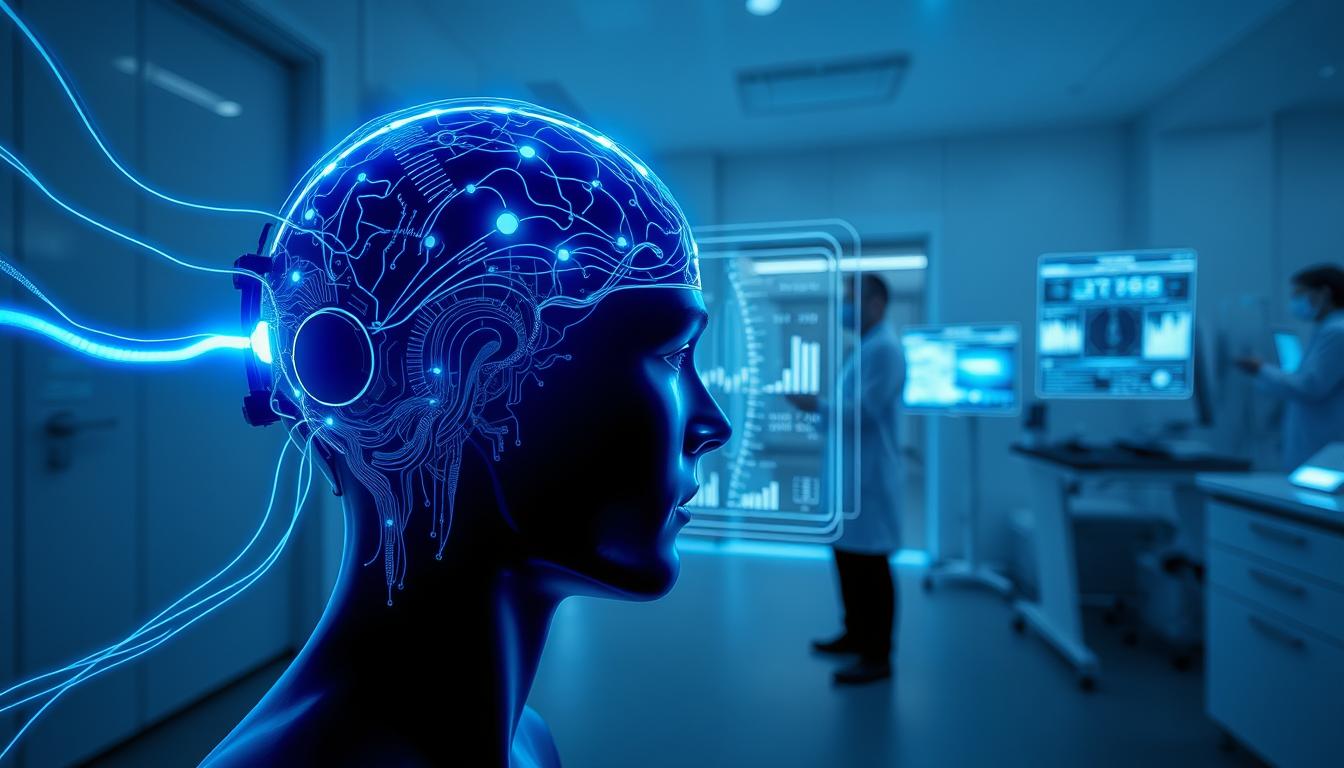
Brain-computer interfaces (BCIs) are no longer just science fiction. They are now a real part of medicine. These neural interfaces turn brain signals into actions. This lets people with paralysis or ALS control devices like robotic limbs.
BCIs don’t read minds. They use brain signals to help patients interact with the world again.
Today’s BCI technology uses signals like EEG and ECoG. It’s making big changes, like letting people type messages or speak again. Dr. Edward Chang’s neuroprosthesis is a great example.
Systems like the Stentrode, implanted via catheter, show how far we’ve come. But we face challenges. We need to make these systems more reliable and address ethical issues.
BCIs are changing healthcare by helping people move again or reducing pain. With over 15 years of research, we’re getting closer to making a big difference. Our goal is to create safe, long-lasting systems that change lives.
Introduction to Mind-Controlled Technology

Mind-controlled technology connects our brains to devices, letting us control things with our thoughts. It uses neural signal processing to turn brain signals into actions. In the 1970s, scientists started exploring this idea. But it wasn’t until 1980 that Elbert et al. showed it was possible to move objects on a screen with brain signals.
This breakthrough led to thought-controlled systems that help people with paralysis or mobility issues. These systems have come a long way, thanks to ongoing research.
By 1980, Elbert et al demonstrated that persons given biofeedback could control a rocket image’s vertical movement through EEG signals.
Over the years, neurotechnology has made great strides. In 2011, a study showed people could move virtual rings 85% of the time with their brain signals. By 2012, controlling drones with brain signals was also possible.
But there are challenges. Current systems need implants or aren’t very accurate. Now, AI is helping to improve these issues. It aims to better understand brain signals and help more people, like stroke survivors and amputees.
As research speeds up, we’re seeing new ways to interact with technology and each other. These advancements are exciting and hold a lot of promise.
The Science Behind Brain-Computer Interfaces
Brain-computer interfaces (BCIs) use neural activity monitoring to turn thoughts into actions. They detect electrical signals from neurons. These signals are captured by methods like electroencephalography (EEG), electrocorticography (ECoG), or intracortical recordings.
EEG tracks brain patterns with scalp sensors. It’s less invasive but can help patients regain movement, like the FDA-approved headset for stroke rehab (2021). ECoG, which requires surgery, offers clearer signals than EEG.
Intracortical recordings are the most invasive. They embed microarrays directly into brain tissue. This method captures detailed neuron data, allowing for precise prosthetic control.
Researchers have taught algorithms to recognize unique brain patterns for words like “dog” versus “cat.” This improves brain signal interpretation. Training users can take hours, but the results, like controlling drones or typing with thoughts, are groundbreaking.
These methods turn signals into commands, whether non-invasive or implanted. AI algorithms clean up the data, making it usable. This science is not just for labs; it’s already changing healthcare and more.
Applications in Medicine
BCI is changing lives by giving back lost abilities. It lets users control robotic limbs and wheelchairs with their minds. Stroke survivors are using BCI-driven exoskeletons to move better, with some achieving 90% accuracy in virtual tasks.
For those with ALS or spinal injuries, BCI brings movement and independence. This technology is a game-changer.

BCI is also helping people communicate. Paralyzed users can now type messages with their thoughts. Scientists are exploring ways to restore speech pathways too.
A study found 15 people could control wheelchairs with EEG, showing it’s practical for everyday use. This technology opens new doors for those who can’t speak or move.
Rehabilitation is getting a boost from BCI. Stroke patients are recovering motor skills faster with BCI-based therapy. One trial showed chronic hemiparetic patients improved arm function with exoskeleton training.
Even noninvasive EEG systems are as effective as invasive ones, making BCIs more accessible. New tech like EEG source imaging is improving accuracy. This lets users control robotic arms with more precision.
The future looks bright for BCI in medicine. The Nano-MIND system could lead to better treatments for Parkinson’s. As research grows, BCIs might become common in clinics. They offer hope for a better quality of life for those with neurological challenges.
Case Studies: Successful Implementations
“The BCI allowed me to do things I thought I’d never experience again. It’s not just technology—it’s hope.” – Participant in BrainGate trial
BCI success stories are changing lives for people with paralysis. In 2006, a man with tetraplegia controlled a computer and robotic arm. Now, Neuralink’s human implant shows big steps forward in BCI technology.
These systems use detailed neural signals to help users grasp objects or type messages on their own. This is a big step towards restoring mobility.
In 2012, a woman paralyzed for 14 years drank from a bottle using a BCI-controlled robotic arm. After 13 weeks of practice, she could pinch and grasp with 90% success. The DEKA Arm System, controlled by neural signals, also lets amputees do things like handle eggs or use keys.

Neuroplasticity is key. A 52-year-old with paralysis learned to move his hands again through BCI training. This shows how neural systems can adapt to brain changes over time.
Studies show these systems now last 7 months without needing to be recalibrated. This means patients can spend more time on activities and less on adjustments.
BCI has helped ALS patients type again and has enabled exoskeleton-assisted steps. These advances show BCI’s huge promise. As technology improves, we’re getting closer to using it in everyday life.
Benefits of Mind-Controlled Technology in Healthcare
BCI benefits are changing lives by giving patient independence to those with paralysis or communication issues. Now, people can type messages or move a wheelchair just by thinking. This technology helps stroke survivors and ALS patients interact with the world, boosting their dignity and self-determination.

BCIs do more than just control physical actions. They let people manage smart home devices, access education, and enjoy entertainment on their own. This reduces the need for caregivers, easing their emotional load and improving mental health. For example, non-invasive EEG-based systems already help users navigate digital interfaces, showing their practical use in everyday life.
Real-time neurofeedback during therapy sessions accelerates recovery by reinforcing neural pathways,” explains a 2023 study on stroke rehabilitation. BCI-driven treatment optimization has shown treatment optimization gains: stroke patients using BCIs saw Fugl-Meyer Assessment scores improve by 6.3-13.2 points post-therapy, outpacing traditional methods alone.
Hospitals save money by cutting down on caregiver hours and shortening stays. BCI systems also make neurorehabilitation more efficient: 30-40% of stroke survivors who can’t do standard rehab now benefit from tailored BCI protocols. These systems also lower long-term care costs for conditions like spinal cord injuries, which affect 250,000-500,000 people annually.
As BCIs evolve, their role in healthcare efficiency grows. New technologies like adaptive filters reduce signal interference, making them more reliable. With the global geriatric population increasing, BCIs will play a bigger role in treating chronic conditions like Parkinson’s and Alzheimer’s. These advancements promise a future where technology and care work together to unlock human possibilities.
Challenges and Ethical Considerations
BCIs are getting better, but we face big challenges. Invasive systems need surgery, which can lead to infections or damage. Non-invasive methods need frequent updates to work right.
There’s a lack of long-term studies, with only 56 out of 924 papers making the cut. These BCI limitations show we need safer, more reliable tech.
Keeping brain data private is a huge worry. If someone hacks into your brain signals, they could see your deepest thoughts. Laws like GDPR don’t cover neural data well, leaving us exposed.
A 2023 survey found 76% of BCI studies talk about ethics. But, we’re missing clear rules to protect us. Sullivan et al. (2023) say “ethical language” often doesn’t lead to real action.
Neuroethics must guide this tech’s growth, ensuring it benefits all without exploitation.
Equity is another big issue. High costs might block access for those who need it most. Military use also raises concerns, with soldiers possibly being seen as vulnerable.
Legal frameworks are behind, too. Bublitz et al. say users could face legal trouble if BCIs cause harm. We need clear rules to balance progress with safety.
To tackle these problems, we need to work together. Neurosurgeons, ethicists, and lawmakers must team up. With careful steps, BCIs can change lives while respecting our privacy and freedom.
Future Trends in Mind-Controlled Technology
The future of BCI is bright, thanks to new neural technologies. Wireless interfaces and AI systems are leading the way. Companies like Neuralink and Blackrock Neurotech are pushing the boundaries.
By 2045, the market could hit $1.6 billion. This growth is driven by portable and adaptable tech.
AI is making devices more accurate. It personalizes them, learning each user’s brain signals. Wireless tech also makes devices more mobile.
New tech like dry EEG sensors and quantum sensors is on the horizon. They promise smaller, safer BCIs.
These advancements aim to change lives. They could help paralysis patients and improve surgery.
While there are hurdles, the mix of AI and new neural devices is exciting. It suggests a future where our thoughts control technology.
How Healthcare Providers Can Embrace BCIs
Healthcare providers wanting to use BCIs need to focus on healthcare implementation strategies. These strategies should be both innovative and practical. Training programs should teach clinicians how to use and manage BCIs safely.
Courses should cover neurology, engineering, and ethics. This way, they can meet both technical and patient-care needs.
“BCI systems require interdisciplinary collaboration to succeed.”
For clinical integration, starting with non-invasive BCIs like EEG or fNIRS is a good idea. These are easy to use and don’t increase infection risks. They can help with stroke rehab or support ALS patients.
Healthcare providers should also push for insurance coverage for these devices. This will help more patients get access to BCIs. Groups and trials can show how BCIs can save money by improving patient outcomes.
Training should teach both technical skills and empathy. For example, neurologists and physical therapists can work together. They can use BCIs to help patients with stroke or spinal injuries.
Using AI can make BCIs more accurate. This can help show insurers the benefits of BCIs. For example, 90% of ALS patients with BCIs can communicate again.
Begin with small steps: start with pilot programs for epilepsy or post-stroke therapy. Working with tech developers and patient groups ensures BCIs help those who need them most. By focusing on fairness and education, healthcare can make BCIs a reality for better care.
Conclusion: The Promise of Mind-Controlled Technology
The future of medicine looks bright thanks to brain-computer interfaces (BCIs). These systems turn brain signals into actions. They’re helping paralyzed patients and improving mental health care.
BCIs could be key in treating depression and chronic pain. They’re already making a difference.
But we must move forward carefully. One in four U.S. adults deals with mental illness each year. BCIs, like those in stroke recovery trials, offer new hope.
Yet, we face challenges. We need to make these systems more accurate and ethical. It’s important to make sure they’re safe and accessible for everyone.
Neuroscientists, engineers, and ethicists are working together. They’re trying to understand brain signals for conditions like autism and ALS. The BRAIN Initiative and clinical trials for depression treatment show great promise.
But we need to involve patients in the design. This ensures the tools meet real-world needs.
BCIs today help some regain communication. But their true power lies in ethical and inclusive growth. By combining science with empathy, we can change medicine’s future.
We can make personalized care a reality. The path ahead is clear: create systems that listen to both neurons and human voices.