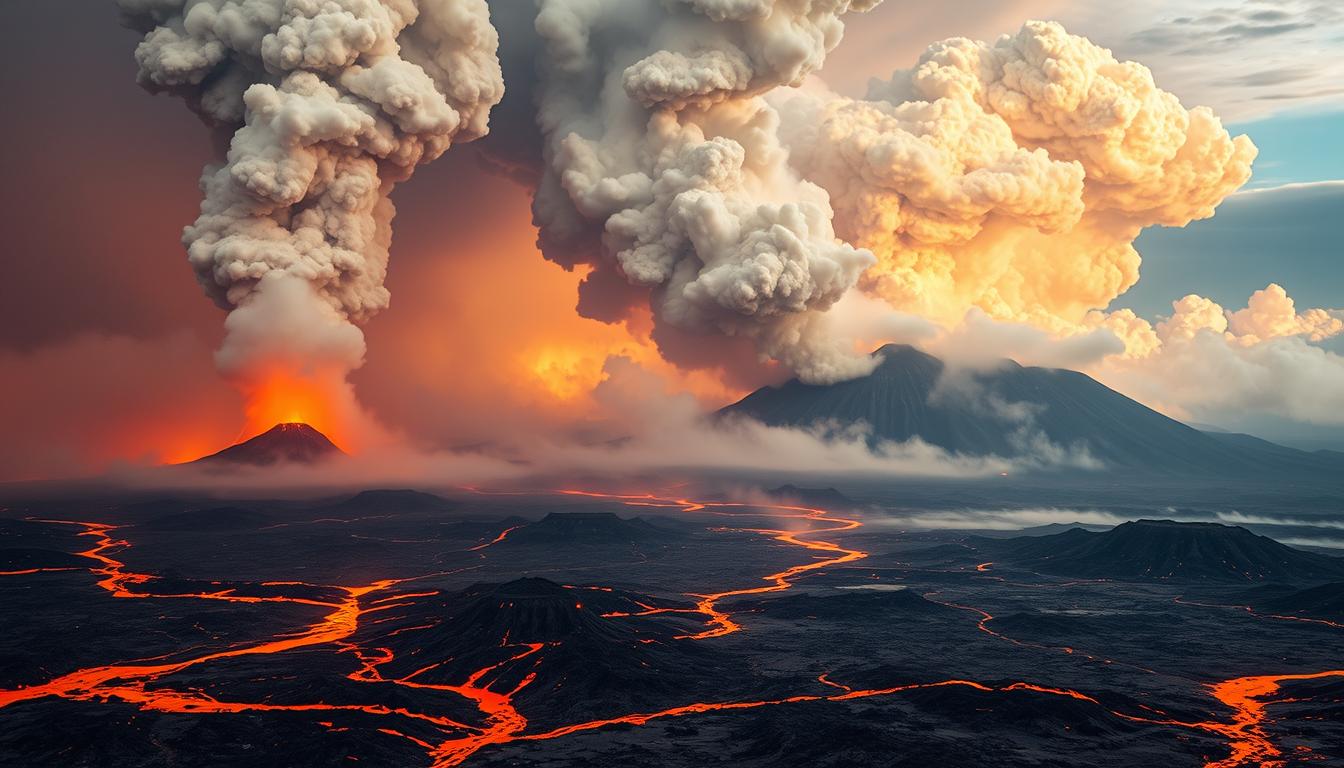
Supervolcanoes are the most powerful volcanic systems on Earth. A VEI 8 eruption, the highest on the Volcano Explosivity Index, ejects over 1,000 cubic kilometers of material. This creates a caldera-forming eruption. Yellowstone, Toba, and Taupo are examples of such systems.
Their eruptions could bury landscapes in ash and change the global climate.
In 1883, Krakatoa’s eruption killed over 36,000 people. It was heard 2,000 miles away in Australia. Supervolcanoes like Yellowstone pose even greater risks.
A VEI 8 blast could cover the northern Rockies in three feet of ash. It could also inject 2,000 million tonnes of sulfur into the sky. This could drop global temperatures by 10°C.
These rare events can reshape ecosystems. Yet, Yellowstone’s system has been stable for 140 years. There are no signs of imminent danger.
Understanding Supervolcanoes
Supervolcanoes are huge, unlike normal volcanoes. They form caldera volcanoes after massive eruptions. These eruptions collapse the Earth’s surface. They are so big, they reach the highest level on the VEI scale, releasing over 1,000 cubic kilometers of ash and lava.
At their heart are huge magma chambers. These can be miles wide underground. Yellowstone’s chambers, for example, are over 30 miles wide. They hold molten rock at 2,500°F. When they erupt, they scatter volcanic deposits far and wide, changing landscapes.
Places like Indonesia’s Toba caldera show their incredible power. Its 74,000-year-old eruption was the largest ever recorded. It left a 30km-wide basin and cooled the Earth for decades. These events happen about every 100,000 years, but scientists can’t predict when.
Scientists look at layers of volcanic deposits to learn about past eruptions. These clues help them understand how supervolcanoes build up magma for years before erupting. Even though supervolcanoes are rare, their eruptions are much bigger than any in history, like Krakatau.
Mechanism of a Supervolcano Eruption
Deep beneath Earth’s surface, a magma chamber forms over millennia. Molten rock melts surrounding rock, creating a pool of magma. This magma is rich in volcanic gases like carbon dioxide and sulfur.
Over thousands of years, the chamber grows. Pressure forces the ground upward, forming a dome. Cracks spread outward, releasing gases that signal an impending eruption.
When the chamber bursts, the explosion propels ash and gas into the atmosphere. Scorching clouds of hot gas and rock—pyroclastic flows—race across the landscape. They destroy everything in their path.
Ash blankets nearby regions, while sulfur dioxide particles could block sunlight globally. The final stage: the emptied magma chamber can no longer support the overlying rock. This causes the land to sink into a massive depression called a caldera collapse.
Recent studies show that a larger magma chamber increases eruption risk more than magma buoyancy. Experiments simulating pressures of 36,000 atmospheres and 1,700°C confirmed how chambers grow. Yellowstone’s history shows three eruptions in 2 million years, the last 600,000 years ago.
Such events eject thousands of cubic kilometers of material. This is far more than even the 1980 Mount St. Helens eruption by hundreds of times.
Potential Effects on Local Areas
Supervolcano eruptions send out pyroclastic flows, hot currents of gas and ash, at 450 mph. These flows can burn everything in hundreds of miles. Lava flows, though slower, can cover landscapes in solid rock.
These forces can destroy cities and infrastructure in just hours. This would lead to a huge number of immediate casualties.
Volcanic ash clouds can spread far from the eruption site. A 10-foot ash layer could collapse roofs and stop transportation. It could also contaminate water supplies.
Even a thin layer of ash, just 1 cm, could harm the U.S. East Coast. It could disrupt power grids and agriculture. Areas within 600 miles would be completely destroyed, with ash burying crops and livestock.
Pyroclastic flows caused 90% of deaths during the 79 AD Mount Vesuvius eruption, proving their lethal reach.
Yellowstone’s caldera is a scary example. It could cause 90,000 immediate casualties in Wyoming, Montana, and Idaho. Ashfall could reach 1,000 miles, disrupting 75% of the U.S.
Air travel and food distribution would stop. Roads would disappear under ash, and buildings could buckle under 30 cm of ash. Emergency services would find it hard to respond in such a disaster.
Communities near the blast zone would suffer irreversible damage. But even distant areas would face problems from ash clogging engines and contaminating water. Survivors would have to face a new, harsh reality.
Rebuilding could take decades. The aftermath would be tough for everyone.
Global Consequences of a Supervolcano Eruption
Volcanic eruptions strong enough to cause a volcanic winter could change Earth’s climate for years. When a supervolcano erupts, sulfur dioxide gases go up into the stratosphere. There, they form a haze that blocks sunlight.
This global cooling effect messes with weather patterns, causing long-term climate disruption. As temperatures drop, crops fail, leading to food shortages all over the world.

Recent studies suggest even big eruptions like Yellowstone’s ancient blast 2 million years ago might only cool the planet by 2.7°F (1.5°C). This is less than the feared 14°F (8°C). But, smaller particles from sulfur dioxide could stay in the air, reflecting sunlight and darkening skies for years.
The 1991 Mount Pinatubo eruption cooled the planet by 0.5°F for two years. This shows the impact of even smaller eruptions.
Agriculture would be hit hard first. Crops in places like the U.S. Midwest could lose entire harvests, leading to global famine. Trade systems would collapse as food disappears. Economies that rely on stable weather would face big crises.
Scientists say while the end of the world isn’t certain, the effects on food systems and climate stability are urgent.
Understanding these risks helps communities prepare for the effects of climate disruption. Monitoring efforts, like those at Yellowstone’s caldera, aim to spot early signs of unrest. This gives time to tackle food shortages and global cooling before disaster hits.
Case Study: Yellowstone Caldera
Yellowstone National Park is home to a famous supervolcano. It has had three huge eruptions over 2.1 million years. The last big eruption was 640,000 years ago, creating a 45-mile-wide caldera.
The caldera is now filled with geysers. Today, we see the power of the magma through hydrothermal features like Grand Prismatic Spring and Old Faithful. These features release 6 gigawatts of heat.
Scientists at the Yellowstone Volcano Observatory (YVO) watch the volcano closely. They use GPS and seismometers to track changes. They’ve seen over 80 minor eruptions, mostly lava flows, but no big eruptions.
The chance of a big eruption is very low, about 0.00014% each year. The magma is active, but there’s no sign of danger now. Small steam blasts happen, but they stay in one place.
Supervolcanoes and Human Health
Volcanic ash inhalation is a big health risk. The fine particles in ash can cut lung tissue, leading to serious breathing problems. People with asthma or other health issues are at a higher risk of serious harm. Even brief exposure can cause lasting damage.

Mental health problems will affect more than just those near the volcano. Survivors often deal with anxiety, depression, or PTSD. Communities that have to move or rebuild may face long-term mental health issues. Healthcare systems might get overwhelmed, slowing down treatment for others.
To protect people, we need to focus on evacuation routes and emergency shelters. Using masks and sending out air quality alerts can help reduce the risk of inhaling ash. We also need to increase mental health services to help with trauma. Looking at past eruptions, like Toba’s 74,000-year event, shows early humans adapted. But today’s societies face different challenges. Planning ahead could save many lives.
Myths and Misconceptions about Supervolcanoes
Supervolcano myths mix science with sensational stories. One common volcanic misinformation is that drilling into volcanoes can stop eruptions. Scientists say this is not true because it would be too expensive and not work.
At deep levels, any drill hole would quickly close due to magma’s heat and pressure. The idea of “drilling into volcanoes” is not only impossible but also not based on science.
Hollywood movies create doomsday scenarios, making it seem like Yellowstone’s next eruption is right around the corner. But, most of Yellowstone’s past 70,000 years saw only small lava flows, not huge eruptions. The magma chamber is mostly solid, with studies showing 70% of its rock is “frozen” and not moving.
Claims that Yellowstone is “overdue” for a big eruption are also wrong. Yellowstone’s last supereruption was 640,000 years ago, which is much longer than its usual 700,000-year gap.
Recent ground uplift from 2004 to 2010 was only 7 cm/year, which is not enough to cause an eruption. Most earthquakes in the area are caused by tectonic movements, not magma. Scientists say there’s no sign of an imminent disaster, but online myths keep spreading. It’s important to separate fact from fiction to avoid unnecessary fear. Knowing the truth about supervolcano myths helps us stay informed, not misled by Hollywood.
Preparedness for Supervolcano Eruptions
Disaster preparedness begins with science. The USGS Volcano Hazards Program watches for ground shifts and gas emissions. This helps find ways to reduce volcanic hazards. Early warnings give us time to plan for emergencies, like knowing how to evacuate.

“At Pinatubo in 1991, forecasts let 200,000 evacuate safely,” said USGS reports. This shows how being prepared can save lives, even for rare events.
Every household should have an emergency kit with masks for ash and extra water. It’s important to know the local volcanic hazard zones and evacuation routes. Yellowstone’s 1-in-700,000 annual risk doesn’t mean we should ignore the dangers. Stay alert with local alerts and community drills.
Global networks like WOVO share data to improve forecasts. Even small steps, like knowing ash cleanup plans or storing supplies, help build resilience. Volcanic threats are rare, but smart planning ensures we’re ready when warnings come.
Research and Monitoring of Supervolcanoes
Scientists around the world are using advanced tools to track volcano monitoring systems. At the Yellowstone Volcano Observatory (YVO), seismic activity is watched 24/7 with hundreds of sensors. These sensors pick up even the smallest tremors, helping experts tell if it’s just a normal shift or something more serious.
Ground deformation is also key. GPS stations measure tiny changes, as small as a few millimeters. Over time, these changes show if magma is moving underground. Satellites scan the surface to map these shifts, adding more data for analysis.
Special equipment checks gas emissions at fumaroles and vents. If carbon dioxide or sulfur dioxide levels suddenly rise, it could mean magma is on the move. YVO’s systems alert scientists to any changes, like the 2022 uplift event that caused brief worry but was natural.
Even with these tools, predicting eruptions is tough. Yellowstone’s chance of a super-eruption is low, but research keeps improving early warning systems. New tech like AI and drone surveys helps scientists better understand risks. This work is critical for keeping people safe by reading Earth’s hidden signals before it’s too late.
Historical Supervolcano Eruptions
One of Earth’s most dramatic ancient volcanic eruptions was the Toba eruption in Indonesia around 74,000 years ago. This event, part of the prehistoric climate change timeline, spread ash across Asia and Africa. Some theories suggest it caused a human evolution impact, nearly wiping out early human populations. Scientists debate this “Toba catastrophe theory,” but evidence like genetic diversity in humans hints at a possible population bottleneck.

More recently, the Taupo Volcano in New Zealand erupted 26,500 years ago, marking the most recent ancient volcanic eruptions classified as VEI 8. Its 1,170 cubic kilometer ash cloud altered regional landscapes. The 535 CE eruption in Java caused global cooling, freezing crops and sparking famine. Historical records describe “a perpetual fog” blocking sunlight, leading to societal disruption.
“The sun gave forth its light without brightness,” wrote Procopius, describing the 535 CE event. This darkened sky matches ice core data showing sulfur spikes from volcanic ash.
Studying these events helps modern scientists predict future risks. While Toba eruption impacts remain debated, their legacy shapes how we understand supervolcanoes’ power. Each eruption serves as a reminder of Earth’s unpredictable past—and the need to prepare for its future.
The Future of Supervolcano Research
Scientists are changing how we predict volcanic eruptions with new tools. At Yellowstone, they use fiber-optic cables and computer modeling to track magma. In Italy, Campi Flegrei uses sensors to watch the ground.
For 20 years, Campi Flegrei’s surface has risen 1 meter. This slow rise hints at eruption risks. It shows scientists how to better predict these events.
New mitigation technologies aim to find safe ways to release magma pressure. AI models help predict where ash will fall. Teams from the US, Europe, and Chile work together.
Stanford’s fiber-optic networks at Long Valley Caldera are expanding. This helps monitor more sites around the world. It’s all about using technology and teamwork to save lives.
Even though we can’t stop eruptions, better computer modeling helps us understand their effects. Studies in Chile and Bolivia are improving our knowledge of magma. The goal is to use this knowledge to prepare for future dangers.
Conclusion: Living with Supervolcanoes
Supervolcanoes remind us of Earth’s ever-changing systems. Their eruptions can change landscapes over long periods, but they pose little risk to us today. Yellowstone’s last big eruption was 640,000 years ago, and there’s no sign of another one soon.
Scientists watch for small earthquakes and ground movements. This helps keep communities safe and informed. Volcanic eruptions, like the one at Toba 74,000 years ago, were huge but didn’t end humanity. People found ways to survive, as seen at the Shinfa-Metema 1 site.
Today, scientists keep studying these volcanoes. They learn about Earth’s inside and our planet’s past. Even though supervolcanoes are quiet now, studying them helps us understand earth systems and prepare for rare disasters.
Yellowstone’s magma chamber is watched all the time, and there’s no urgent danger. Eruptions happen thousands of years apart, making a big disaster unlikely in the next few centuries. Science helps us balance wonder with caution, turning ancient forces into lessons for resilience and discovery.