
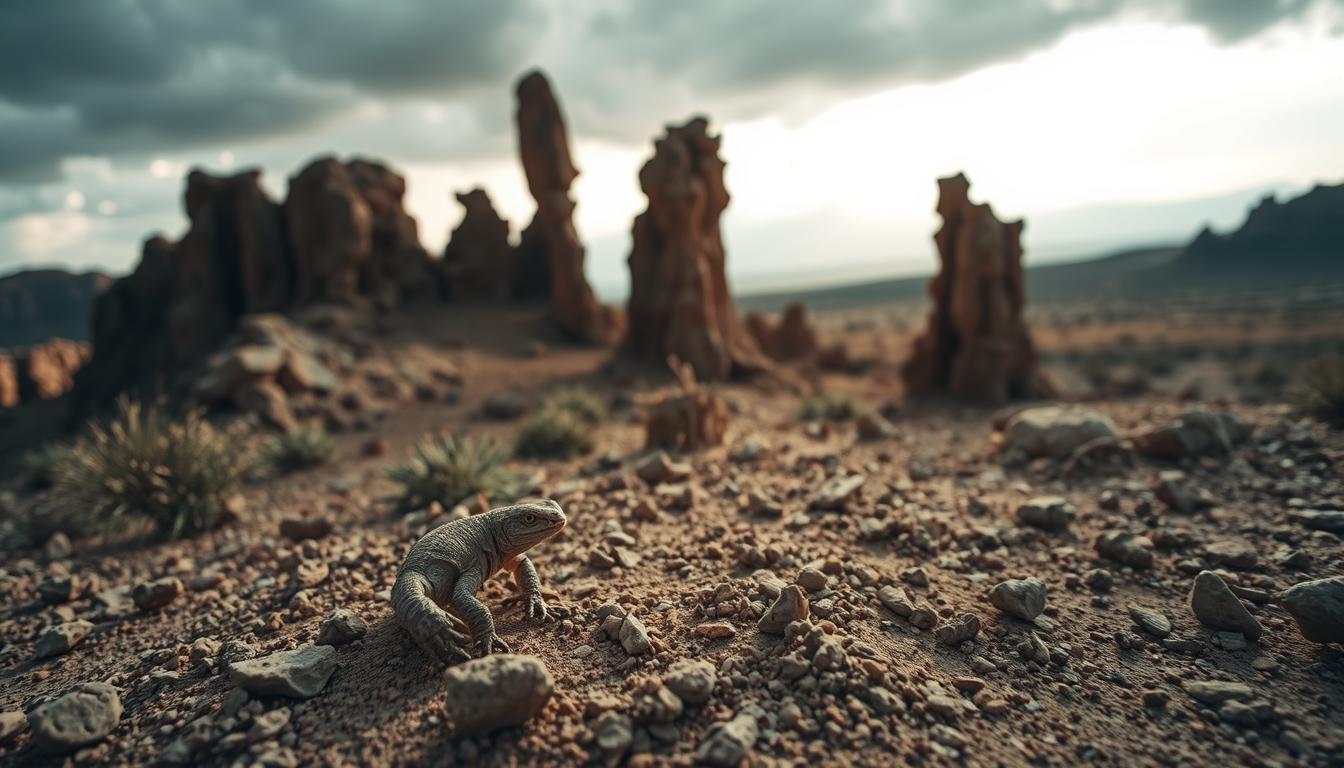
Earth’s most resilient animals live in places where survival seems impossible. They thrive in extreme habitats like frozen glaciers and boiling hot springs. Life in these environments depends on amazing biological adaptations.
Tardigrades, or water bears, are at the top of this list. They can survive temperatures near absolute zero, space vacuum, and radiation. These tiny creatures, found even in Denmark’s soil, show how small organisms can outlast harsh conditions.
Recent studies in Denmark found 96 tardigrade DNA sequences. Only 13 known species have been identified. Their ability to enter cryptobiosis lets them pause life for decades, reawakening when conditions improve.
Beyond tardigrades, resilient animals like emperor penguins endure -40°F Antarctic winters. Sahara desert ants use long legs to avoid scorching sands. Each species’ survival strategies show nature’s creativity in extreme habitats.
Understanding Extreme Environments
Extreme conditions shape the planet’s most challenging harsh habitats. These ecosystem extremes include scalding hydrothermal vents, bone-dry deserts, and acidic pools. Life here faces environmental stress like crushing pressures or toxic chemicals. Organisms surviving these zones rely on survival adaptations to endure what most life cannot.
Extremophiles thrive in places once deemed lifeless. Archaea, for instance, use unique membrane structures to withstand boiling temperatures. Bacteria like Deinococcus radiodurans repair DNA after radiation blasts. These traits let life persist in extreme conditions, proving biology’s flexibility. Studying these adaptations helps scientists explore Earth’s earliest life forms and search for extraterrestrial life.
From deep-sea trenches to volcanic soils, every harsh habitat reveals how life pushes survival limits. These environments aren’t just barriers—they’re laboratories for discovering life’s hidden survival limits.
The Mighty Tardigrades
Meet the water bears—tiny, eight-legged creatures no bigger than a grain of sand. These microscopic resilience champions thrive in places most life can’t. Tardigrades survive extreme conditions: from -328°F (-200°C) to 304°F (151°C), and even the vacuum of space. Their secret? Cryptobiosis, a super-survival mode where they dry up into a tun state, halting all metabolic activity until conditions improve.

When in cryptobiosis, water bears shrink to a lifeless “tun,” waiting decades to rehydrate. Experiments show they’ve survived space exposure on the ISS, withstanding solar radiation a thousand times deadlier than what humans can endure. Their Dsup proteins shield DNA, making tardigrade survival a marvel. Scientists study these microscopic superheroes to develop drought-resistant crops or radiation-resistant medicines.
Found from mountaintops to muddy puddles, these tiny survivors prove life’s limits are limitless. Their microscopic resilience challenges our understanding of life’s boundaries, giving clues for future space travel and medical breakthroughs.
Life in the Deep Ocean
Surviving in the deep ocean is beyond our wildest dreams. At depths where no sunlight can reach, deep sea creatures live under pressures that are 1,000 times higher than ours. Hydrothermal vents, which release hot, mineral-rich water, are home to life. These hydrothermal vent life communities use chemosynthesis, not sunlight, to survive.
Scaly-foot snails have iron-plated shells to survive the crushing depths. This shows how important pressure adaptation is for survival. Research in Communications Chemistry in 2022 found that deep-sea creatures produce TMAO to protect themselves from extreme pressure.
Bioluminescence lights up the dark depths. Over 90% of bioluminescent organisms here make their own light. Anglerfish use their bioluminescent lures to catch prey. Some species even migrate up at night to find food.
Explorations with the Alvin submersible have found life near hydrothermal vents. These discoveries could lead to new materials or medicines. From the Mariana Trench’s extreme pressure to life thriving at 50°C, the deep sea is full of secrets.
Extreme Temperatures: The Polar Regions
The Arctic and Antarctic are home to species that defy the odds in some of Earth’s coldest environments. Arctic wildlife like polar bears and Arctic fish survive where most life cannot. In Antarctica, antarctic organisms such as emperor penguins endure temperatures below -70°C.
These creatures rely on unique polar adaptations to survive freezing conditions. Male emperor penguins famously balance eggs on their feet for months. They rely on stored fat during freezing temperature survival challenges.
Their huddling behavior traps warmth, shielding chicks from relentless winds.

Arctic fish avoid freezing blood thanks to antifreeze proteins that lower ice formation points. Polar bears’ thick fat layers and hollow fur traps heat, shielding them from subzero blizzards. Even microscopic cold climate species, like algae and bacteria, thrive in ice crystals using dormant states.
These adaptations let life persist where most would perish. Yet climate shifts threaten these delicate balances. Melting ice disrupts habitats, forcing species to adapt faster than evolution allows.
As polar regions warm, the survival stories of these hardy creatures face new tests.
Life in the Desert
Deserts might look empty, but they’re full of life. Camels, for example, live well in places like the Sahara. They have humps that store fat, helping them survive for months without food.
When they find water, they drink a lot in a short time. This is how they deal with drought. Their blood also helps them handle the heat, showing they’re well adapted.
Kangaroo rats don’t need to drink water. They get moisture from seeds. Cacti store water in their stems and use special photosynthesis to save water.
Even beetles can collect fog to drink. This shows how life finds ways to survive in the desert.
Microbes in salt flats can wait decades for rain. They show us that life can exist in extreme conditions. Desert creatures teach us that even in harsh places, life can thrive in many ways.
Volcanic Landscapes and Their Inhabitants
Volcanoes might look like empty lands of fire and ash. But they are actually home to life forms that thrive in extreme conditions. Geothermal organisms like thermophilic bacteria live in hot vents and acidic pools. They have learned to survive in boiling waters.
Take Yellowstone’s Grand Prismatic Spring as an example. It’s full of bacteria that color its waters in beautiful shades of the rainbow. These bacteria can handle temperatures up to 80°C (176°F) thanks to special proteins that keep their shape.

In Iceland, extreme temperature organisms play a big role in both nature and industry. Geothermal plants use the heat from volcanoes to generate power. This heat also supports life, like Thermus aquaticus bacteria, which help scientists in labs.
Even plants and insects near volcanoes adapt to their surroundings. Some mosses grow on lava fields, and flies can survive in areas filled with sulfur fumes. This shows how life can find a way to survive even in harsh conditions.
“Volcanic ecosystems are living labs for survival,” says Dr. Elena Marquez, a geobiologist. “Their adaptations could revolutionize medicine and energy.”
Near active vents, life finds a way to exist where most would not. From bacteria to plants, these organisms show the incredible resilience of life, even in the shadow of fire.
The High Altitude Survivors
High up in the world’s highest peaks, life finds a way to thrive. Highland creatures like the bar-headed goose and Tibetan antelope live in thin air. They use evolution’s tricks to survive where others can’t.
Bar-headed geese fly over Mount Everest, where oxygen is scarce. Their bodies work faster to use oxygen, helping them survive. Tibetan antelopes have special blood cells that hold onto oxygen better.
Even plants adapt. They grow tiny hairs and bright colors to protect against UV rays and frost. Humans also adapt, with over 400 million people living above 1,500 meters.
Indigenous Andeans and Sherpas have genes that help them use oxygen better. These thin air organisms show incredible resilience. They turn Earth’s toughest slopes into their homes.
Survival in Acidic Environments
Extreme pH environments are tough for most life forms. But acidophiles thrive where others can’t. In Spain’s Rio Tinto, water pH drops as low as 2. Yet, microbes like Ferroplasma and Cyanidium caldarium do well.
These microbes have special ways to handle acid. Their cell membranes keep out protons. They also have proteins that work well even in very acidic conditions.

In Yellowstone’s springs, acidophiles like Acidiphilium and archaea survive by using sulfur chemistry. They turn sulfides into sulfuric acid. This helps shape ecosystems, like acid mine drainage sites.
Even protists like Cyanidioschyzon merolae can handle pH 0. They have genetic traits that help them survive. These microbes don’t just survive; they shape their environments.
Scientists study these microbes for new ways to clean up pollution. Acidophiles in mining zones can break down toxic metals. This helps clean up pollution. Their ability to adapt to acid also inspires new industrial innovations.
Even common bacteria like E. coli have acid resistance systems. This shows nature’s creativity in harsh environments.
From Rio Tinto’s iron-rich waters to volcanic springs, acidophiles show what life can do. They live in pH 0.9 habitats, proving evolution’s endless solutions to extreme challenges.
The Impact of Climate Change
Even the toughest survivors face new challenges as global warming changes their homes. Species like Emperor penguins must adapt quickly due to habitat changes. Rising temperatures melt sea ice, disrupting their breeding cycles and pushing their populations to the limit.
Species like Thermus aquaticus, which thrives at 80°C, may not be safe from environmental threats. Ocean acidification weakens the shells of deep-sea organisms. Desert species face challenges as rainfall patterns change.
High-altitude ecosystems are invaded by species that once couldn’t survive there. Adaptation limits are reached when habitats change too fast. Tardigrades can survive droughts, but their food sources disappear when wet-dry cycles collapse.
Researchers study how microbes in acidic lakes, like Picrophilus, adapt to pH changes caused by melting glaciers. Some species, like halophiles in salt lakes, change their enzyme production to handle salinity swings. This shows that resilience is possible.
Yet, there is hope. Scientists study extremophiles’ genetic tools to create climate-resistant crops. Biotech firms use enzymes from extremophiles to make eco-friendly products. Understanding adaptation limits helps prioritize conservation efforts for these living marvels.
Future Research Directions
Extremophile research is making big strides, with global effects. The XTREAM project is a 4-year effort with €4.46 million funding. It brings together 13 teams from 7 European countries.
They’re exploring microbial life in extreme places like glaciers and acid mines. Their goal is to create eco-friendly biotech solutions. Studies on protists show they can live in pH extremes and high temperatures.
These findings could lead to new materials that can handle harsh conditions. Scientists are also looking at tardigrade proteins like Dsup. These proteins protect cells from radiation, which is important for space travel.
Research on organisms like Planococcus halocryophilus helps us understand life’s limits. This is key for space exploration. The red alga Cyanidioschyzon merolae thrives at 60°C, giving us clues about life’s survival.
By 2028, XTREAM hopes to make bio-based products cheaper. They aim to mimic how extremophiles survive. This could change industries like medicine and energy.
There’s a need for more research on protists. Scientists want to study more species. This will help us understand life better.
“Nature’s solutions to extreme conditions are blueprints for human innovation.”
Researchers have found 7 polyextremophiles so far. They want to apply lab findings to real-world problems. Studying extremophiles helps us understand Earth’s biodiversity and explore space.
Every discovery shows us what life can endure. It also shows what humans can achieve.
Conclusion: The Resilience of Life
Life finds a way to thrive in Earth’s most extreme places. This shows how clever nature is at adapting. Antarctic penguins can handle -89°C, while Pompeii worms survive 80°C vents. Their unique traits, like tardigrades freezing their metabolism, prove life’s ability to endure.
Biodiversity is key, not just for ecosystems but also for science and medicine. Extremophiles, like halobacteria in salt lakes, help us in biotechnology. They also give us clues about life beyond Earth. These creatures teach us that resilience is more than just surviving—it’s about evolving and growing.
Learning from these survivors helps us appreciate fragile habitats. Creatures like hydrothermal tube worms and Antarctic midges push our understanding of life’s limits. By protecting their homes, we ensure new discoveries will be made. Exploring Earth’s extremes honors life’s strength and the endless possibilities of adaptation.