
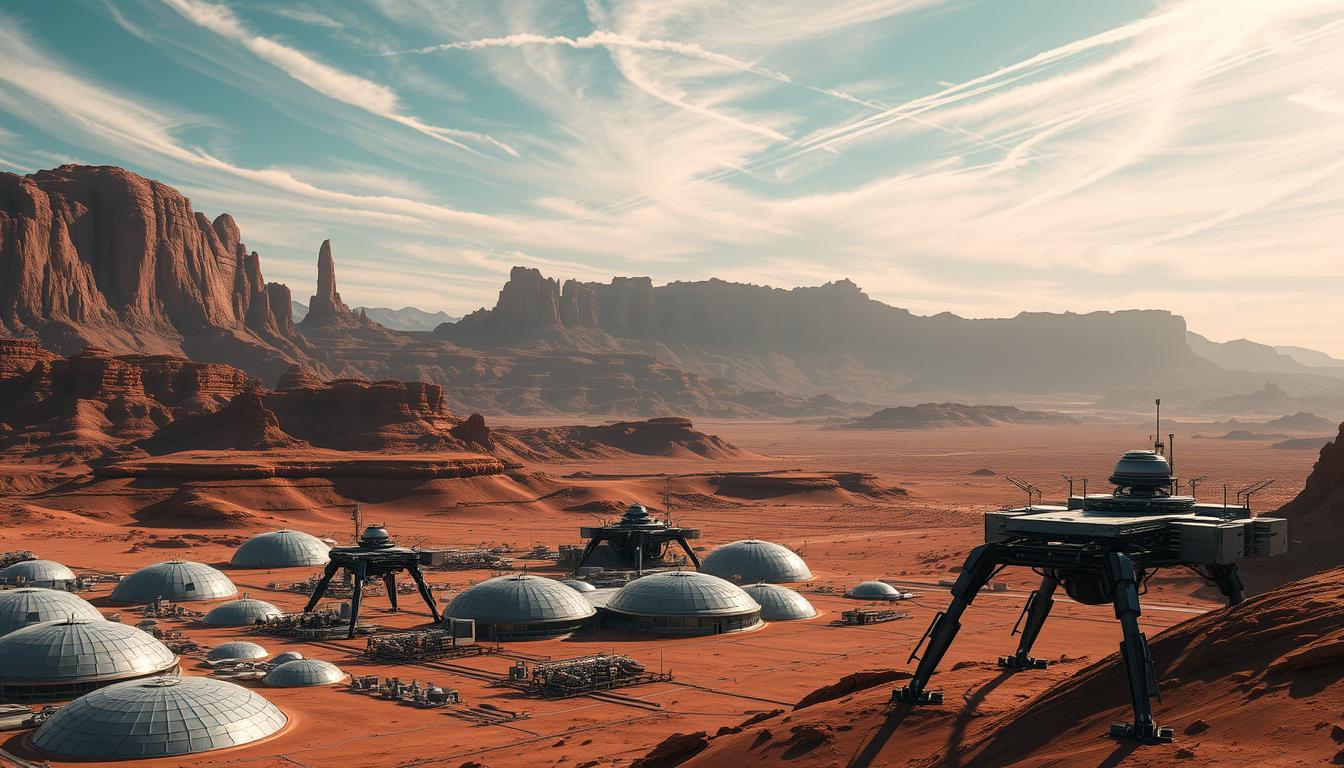
Mars once had lakes and flowing water, but now it’s a frozen desert. Terraforming Mars aims to make it habitable again. Researchers at Harvard and NASA are studying silica aerogel to trap heat, giving hope for life in small areas.
The current atmosphere on Mars is only 0.6% of Earth’s. Even if we mined all the CO2 on the surface, we’d only get to 10-14% pressure. At night, temperatures drop to -101°C, and the solar wind erodes what little air Mars has.
NASA’s MAVEN mission shows Mars is losing its atmosphere, making things harder. Planetary engineering is a huge challenge. We need a magnetic field 5 times stronger than what we have now to protect against radiation.
Mars’ weak gravity can’t hold much air, and its soil lacks nutrients. But, there’s progress in 3D-printed habitats and asteroid missions. Making Mars habitable will take centuries of innovation, combining Earth’s technology with dreams of survival.
Understanding Terraforming and Its Importance
Terraforming, or making Mars habitable, has moved from science fiction to real science. In 1971, Carl Sagan suggested using greenhouse gases to warm Mars. This idea sparked debates about mars colonization. Now, it’s seen as a bold step toward interplanetary colonization, a backup plan for humanity’s survival.

Mars’ atmosphere is only 1% of Earth’s, with CO2 making up 95% of it. Humans need at least 250 millibars of pressure and breathable oxygen. Terraforming aims to create a sustainable environment on Mars over centuries. It plans to raise temperatures to melt polar ice caps, releasing CO2 and thickening the atmosphere.
But, there are huge challenges. Mars’ weak gravity can’t hold gases, and it lacks a magnetic field, leaving the surface exposed to radiation. Yet, new tech in greenhouse gases could start a warming cycle. Success could also change how we manage Earth’s climate.
Interplanetary colonization takes time. Even the most optimistic timelines suggest it will take millennia. But the stakes are high: surviving as a species beyond Earth requires exploring every option. Terraforming isn’t just about Mars—it’s about learning to thrive in the vast, unpredictable cosmos.
Current State of Mars: Challenges Ahead
Mars’ martian environment is tough for future settlers. Its mars atmosphere is only 0.6% of Earth’s, with freezing temperatures. The lack of a magnetic field means no protection from the sun’s rays.
The air is mostly CO₂, with no oxygen for humans. Even if Mars got warmer, the air pressure is too low. It’s not enough to keep our bodies from boiling.

The soil is toxic, making farming hard. Mars gets only 60% of Earth’s sunlight, making solar power unreliable. Dust storms can last for months, covering everything and blocking sunlight.
Gravity on Mars is weaker, which could harm our bones over time. Scientists think melting ice could create a 5–11 meter ocean. But, releasing CO₂ from the ground might only raise the pressure to 30–60 kPa.
Adding greenhouse gases is also a challenge. Methane breaks down fast, and mining fluorine is untested. Overcoming these obstacles is key to making Mars habitable for humans.
Proposed Methods for Terraforming Mars
Scientists have come up with bold ideas to start mars climate change through terraforming technology. One idea is to use martian greenhouse gases in tiny particles called nanorods. These particles, smaller than glitter, could trap heat in Mars’ thin atmosphere. Tests show they might warm the surface by over 50°F, making it possible to survive.
Another idea is to use orbital mirrors to reflect sunlight onto icy regions. This would speed up ice melt. Ammonia-rich asteroids from the outer solar system could also be sent to Mars. When they vaporize, they release gases that help warm the planet. Some even suggest using chlorofluorocarbons (CFCs) to boost warming, but this is controversial.
A University of Chicago study led by Edwin Kite found nanorods to be a breakthrough. Releasing them via ground-based “fountains” could achieve results in months. It would need millions of tons, but that’s 5,000 times less than older plans. This terraforming technology could make projects possible without needing to ship a lot from Earth.
Researchers say we should use a mix of methods. For example, nanorods and orbital mirrors together could increase warming. Each method has its challenges, from technical issues to ethical concerns. But these ideas show our creativity in trying to make Mars habitable.
The Role of Microorganisms in Terraforming
Microorganisms could be Mars’ first pioneers. Scientists are studying Earth’s hardiest life forms, like cyanobacteria, to start martian soil modification. These tiny organisms once changed Earth’s atmosphere during the Great Oxygenation Event.
Today, lab experiments show certain lichens survive 533 days in Mars-like conditions. Imagine cyanobacteria engineered to thrive in the Red Planet’s thin air. They could slowly produce mars oxygen production through photosynthesis.

Robust microbes like Deinococcus radiodurans resist radiation and extreme cold—key traits for Mars survival. Their DNA repair systems could let them survive -62°C (-80°F) temperatures. NASA’s MOXIE device on Perseverance already extracts oxygen from CO₂, but microbes might do this autonomously over time.
By breaking down regolith, they could release nutrients for a sustainable mars ecosystem. This turns barren soil into fertile ground.
Microbial colonies might first target enclosed habitats, like domed bases. Algae could scrub CO₂, while cyanobacteria enrich soil. This “microterraforming” approach focuses on small, manageable zones first.
Yet challenges remain: Mars’ thin atmosphere lets radiation bombard surfaces, and cold limits microbial activity. Even with advances, creating breathable air would take millennia. This shows that patience is as vital as technology.
Building a Sustainable Ecosystem
Unlocking mars water resources is key to sustaining human settlement on mars. Scientists say melting polar ice and underground deposits could create a shallow global ocean 5-11 meters deep. But, we need to protect this water from solar radiation.

Plants and microbes would create Earth-like cycles on Mars. Algae would release oxygen, and lichens would break down regolith into soil. Hydroponic farms already grow food in space stations.
Scaling these systems for future mars habitation requires closed-loop recycling. Filters must purify wastewater, and CRISPR-modified crops could thrive in low gravity.
Atmospheric engineering is a big challenge. Mars’ CO2-rich air needs nitrogen and oxygen balance. Greenhouses could trap heat, but keeping Earth-like temperatures (-60°C to 15°C) takes decades.
Soil creation alone could take centuries. We need perchlorate-removing bacteria to detoxify red soil.
Self-sustaining systems need redundancy. Solar panels for energy, fusion backups during dust storms. Every component must work together like gears in a clock.
The stakes are high. We’re building a second home for humanity—or a monument to ambition.
Energy Needs for Terraforming Mars
Changing the martian environment needs a lot of energy. We must heat the planet for centuries to control the mars temperature regulation. Nuclear reactors could help, but solar panels face a big challenge due to Mars’ weak sunlight.
Imagine sending 2,390,000,000,000,000 coal shipments from Earth. It’s not possible, but even that wouldn’t be enough.
We need to use Mars’ own resources. NASA’s MRO found dry ice that could power new systems. Machines using the Leidenfrost effect might use less energy.
Scientists think Martian dry ice could be a clean energy source. It could turn seasonal carbon dioxide into power. A 2023 study says Mars’ resources could help it survive.
But, there are big challenges. We need CO2 to raise the atmosphere, but Mars’ soil only has 4% of what we need. Using asteroids could be too expensive. Solar wind took away Mars’ atmosphere, and keeping new air requires constant energy.
Fixing Mars isn’t just about technology. It’s about finding sustainable ways to use Martian materials. We need to use Earth’s smart ideas and Mars’ hidden resources.
The Technology Behind Terraforming
Today’s tech isn’t ready for terraforming Mars. NASA’s MOXIE experiment makes oxygen at a slow 10 grams per hour. This is far from enough for mars colonization. Dr. Jim Green suggests creating a magnetic shield to block solar wind, but we can’t make a strong enough field yet.
Silica aerogel is a near-term hope. Lab tests show it can warm up areas by 50°C. But making it cover the whole planet is a long way off. Space exploration also faces the challenge of Mars’ thin atmosphere, only 0.6% of Earth’s.
There are big gaps in tech, like efficient CO2 mining and detoxifying soil. NASA’s 1976 study said it would take 2,000+ years for microbes to change the atmosphere. But, new robotics and energy breakthroughs have shortened this timeline.
Despite the hurdles, we’re making progress. Innovations like aerogel greenhouses and CO2 harvesters are steps forward. But we need big leaps in materials science and engineering to make Mars habitable. The journey to Mars needs constant research and teamwork.
Financing the Terraforming Effort
Transforming Mars into a home is a huge task that needs a lot of money. The costs are higher than any project on Earth. SpaceX made $55 million in 2022, showing the space industry is growing. But, making Mars habitable will need much more money.
Lockheed Martin has a huge market value of $133 billion. This shows companies can help fund such projects. But, working together with the government might be the best way.
Researchers like Edwin Kite from the University of Chicago have found ways to save money. His idea uses Martian materials to warm the planet. This could make terraforming cheaper by a lot.
His study says using these tiny silica particles could be very cost-effective. Deploying 2 million tons of them each year could make Mars engineering possible. This would need a big investment but could work.
Finding money for Mars needs careful planning. We must think about both short-term and long-term goals. Ideas like bonds or international groups could help share the costs.
Private companies might make money from Mars too, like by mining or tourism. But, making Mars habitable is more important. We should spend money now for the future.
Ethical Considerations in Terraforming Mars
The push for mars habitability raises big questions. “If you’re going to enable life on Mars, are you sure there’s no life there already?” asks Robin Wordsworth, a Harvard researcher. The martian environment might have microbes, and changing it could harm them. What rights do alien ecosystems have?
“The martian environment might hold answers older than Earth’s own life,” says Wordsworth. “Destroying that to build human colonies demands careful scrutiny.”
Ethicists argue about terraforming’s ethics. Fogg’s four ethical frameworks show the debate. They range from prioritizing human survival to protecting Martian ecosystems. Christopher McKay thinks a Martian biosphere is more valuable than individual microbes, but critics warn of big risks.
Some say we should focus on Earth’s problems first. They argue that resources spent on space could help feed or shelter billions here. But others see Mars as a safeguard against Earth’s dangers like asteroid strikes or climate collapse.
The decision to terraform Mars is a big moral choice. It’s not just about engineering. It’s about balancing humanity’s future with our role in the universe.
The Future of Humanity on Mars
Starting a human settlement on Mars is a big step. The first settlers will have to deal with Mars’ gravity. They will need homes made from Martian soil.
Michio Kaku’s book, *The Future of Humanity*, talks about growing cities on Mars over time. But, funding cuts and political changes have slowed things down. Now, companies like SpaceX are leading the way.
Creating a sustainable Mars ecosystem is a challenge. Tech like algae air filters and domes is helping. But, adapting humans to Mars’ low gravity could take thousands of years.
Kaku says survival on Mars depends on using Earth-like technology wisely. China and India are also stepping up their space efforts, filling the gap left by Western countries.
A Mars society will develop its own culture, shaped by isolation and creativity. Even though terraforming Mars is far off, small settlements could thrive by 2200. Kaku believes becoming a multiplanet species is a test of our adaptability.
Every step towards Mars makes us think about our future beyond Earth. It’s a chance to reimagine our place in the universe.