
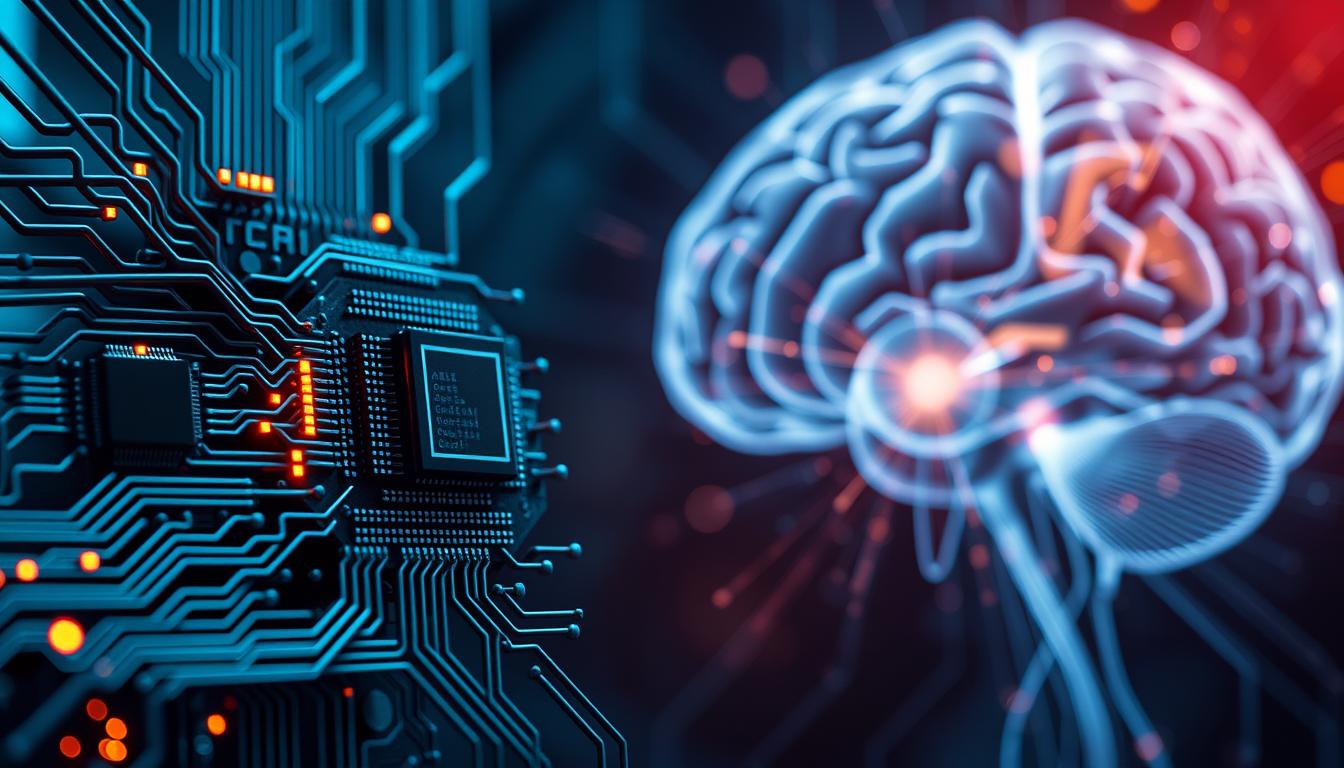
Artificial general intelligence, or AI as smart as humans, is a big topic. Some think it could happen by 2059, with a 10% chance by 2032. AI is already better than us at chess, medical imaging, and even making art like Van Gogh.
IBM’s Deep Blue beat chess champion Garry Kasparov in 1997. This showed AI’s power. But, AI can’t do simple things like drive a car or understand emotions.
AI is great at specific tasks, like writing stories or making images. But it can’t learn like humans do. Humans learn quickly, while AI needs lots of data. The goal of AGI is to make AI as smart as us, but there are big challenges ahead.
Debates are ongoing about when or if AI will be as smart as us. The question is, can AI ever be as creative, empathetic, and intuitive as humans?
Understanding Intelligence: AI vs. Human Intelligence
Human intelligence is built on cognitive abilities like creativity and emotional understanding. These skills help us adapt and solve problems. On the other hand, AI uses computational power and machine learning to process data fast. But, AI’s decisions lack the empathy and intuition humans have.

AI is great at analyzing big datasets quickly. For instance, it can solve 10 math problems in a minute, much faster than humans. But, humans are better at creative tasks like art or solving moral dilemmas. Intelligence comparison shows AI struggles with abstract ideas like humor or ethics.
Machine learning helps AI get better over time. But, it can’t match human curiosity or passion. Humans innovate by mixing ideas, while AI relies on existing data. This shows why working together, not competing, is essential. AI’s power changes industries, but human traits like adaptability and emotional intelligence are priceless in healthcare or leadership.
The Evolution of AI
AI started in the 1950s with simple systems. Pioneers like Alan Turing and the Dartmouth Conference set the stage. Over time, neural networks became key, mimicking the brain to process data. By the 2010s, deep learning and machine learning changed the game.

Today, AI systems like Google’s AlphaGo and OpenAI’s GPT show this progress. They use neural networks to analyze huge datasets. This has led to big wins in art, medicine, and gaming.
The global AI market is now over $100 billion. Companies like Microsoft and NVIDIA are leading the charge. Deep learning has made AI do things once thought only humans could do, like writing poetry or diagnosing diseases.
Despite early challenges, like the “AI winters” of the 1970s, we’ve made huge strides. Better algorithms, cloud computing, and big data have made AI real. From solving puzzles to making self-driving cars, each step shows AI getting smarter.
The Cognitive Abilities of Humans
Human cognition is all about being adaptable. Unlike AI, which needs huge datasets, kids can learn new things quickly. For example, they can tell the difference between apples and oranges after seeing just one.
This ability to learn fast is key to our quick thinking. While AI can process information fast, our brains use past experiences to understand new things. This makes our thinking more meaningful.
Emotional intelligence helps us get along with others. Studies show 70% of jobs need skills like empathy and teamwork. These are things AI can’t do.
These skills help us make decisions and solve problems. They’re important in jobs that require creativity. In fact, 80% of roles value creativity, where humans are unbeatable.

Humans are great at making connections between ideas. When we invent or create art, our intuition helps us find new solutions. This is something AI can’t do.
Our ability to work together also sets us apart. It lets teams come up with new ideas that code alone can’t. These strengths make human thinking essential in leadership, education, and healthcare, even with AI’s speed.
Limitations of Artificial Intelligence
AI has great promise but also clear AI limitations that show it’s not like human thinking. Current systems often struggle with common sense reasoning. They fail to understand basic real-world logic that humans easily grasp. For example, an AI might think a ball could fall through a table, not knowing about gravity.
This problem comes from AI’s focus on pattern recognition, not true understanding. It doesn’t really get what’s going on.
Another big issue is hallucinations in AI. Models can create false information with complete confidence. This happens because AI can’t question its own knowledge or check facts in context. In 2023, 1,380 experts, including Elon Musk and Steve Wozniak, signed a letter warning about these dangers.
Machine consciousness is hard to achieve. AI lacks self-awareness, emotions, and a moral compass. These are key for tasks like healthcare or customer service. Without machine consciousness, systems can’t empathize or make complex moral decisions.
In fields like healthcare, AI’s advice needs human review to avoid mistakes. This is because AI can’t truly understand the situation.
Data quality is another big hurdle. Gartner’s 2018 report said 85% of AI projects fail because of biased data or flawed algorithms. For example, facial recognition systems have shown racial biases. This shows AI’s results depend on the data it’s given.
These issues mean we need to keep checking AI’s work to make sure it’s fair and accurate. Humans must always review AI’s decisions.
Scenarios Where AI Outperforms Humans
Superhuman AI systems are better at certain tasks than humans. In games like chess and Go, AI like Deep Blue and AlphaGo have beaten world champions. They can process millions of possibilities in seconds, something humans can’t do.
AI is also better at repetitive tasks, such as analyzing medical scans or finding financial fraud. For example, AI can spot cancer cells in MRI scans with 95% accuracy. This is faster and just as precise as human radiologists.

AI is great at handling large amounts of data. For example, GPT-4 scored 163 on the LSAT, beating most law school applicants. In cybersecurity, AI finds malware patterns faster than humans by checking global threat databases in real time.
Even in creative fields, AI can write code or design faster than humans. But, it can only create based on what it has learned, not truly be creative.
AI shines in tasks that need scale and consistency. Self-driving cars can navigate highways with precision, avoiding human mistakes like tiredness. In manufacturing, robots can assemble parts with incredible accuracy, far beyond what humans can do.
These examples show AI’s strength in tasks that require computational power and error-free execution. But, human intuition is essential in situations that are not clear-cut.
Areas Where Human Intelligence Prevails
AI can process data fast, but humans have a special edge in emotional cognition. We can understand and feel emotions, something machines can’t do. This skill helps us form deep connections and make ethical choices, areas where AI falls short.
Humans excel in creative thinking, creating art, stories, and new ideas. Our creativity comes from our feelings and experiences, making our work connect with everyone. AI can mimic creativity, but it can’t truly invent new ideas.
Our general intelligence lets us handle different tasks well. We can figure out unclear situations and apply what we know in new ways. AI is great at specific tasks like playing chess or spotting fraud, but it can’t understand common sense or ethics like we do.
Being able to feel deeply and make ethical decisions is a human strength. These abilities, combined with our consciousness and experiences, make us better at empathy, creativity, and moral reasoning. As AI takes over simple tasks, our unique skills mean we can work alongside machines, not be replaced by them.
Future Prospects: Can AI Surpass Human Intelligence?
Researchers are working hard to make AI as smart as humans. They aim to create systems that can reason like us. If they succeed, superintelligence could change how we solve problems in many fields.
But, there’s a big debate about when this will happen. Some think we’ll see AI as smart as humans by 2032. Others believe it won’t happen until 2059. This depends on big advancements in areas like quantum computing.
Quantum computing could make AI faster at processing data. This could help AI understand more than it does now.
Once AI can improve itself, things could move very fast. This could lead to a technological singularity, where AI changes itself a lot. But, there are big challenges ahead. AI needs to understand common sense and ethics to avoid problems.
Even though AI is getting better, it’s not as good as humans in some areas. It’s great at playing chess or analyzing data, but it lacks empathy and creativity. When superintelligence comes, we need to be careful. It could change everything for better or worse.
Big tech companies are spending a lot of money on AI. The global AI market is expected to reach $997 billion by 2028. The real question is how we’ll handle this change. Working together, we can make sure AI helps us, not hurts us.
Collaboration Between Human and AI
Human-AI collaboration brings together the best of both worlds. Machines handle data and repetitive tasks. Humans, on the other hand, bring creativity and ethics to the table. This partnership is all about complementary strengths. AI assistants are great at processing numbers, while humans excel in strategy and empathy.
In healthcare, UCSF’s AI scans mammograms for any issues. This lets doctors focus more on caring for patients. Legal teams use Luminance to quickly go through contracts. This frees up lawyers to focus on interpreting the findings.
Farmers work with John Deere’s systems to improve crop yields. They combine data analysis with their local knowledge. This partnership is a win-win for both.
Tools like Starmind.ai mix human expertise with AI’s efficiency. By working with Microsoft Copilot, teams can answer questions faster and more accurately. AI assistants like Grammarly and Hemingway help improve writing, but humans make the final decisions.
This approach avoids the problems that come with relying solely on AI. For example, PepsiCo uses Starmind to check AI’s work. This ensures the results are reliable.
Studies show that humans and AI working together do better than either alone in creative tasks. AI looks for patterns, while doctors add context. This partnership drives progress without replacing human roles.
As HubSpot demonstrates, AI can analyze customer data, but humans create the marketing message. This shows how AI can support human creativity.
While there are challenges, like dealing with misinformation, solutions like Starmind’s feedback loops help. The key is trust. Humans guide AI ethics, and AI helps humans reach new heights. Together, they achieve things they couldn’t do alone.
Conclusion: The Balance of Intelligence
Intelligence isn’t a race to win. The future of intelligence is about balancing AI’s strengths with human creativity and ethics. AI can process data faster than humans, but it lacks emotional understanding. This means it can’t replace human judgment in ethics or art.
Human-centered AI should focus on values like fairness and transparency. Developers must embed ethical principles in these systems. This ensures technology serves people without bias.
Technological coevolution means humans and AI will grow together. Education and policies must prepare societies for this change. This way, tools like chess-playing algorithms or data analysts can enhance human roles, not replace them.
Choosing ethical frameworks now will shape AI’s future. When developers focus on human benefits, innovation grows. The goal is to create tools that amplify human abilities, not to declare a winner. With care and foresight, this partnership can unlock solutions that neither side could achieve alone.