
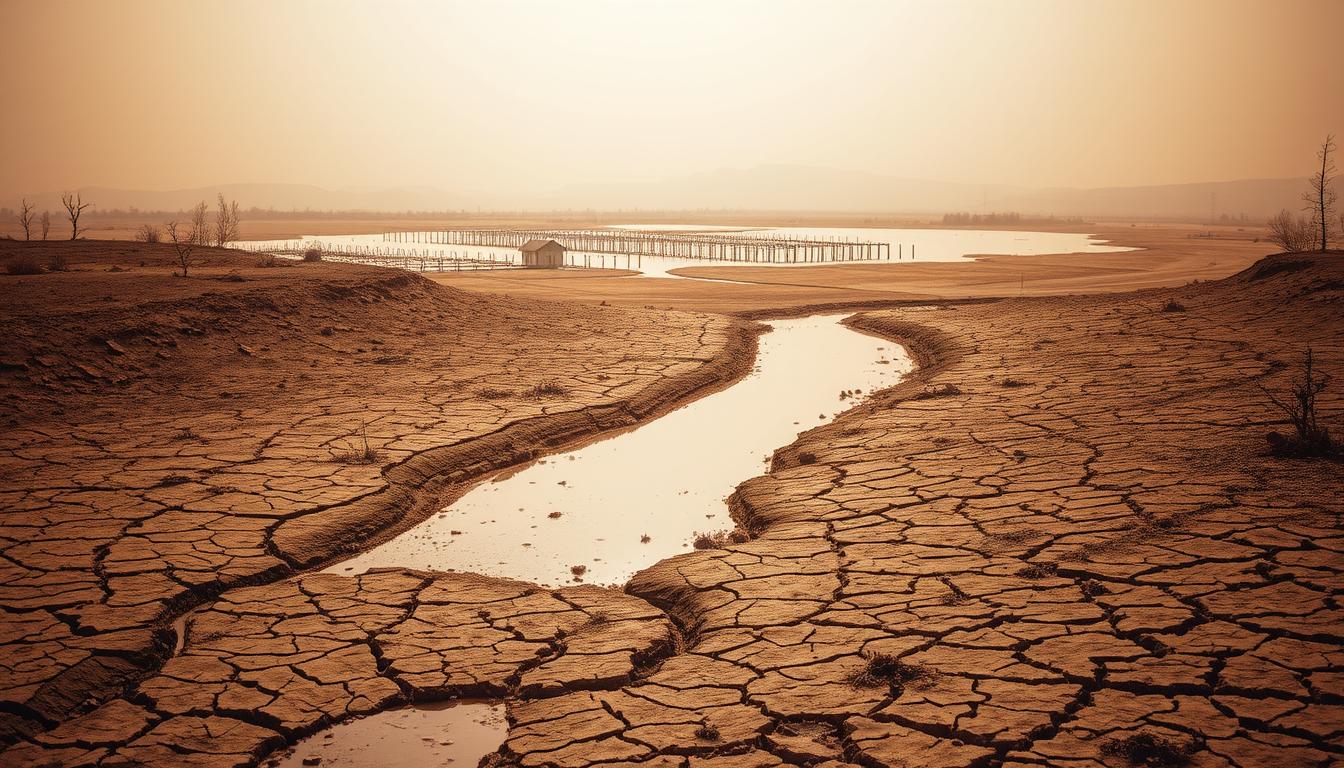
Disappearing lakes and rivers change our planet’s map. Owens Lake, once 108 square miles, vanished by 1926, leaving a dust bowl. The Aral Sea, once the world’s fourth-largest inland water source, now holds just 10% of its 1960 size. These vanishing water bodies reveal nature’s fragility—and human impact.
From Tulare Lake’s comeback in 2023 to Lake Chad’s 95% loss, these shifts show how water sources can vanish and reappear. Droughts, diverted rivers, and climate change push lakes like Urmia to 40% of their original size. Even the Dead Sea drops 3 feet yearly, prompting plans to pump 53 billion gallons from the Red Sea.
These vanishing water bodies hold stories of loss and resilience. The Aral Sea’s split into northern and southern lobes by the 1980s, or Tulare Lake’s floods displacing farm workers, prove their power. This article explores the science and human tales behind these mysterious vanishings—and what they mean for our future water sources.
What Are Disappearing Lakes and Rivers?
Disappearing waterways can vanish suddenly or over years. Lakes might dry up due to drought, underground drainage, or human activity. For example, the Aral Sea—once the world’s fourth-largest lake—dried up after rivers feeding it were diverted for farming. Today, its eastern basin is dried up, leaving behind a desert.
Similar stories exist globally: Tulare Lake, California’s largest freshwater lake before 1900, vanished after drainage projects for agriculture. Even vanished water sources like these leave lasting impacts on ecosystems and communities.

Scientists track these changes using satellites and historical data. Over 2,000 lakes studied show 53% have lost water—22 billion tons yearly, equivalent to 17 Lake Meads. Some vanish because of disappearing waterways sinking underground, while others shrink from climate shifts or overuse.
For example, Lake Powell’s storage dropped 7% due to sediment buildup. Yet, 24% of lakes grew in less populated areas, balancing losses.
Understanding why lakes vanish helps protect remaining water. The Aral Sea’s decline displaced millions, showing how dried up lakes affect people. By studying these patterns, researchers hope to prevent future crises. Next sections explore specific cases and solutions to slow these trends.
The Magic of Lakes That Once Were
Some lost lakes vanish like mirages, leaving behind stories of what once was. Take Tulare Lake, once the largest freshwater body west of the Mississippi. By 1898, it nearly vanished, reappearing only during rare wet years. “It’s hard to picture its size today,” says Vivian Underhill, a water scientist.
Now, after 2023 rains briefly revived it, the lake’s return cooled local temperatures and brought back bird migrations—though farmers argue over draining it again.
“Lake Poopó’s ghostly salt flats remind us how fragile these ecosystems are.”
Bolivia’s Lake Poopó, a 1,000-square-mile wonder, turned to dust by 2015. Slovenia’s Lake Cerknica performs a yearly trick: it drains underground, turning into a meadow each summer. This historical lake has baffled locals for centuries, its cycles tied to hidden karst springs.
Even Australia’s Lake George, a dried up lake for most years, becomes a vast salt flat, echoing Tulare’s fate.

These vanishing lakes aren’t just gone—they’re reminders of nature’s balance. From Tulare’s ghostly return to Cerknica’s yearly dance, they blend wonder with warnings. Each lost lake holds tales of drought, human choices, and the quiet power of hidden waters waiting to resurface.
Rivers That Have Disappeared into Thin Air
Some rivers vanish not because of drought but due to hidden paths beneath our feet. Take Minnesota’s Devil’s Kettle Falls, where the Brule River splits. One channel plunges into a pothole, vanishing into vanishing rivers mystery. Scientists tracking dyes and ping-pong balls there debate whether water reemerges downstream or feeds distant underground waterways. The site remains a puzzle for adventurers and geologists alike.

Bosnia’s Unac River offers clues. It flows openly for miles before sinking into limestone, becoming a sinking rivers example of karst terrain. These underground waterways carve tunnels through rock, letting rivers vanish for kilometers. Similar vanishing acts occur globally—from Turkey’s Kizilirmak to Mexico’s Cenote Angelita—where water disappears into Earth’s hidden veins.
Human hands also rewrite river routes. The Colorado River, once a lifeblood for North America’s wetlands, now dwindles to a trickle before its delta. Dams and irrigation drained its flow, turning a once-vibrant estuary into parched land. Like China’s Yellow River, which dried periodically before restoration, these vanishing rivers mirror our fragile bond with nature.
Natural Events Leading to Disappearance
Natural causes of disappearing lakes often hide beneath the surface. karst topography shapes landscapes where water dissolves limestone and gypsum, forming underground rivers and sinkholes. In 2005, Lake Beloye in Russia vanished overnight when its waters funneled into a sinkhole, exposing a deep underground channel. Such events reveal how soft bedrock can collapse, draining lakes in hours.
Glacial lake outburst floods also trigger sudden vanishings. Chile’s Lake Cachet II lost 200 million cubic meters of water in 2008 after its ice dam shattered. As glaciers retreat, these unstable barriers burst, sending torrents downstream and leaving dry basins behind. Oregon’s Lost Lake drains yearly through a lava tube, turning into a meadow by summer—a seasonal reminder of hidden geology.
Climate plays a role too. Australia’s Lake George dries completely during droughts, while Lake Urmia in Iran shrank 7 meters due to droughts linked to climate change. These shifts highlight how natural cycles and human-driven warming amplify vanishing acts. Even the Colorado River’s diverted course and the Aral Sea’s 90% shrinkage show how forces above and below ground reshape Earth’s surface.
Scientists study these vanishing lakes to predict risks and protect ecosystems. Sinkholes and karst systems remind us that water’s journey is rarely straightforward—sometimes vanishing is just part of nature’s hidden dance.
Human Impact on Water Bodies
Human activities have greatly changed Earth’s water systems. Owens Lake in California used to be 108 square miles big. But after Los Angeles diverted its water 200 miles away, it dried up by 1926. This shows how human impact on water bodies can destroy ecosystems in just decades.

Today, farming is making things worse. Iran’s Lake Urmia lost 80% of its size because of dams and agricultural irrigation. The Aral Sea shrunk to 10% of its size due to Soviet irrigation projects for cotton. These examples show how farming and cities are putting too much pressure on water.
Using too much groundwater is also a problem. The Ogallala Aquifer, which helps U.S. farms, is being pumped too fast. Tulare Lake in California was drained for farmland by the early 1900s. These changes show the need to find a balance between growth and protecting nature.
The Environmental Consequences of Vanished Water Bodies
When lakes disappear, the environmental consequences of disappearing lakes affect whole areas. The Aral Sea shrunk by 80%, turning good farmland into deserts. Now, dust storms carry harmful salts and pesticides, harming nearby people’s health.
These dust storms are not alone. Owens Lake in California is now a toxic dust spot. It costs millions to control the air pollution it causes.
Lost waterways harm wildlife too. The Pacific Flyway lost important wetlands, hurting birds like the sandhill crane. Elders remember the sound of birds flying together, but now it’s rare.
“When rivers die, so does the life they sustain.”
Climate changes also happen. Without the Aral Sea, winters are colder and summers hotter. Rivers like the Colorado are drying up, threatening food.
Water loss leads to soil erosion and floods. This hurts farmers and cities, making crises worse.
The Revival of Disappearing Water Sources
Efforts to revive vanished waterways are showing success. In California, Mono Lake’s water level has stopped falling after dropping 45 feet. Legal protections and conservation efforts helped, allowing birds like pelicans to return.
Nearby, Tulare Lake reappeared in 2023 after decades of drought. Satellite images showed it stretching 10 miles wide. Though pollution and flooding caused $300 million in losses, this shows nature’s ability to recover.
The Aral Sea’s decline to 10% of its size by 2007 led to action. Kazakhstan planted 1.3 million hectares of trees to fight desertification. USAID’s ERAS projects also helped, planting drought-resistant shrubs to improve soil health.
The Kok-Aral Dam slowed the Aral Sea’s shrinkage. This allowed 20 fish species to return to the northern Aral Sea. These efforts show the importance of combining engineering and ecology in revival of water bodies.
Zambia’s Lake Kariba, vital for hydropower, is facing low water levels. But, adaptive farming techniques funded by the Green Climate Fund offer hope. Bhutan and Uzbekistan are also making progress with climate-resilient agriculture and drip irrigation.
These stories highlight the power of human ingenuity in helping nature recover. But, we must act early to overcome challenges.
Fascinating Cultural Tales of Disappearing Water
Water bodies have a deep cultural significance of water bodies for communities around the world. The Tachi Yokuts see lakes as living parts of their heritage. They revived traditions at Tulare Lake, once called “Pa’ashi,” showing how indigenous water knowledge connects people to land.
Legends and myths are part of water folklore. They mix history and nature in a unique way.
They’ve been able to practice their traditional hunting and fishing practices again,” Underhill says.
The Tachi Yokuts’ return to Tulare Lake brings back ceremonies and ancestral ties. For centuries, their stories warned of ecological balance—a lesson now echoed in modern crises. The Aztecs built Tenochtitlan on a lake-filled island. Today, Mexico City sinks into its former lakebed, a silent reminder of altered landscapes.
Legends of vanishing waters span continents. In Kyrgyzstan, Lake Merzbacher’s yearly floods inspire tales of mountain spirits. The Aral Sea’s collapse mirrors Central Asian myths of divine punishment for greed. These water folklore narratives often mirror scientific truths, proving ancient knowledge predicted today’s challenges.
Indigenous stewardship practices, like those of the Tachi Yokuts, reveal time-tested methods to sustain water systems. Their stories and rituals hold keys to balancing human needs with nature’s rhythms—a lesson as vital as the rivers themselves.
How to Understand and Prevent Future Disappearances
Conserving water bodies is urgent. The Aral Sea lost 80% of its volume and 64% of its depth. This shows what happens when we ignore water conservation. Programs like Uzbekistan’s GCF-funded drip irrigation aim to save water and increase crop yields.
Preventing lake disappearance needs sustainable water management. This includes protecting wetlands and rivers.
Communities around the world are working to save these resources. In Zambia, training farmers has helped reduce the strain on Lake Kariba. The lake’s water levels dropped six meters in three years. In California, restoring Tulare Lake could help ecosystems and economies.
These examples show the importance of adapting to nature, not fighting it.
Individual actions also play a big role. Fixing US household leaks can save a lot of water. Cutting agricultural water use can protect rivers like the Yangtze and Colorado. Simple actions like eating less beef can also help.
Global efforts, like UNDP’s NAP programs, are making a difference. By 2030, we aim to ensure clean water for all. Adapting to climate change now will help rivers and lakes last for future generations.