From the first chipped stone flakes 3 million years ago to the global spread of the bow and arrow, ancient tools tell a story of ingenuity. These tools changed how early humans hunted, communicated, and adapted. The earliest stone choppers and hand axes, made 2 million years ago, started a journey where tools became key to survival.
500,000 years ago, technological innovations like spear points and fire-making tools accelerated. Spear points from Southern Africa spread across continents. Moroccan beads from 140,000 years ago show early social symbolism. Even tools made from obsidian, 150 kilometers away, show early humans shared knowledge.
Tools evolved from simple flakes to complex arrowheads and polished ornaments. This shows rising cognitive skills and global connections. The 3-million-year timeline shows technological leaps didn’t just improve survival; they paved the way for modern society. Each breakthrough, from fire control to distant trade networks, set the stage for future innovations.
The Dawn of Tools: A Brief Overview
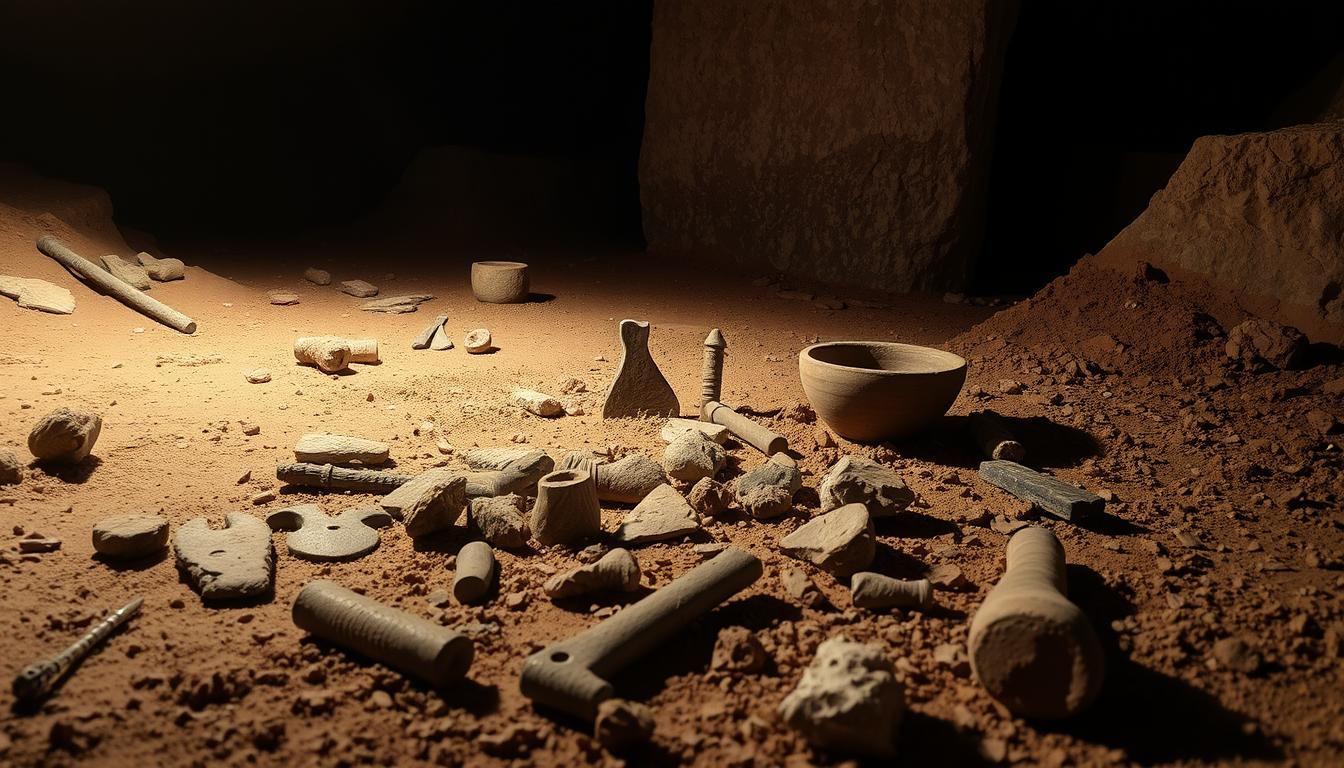
Prehistoric tool making started over 2.6 million years ago. This marked a big change in human history. The Oldowan tools, found at Olduvai Gorge in Tanzania, are some of the oldest tools made by humans.
These tools were made from chipped stones. They include simple flakes and choppers. These were the first tools made by early humans like Homo habilis.
To make these tools, early humans used a hammerstone to strike a stone core. This created sharp edges for cutting or scraping.
These early tools helped early humans to butcher animals and access marrow. They also helped in processing plants. This improved survival and brain development.
Recently, discoveries of 1.5-million-year-old bone tools have changed our understanding of early technology. These tools show the stone tool evolution that started with the Oldowan industry. They laid the groundwork for future advancements.
Every tool, from simple flakes to Acheulean handaxes, shows the growing problem-solving skills of early humans. These early tools played a key role in shaping the path to complex societies.
The Hand Axe: A Multifunctional Marvel
Acheulean hand axes were made as far back as 1.5 million years ago. They changed how early humans survived. These tools were not just stones; they were advanced multi-tools from prehistory. They were found everywhere from Africa to Europe, showing ancient migrations.

These tools had symmetrical edges and rounded points, showing great craftsmanship. Unlike old tools, Acheulean hand axes needed careful planning. They could skin animals, crack bones, and dig up roots.
Each detail on these tools shows they were made with thought. This shows how human thinking was evolving.
These tools lasted over a million years, showing their durability. They were used for so long because they were so versatile. Even today, scientists study how early humans made them stronger using heat.
This shows early humans were learning from each other. Skills were passed down through generations, improving this technology.
The Wheel: A Game-Changer in Transportation
The invention of the wheel around 3500 BCE changed how humans moved goods and ideas. Studies funded by the National Science Foundation found its origins in the Carpathian Mountains. This breakthrough in wheel and axle technology led to the first prehistoric mobility innovations.
It reshaped trade and settlement patterns. The Ljubljana Marshes Wheel, dating to 3150 BCE, shows early engineers could make rotating wooden disks. This was centuries before full-scale wagons were invented.
At first, wheels were used for pottery, not ancient wheeled transportation. Over time, communities adapted the wheel for carts. The first full-size vehicles appeared by 3500 BCE.
Archaeologists found evidence of these innovations in Mesopotamian pottery wheels. These were used before chariots by 300 years. The wheel and axle technology spread fast, helping the Yamnaya people migrate across Eurasia with large wagons.
This shift boosted economic growth by connecting distant regions. It improved cargo capacity.
Technological milestones like Egypt’s spoked chariots and China’s first wheelbarrow (100 CE) showed the wheel’s versatility. Even today, the basic wheel mechanics are the same as 3500 BCE. It proves its timeless design.
From trade routes to warfare, this simple invention became key to human progress. It linked distant cultures and economies across millennia.
Agriculture Tools: Cultivating Civilization
Over 12,000 years ago, the Neolithic agricultural revolution changed everything. Tools like stone sickle blades and digging sticks helped people settle down. These prehistoric farming implements let them harvest wild grains by 9,700 BCE. This marked the start of farming, leading to the growth of permanent villages.

Later, plows and irrigation canals became part of early farming tech. In Çatalhöyük, a city with 8,000 people, farmers used wooden plows and ditches. By 7,700 BCE, farming spread worldwide, with rice in China and squash in Mexico. These tools helped feed more people.
Domesticating animals like goats and pigs started 13,000 years ago. By 5,500 BCE, people in Mexico and North America grew maize and sunflowers. These steps helped cities and complex societies grow. Even simple tools like wooden sickles and irrigation ditches helped civilizations like the Song dynasty improve farming over time.
Early tools like wooden plows and hand-pounded grain were used for thousands of years. But their impact was huge. The Neolithic agricultural revolution did more than grow food—it laid the groundwork for cities, writing, and trade. Without these simple tools, our modern world wouldn’t exist.
Metalworking: The Bronze and Iron Ages
Advances in ancient metallurgy changed human history. The Bronze Age brought new tools and weapons made from copper and tin. But, tin became hard to find after 1200 B.C., leading to new discoveries.
As trade networks failed due to droughts, people turned to iron age tools. Iron was more common and made tools stronger.
Prehistoric metal working changed a lot over time. By 1200 B.C., the Mediterranean moved to iron because of tin shortages. In China, the Shang Dynasty used bronze for special items from 1600–1046 B.C. Scandinavia’s Iron Age lasted until A.D. 800.
Not all cultures changed at the same time. Some kept using bronze longer.
“Climate shifts like the 1250–1100 B.C. droughts forced societies to rethink materials,” notes a 2023 study linking environmental collapse to technological pivots.
Iron helped start big changes in farming. New tools meant more food and bigger cities. War also changed with sharper weapons.
By 550 B.C., the Mediterranean marked the end of the Iron Age with written records. Northern Europe was slower to adopt these changes. Today, we see the impact of these times in artifacts like the Tollund Man’s iron axe and Chinese bronze ritual vessels.
The Compass: Navigating the Unknown

Ancient tools like the compass changed how we explore. The compass started in China during the Han Dynasty. It was a lodestone “south-pointing spoon” used for feng shui.
By the 11th century, sailors used it for sea travel. They put magnetized needles in water.
By 1088, scholar Shen Kuo wrote about the needle’s direction. This was a big step for the compass.
By the 12th century, Europeans and Arabs used it for long trips. They made it better with a 32-point compass rose.
This led to the Age of Exploration. Sailors like Columbus used it to cross oceans. But early compasses had problems with magnetic declination.
Despite these issues, compasses helped expand trade. They connected cultures and economies around the world.
Today, we have GPS, but the compass is a reminder of our drive to explore. It shows how simple ideas can change history.
Writing Instruments: Documenting Human History
Humans started writing long before paper was invented. The Ishango Bone and Blombos Ocher Plaque show early prehistoric information recording. They used simple notches and symbols.
These early ancient writing tools set the stage for later history of writing implements. From Mesopotamia’s reed styluses to medieval quills, each step was important.
In 3100 BCE, Mesopotamians used reed styluses on clay tablets to create cuneiform. This was the first standardized script. Egyptian scribes made papyrus scrolls, and Greek and Roman wax tablets allowed for reusable writing.
By the Middle Ages, quill pens made from bird feathers helped scribes write faster. They copied sacred texts.
“Writing tools are the silent witnesses of civilization,” noted archaeologist Anne-Marie Dubois. “They turn fleeting thoughts into enduring legacies.”
China’s 5th-century BCE brush pens and India’s iron styluses for palm-leaf manuscripts show cultural adaptations. The 19th-century fountain pen and 20th-century ballpoint pen made writing more accessible. Today, digital styluses and apps keep this tradition alive.
From bone carvings to touchscreens, these tools have changed how we store and share knowledge. Each era’s development of writing technology shows humanity’s drive to capture ideas. This ensures stories live on even after their creators are gone.
Printing Technology: Spreading Knowledge
Knowledge sharing got a big boost with the history of printing technology. Early methods like woodblock carvings in China and Korea started it all. The Diamond Sutra became the first printed book in 868 CE.
Then, Bi Sheng came up with movable type invention around 1040 CE using clay. This changed how texts were made.
In 1450, Johannes Gutenberg made a big leap with metal type and a mechanical press. His 42-line Bible needed 300 unique letter blocks but was much faster to make. By 1500, presses in Europe were making 15 million books a year. This was a huge jump from the 30,000 handwritten manuscripts in a century before.

Printed Bibles and pamphlets helped start big changes like the Reformation. Martin Luther’s writings spread fast, reaching 300,000 copies in a year. Before, books were very expensive, but printing made them cheaper.
By 1600, there were 150 million books out there. Tools like Nicholas Jensen’s Roman typefaces made reading easier for everyone.
Printing presses made knowledge more accessible, boosting literacy and sparking scientific breakthroughs. Today, digital platforms carry on this tradition. But Gutenberg’s work is at the heart of it all. From Bi Sheng’s clay types to Luther’s bestsellers, these innovations made knowledge widely available.
The Clock: Measuring Time Precisely
Humans have always tried to measure time well. They started with sundials and water clocks. The first mechanical clock was made in 1283 in England, showing a big step forward.
In the 1600s, clocks got even better. Christiaan Huygens made a pendulum clock in 1656. It was much more accurate than before. Later, John Harrison solved the problem of finding longitude at sea.
By 1800, clocks were affordable for everyone. Eli Terry made clocks that people could buy. Today, atomic clocks are so precise they help GPS systems work all over the world.
This journey shows how important timekeeping is to us. It has changed how we work and trade. Every second we measure is a step towards mastering time.
Medical Tools: Advancements in Healthcare
Our earliest healers used ancient medical instruments like flint knives 6,000 years ago. Egypt’s 950 BCE wooden prosthetic toes and stone drills were early signs of prehistoric medicine technology. By 300 BCE, bronze scalpels and forceps began the history of healthcare tools.
Then, breakthroughs like 1895 X-rays and 1928 penicillin changed medicine. The evolution of medical devices includes MRI scans (first used in 1977) and robotic surgery. Today, we have tools like pacemakers and CRISPR, all built on ancient discoveries.
From flint blades to AI diagnostics, each step shows our endless quest to heal. These tools save lives every day. They prove that innovation starts with ancient curiosity and never stops.
Communication Tools: Bridging Distances
Ancient methods like smoke signals and drum networks started it all. They let civilizations share news over long distances. The electric telegraph, invented in 1831, was a big step forward, making messages instant.
The telephone came in 1849, changing voice calls forever. Mobile phones, like Motorola’s DynaTAC in 1973, made staying in touch easy. Today, billions of smartphones let us send messages instantly, with WhatsApp having 2 billion users.
Email, introduced in 1991, now reaches 3.8 billion people, sending 333 billion messages daily. Social media, with 4.5 billion users, has changed how we work together. Tools like Slack and Zoom make meetings more effective.
But, there are challenges. 2.9 billion people lack internet access. 5G networks are 100x faster than 4G, and AI translation tools are getting better. Virtual reality, used for meetings, boosts focus by 25%.
“The brain’s Broca’s area links tool use and speech, suggesting our neural evolution mirrors technological progress in communication.”
From ancient drums to 5G, communication has changed a lot. The next step, 6G, aims for seamless global connection. But, making sure everyone has access is key to this progress.
The Future of Tools and Technologies
Humanity has always moved forward, from stone tools to smartphones. Today, new technologies like AI and solar energy are changing fast. They promise to make our lives better and more efficient.
Experts say AI and biotechnology will lead the next big changes. Companies like SpaceX and Tesla are working on amazing inventions. These could be as big as the wheel or printing press, but much faster.
Future tools will meet our basic needs and open new doors. For example, renewable energy could solve our resource problems. Nanotechnology might even fix our cells at a tiny level. Space exploration could let us live on other planets.
Tools and culture have always gone hand in hand. The wheel helped trade grow. AI and quantum computing will change how we think and work. The world is changing fast, and so are we.
As we get better tools, we also grow as humans. Our brains have evolved with technology. The next big steps for humanity will depend on using our creativity wisely. Our journey is far from over, driven by the same curiosity that started it all.