
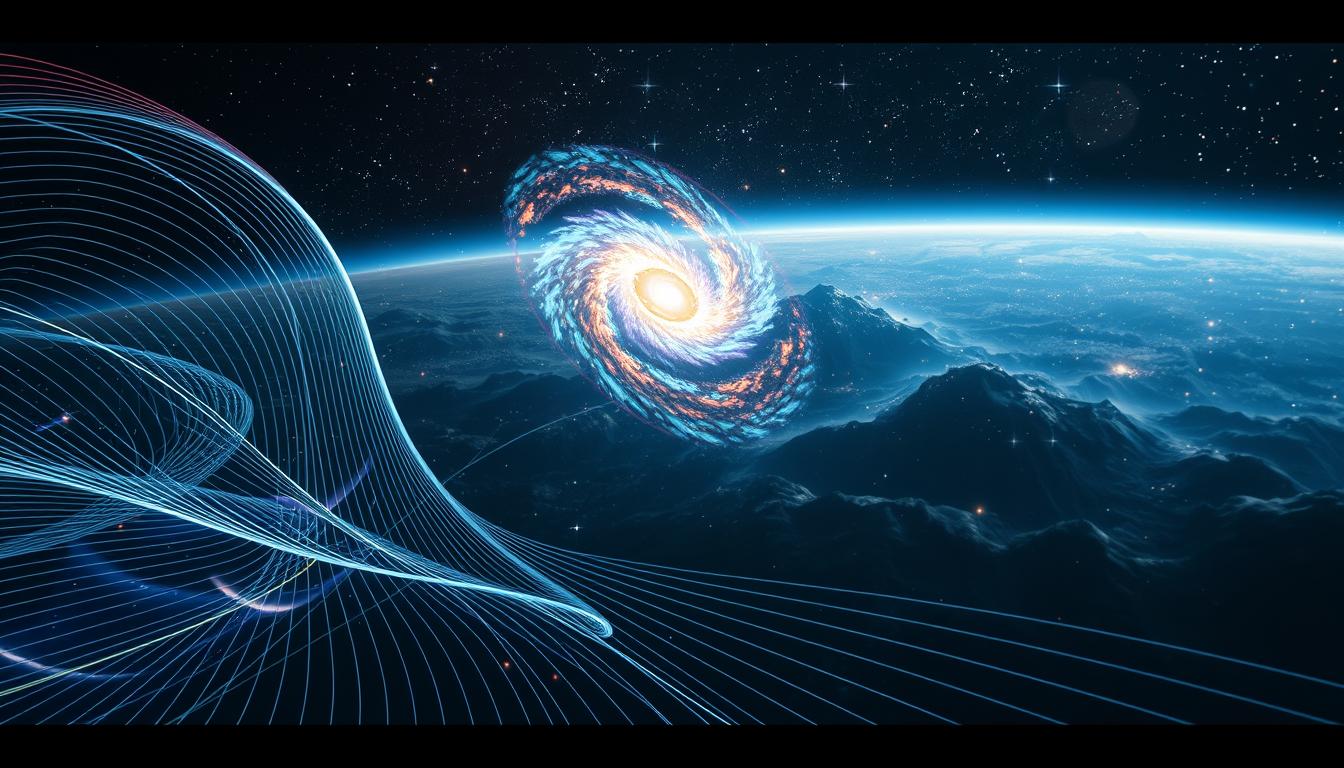
What is time? This question makes us think about its nature of time. Scientists see time as the space between events, like counting seconds from dawn to dusk. In the past, people used shadows and stars. Now, atomic clocks can split seconds into quadrillionths.
Yet, time’s true nature remains a mystery. It’s as important as it is unknown.
Time measurement has come a long way. From sundials to satellites, we’ve made huge strides. Einstein’s 1905 theory changed physics by linking time with space. This idea, known as space-time theories, changed how we see gravity and motion.
GPS devices use these ideas to stay accurate. They adjust for time and space to avoid errors.
For a long time, Newton’s laws said time was fixed. But experiments like Michelson-Morley’s 1887 test showed that wasn’t true. This led to Einstein’s relativity.
Today, we know that space and time curve. This explains how planets orbit and how black holes work. This article will dive into how these discoveries change how we see time in the universe.
Understanding Space-Time Theories
Newton once thought time was always the same. But Einstein’s theory of relativity changed that. It combined space and time into a single, four-dimensional fabric called the spacetime continuum.
This fabric is shaped by mass and energy. Big objects like stars can warp it. This warping changes how time moves.
A clock on Earth ticks slower than one in space. This shows that time can be different depending on where you are.
Today, scientists debate if the spacetime continuum is basic or if it comes from something else. Quantum experiments show particles can stay connected even when far apart. This suggests there might be hidden links between them.
These findings make scientists think about how relativity and quantum mechanics work together. They are trying to understand how our reality is structured.
Now, researchers are looking into if spacetime comes from quantum interactions. Experiments show particles can ignore distance, hinting at deeper principles. These new ideas suggest spacetime might not be fixed, as Einstein thought. Instead, it could come from quantum entanglement or other basic processes.
The Nature of Time
Time is a big mystery in science. Physics says time is a measure, like what clocks show. But, what time really is, is hard to figure out.
For thousands of years, philosophers have wondered about time. They ask if time moves, if it’s real, or if it’s just an idea. Aristotle thought time can’t start, but today’s science is trying to understand where time comes from.

There are many views on time. Some say the future is set, while others think it can change. Some think time is made of events, while others believe it’s always there.
But why does time seem to slow down when we’re bored or speed up when we’re stressed? These questions make us think about time in a new way.
“The A-series of past, present, and future creates contradictions,” argued J.M.E. McTaggart in 1908, proposing time’s unreality. His B-series, based on static before/after relations, also fails to explain change, leaving time’s nature unresolved.
How we see time changes based on culture and our feelings. Research shows that stress or being focused can make time seem different. This shows how our experiences match the big questions about time.
As science keeps moving forward, the mystery of time stays. It connects Einstein’s ideas about space and time with old questions about existence.
The Role of Einstein’s Theory of Relativity
In 1915, Einstein changed how we see time and space with his theory of relativity. He showed that time dilation happens when objects move close to the speed of light. This means moving clocks tick slower than those that are not moving.
General relativity took it further. It explained that gravitational time slows down near heavy objects, like Earth. These ideas were once debated but are now widely accepted.
GPS technology uses Einstein’s ideas to stay accurate. Satellites in orbit around Earth face both speed-induced time dilation and gravitational time effects. If not corrected, their clocks would get out of sync, leading to navigation errors.
Engineers add a 38-microsecond daily adjustment to keep GPS accurate. This ensures that our location data remains precise.
Experiments like Arthur Eddington’s 1919 solar eclipse test confirmed light bending. LIGO’s 2016 detection of gravitational waves proved that merging black holes exist. These findings validate Einstein’s theories, showing they are not just abstract ideas. They are essential for modern technology and space exploration.
Measuring Time: Tools and Techniques
Humans have tracked time for thousands of years, from sundials to water clocks. Today, we use atomic clocks for time measurement. These clocks count seconds with incredible accuracy, thanks to cesium atoms.

Atomic clocks set the time standards worldwide. The second is defined by 9,192,631,770 cycles of radiation from cesium-133 atoms. This method keeps GPS, internet, and global systems in sync. Quartz watches, on the other hand, lose half a second daily, much less accurate than cesium’s yearly drift of 0.00000000333 seconds.
New clocks are even more precise. Strontium atomic clocks track 1/15,000,000,000 of a second yearly, matching Earth’s age. Optical clocks can tick trillions of times per second. These advancements help scientists test Einstein’s theories, like JILA’s 2020 experiment showing gravity’s tiny time-dilation effect over just 1 millimeter of height.
Behind these breakthroughs are places like the National Institute of Standards and Technology (NIST), founded in 1901). Their work ensures global time standards support everything from smartphones to space missions. As quantum tech advances, atomic clocks continue to reveal physics secrets and keep the world on schedule.
The Influence of Time on Modern Science
Time research is key in modern physics. Atomic clocks can measure time to billionths of a second. They test Einstein’s ideas about how gravity affects time.
Quantum time changes how we see time measurement. The time-energy uncertainty principle shows we can’t know exact moments in quantum systems. Also, satellites adjust their clocks daily to match Earth’s clocks, showing relativity’s impact.
The grandfather paradox questions time travel logic: altering the past would erase the traveler’s existence, making the act impossible.
Entropy’s rise shapes the universe’s direction. Julian Barbour’s 2014 model suggests gravity could create time’s direction. Fixed point theorems solve paradoxes by avoiding contradictions.
Future research might link quantum physics and relativity. Studying Planck time (10^-43 seconds) could show if time is quantized. These findings could change our understanding of black holes and the universe’s beginning.
Philosophical Perspectives on Time
Philosophers have long debated the nature of time. They ask if it’s a real force or just a product of our minds. Questions like “Does the future exist?” or “Is time flowing?” spark big debates.
Some believe only the present is real (Presentism), making past and future unreal. Others think all moments are equally real (Eternalism). The Growing Block Theory says the future is empty space.

“Any future event X is already real,” claimed Hilary Putnam, a key eternalist. But critics like Lee Smolin argue time is dynamic, not frozen in a “block universe.”
Eastern philosophies see time as cyclical, unlike Western views of time as linear. These differences show how time perception shapes our worldviews. Even Einstein’s relativity, which merged space and time, hasn’t ended debates.
Modern thinkers like Avshalom Elitzur reject the block universe, saying the future is not real. A-theorists focus on time’s “tensed” nature (past/present/future), while B-theorists see time as a static structure. Over 50% of traditional beliefs about time have been overturned by science, yet core questions—like time’s direction or existence—remain unsolved.
Whether time is a human construct or a fundamental force, these debates show how the nature of time connects science and philosophy. As research advances, answers may emerge—but for now, time’s mystery endures.
The Relationship Between Space and Time
Einstein’s theory of relativity changed physics. It showed that space and time are part of a single spacetime continuum. They merge into a four-dimensional fabric, shaped by gravity and motion. This means we can’t describe events without considering both space and time.
Hermann Minkowski, a mathematician, said, “Henceforth space by itself, and time by itself, are doomed to fade away into mere shadows.” His work showed how time and space change together. For example, muons, tiny particles, live longer when moving fast, just as predicted by spacetime.
Imagine two people moving past each other. One sees a rocket’s clock ticking slower and its length shrinking. This isn’t just an illusion—it’s real. GPS satellites use this to adjust their signals, correcting for time differences caused by Earth’s gravity.
The math behind this is the spacetime interval, given by s² = c²t² − x². This formula remains the same, even if observers disagree on time or distance. Light, moving at 299,792 km/s, is the fastest speed in spacetime. No object can go faster, as mass grows infinitely near light-speed.
Time Dilation: A Fascinating Phenomenon
Time dilation is a key part of Einstein’s theory of relativity. It shows that time moves slower near big objects or when moving fast. GPS satellites use this to stay accurate, correcting for time dilation to avoid errors of 10 miles a year.

Speed changes how time works. Muons, tiny particles, live longer when moving close to the speed of light. This was proven at CERN. Astronauts like Sergei Krikalev and Sergey Avdeev aged a bit less during their missions.
The International Space Station also shows time dilation effects. Over six months, astronauts age a tiny bit less than people on Earth.
Gravity also affects time. The Earth’s core is 2.5 years younger than its crust because of gravity. The 1960 Pound-Rebka experiment showed that clocks run faster uphill. At 10,000 meters, time moves up by 0.0000000001 seconds every year.
GPS relies on these effects. Satellites need to adjust for 38 microseconds every day. This combines gravitational time and velocity effects. The twin paradox shows that a space traveler moving fast ages slower, as seen in Hafele-Keating’s 1971 tests.
These findings shape our world. From particle labs to space travel, time dilation is real. As we explore more, understanding these effects will be key for deep-space missions and precise technology.
Popular Misconceptions About Time
Many think time is always the same. But science shows this isn’t true. Einstein’s relativity says time can speed up or slow down. For example, clocks on Earth run slower than those in space.
Another myth is that time moves the same everywhere. Space-time theories show this isn’t right. Time dilation, seen in satellite GPS, means astronauts age slower. This isn’t just in movies—it’s real in our technology.
Some believe time is separate from space. But physics says they’re together in spacetime. Black holes warp this fabric, bending light around them. Even gravity changes how we see time perception.
“Time travel paradoxes don’t disprove physics,” explains physicist Paul Davies. “Consistent timelines resolve conflicts, making paradoxes impossible.”
Myths also say time only moves one way. While entropy’s rise gives time direction, quantum theories suggest other possibilities. Yet, no experiment has reversed this flow. Misconceptions like “time is a river” ignore the complex reality of spacetime.
By rejecting these myths, we follow science. The nature of time is a mystery, but debunking myths helps us understand space-time theories that shape our universe.
The Future of Time Research
Time research is breaking new ground as scientists dive into quantum time and improve time standards. For example, optical lattice clocks can track time so accurately, losing just one second every 15 billion years. These advancements could change how we use GPS, satellites, and explore space, where small timing errors are critical.
These tools also test the limits of physics, asking if time flows smoothly or in discrete “quanta.”
There are many questions left to answer. Is time a fundamental part of reality or something that emerges? Theories like quantum gravity try to combine Einstein’s relativity with quantum mechanics. But, there are big gaps to fill.
Experiments with quantum systems might show if time’s smallest unit matches the Planck scale. Atomic clocks already help correct for relativity’s effects, like GPS satellites drifting 8 microseconds daily without adjustments. These tools show how time standards impact our daily lives while exploring the universe’s secrets.
Researchers also wonder about time’s direction and its role in black holes or the universe’s creation. Theories like closed timelike curves suggest time travel is mathematically possible. But, physics barriers, like needing negative energy, make it science fiction for now.
As clocks become even more precise, they might detect dark matter or gravitational waves. The next decade could change how we measure time, mixing quantum principles with cosmic scales. This journey is not just for scientists—it’s changing how humanity explores space and understands existence.