
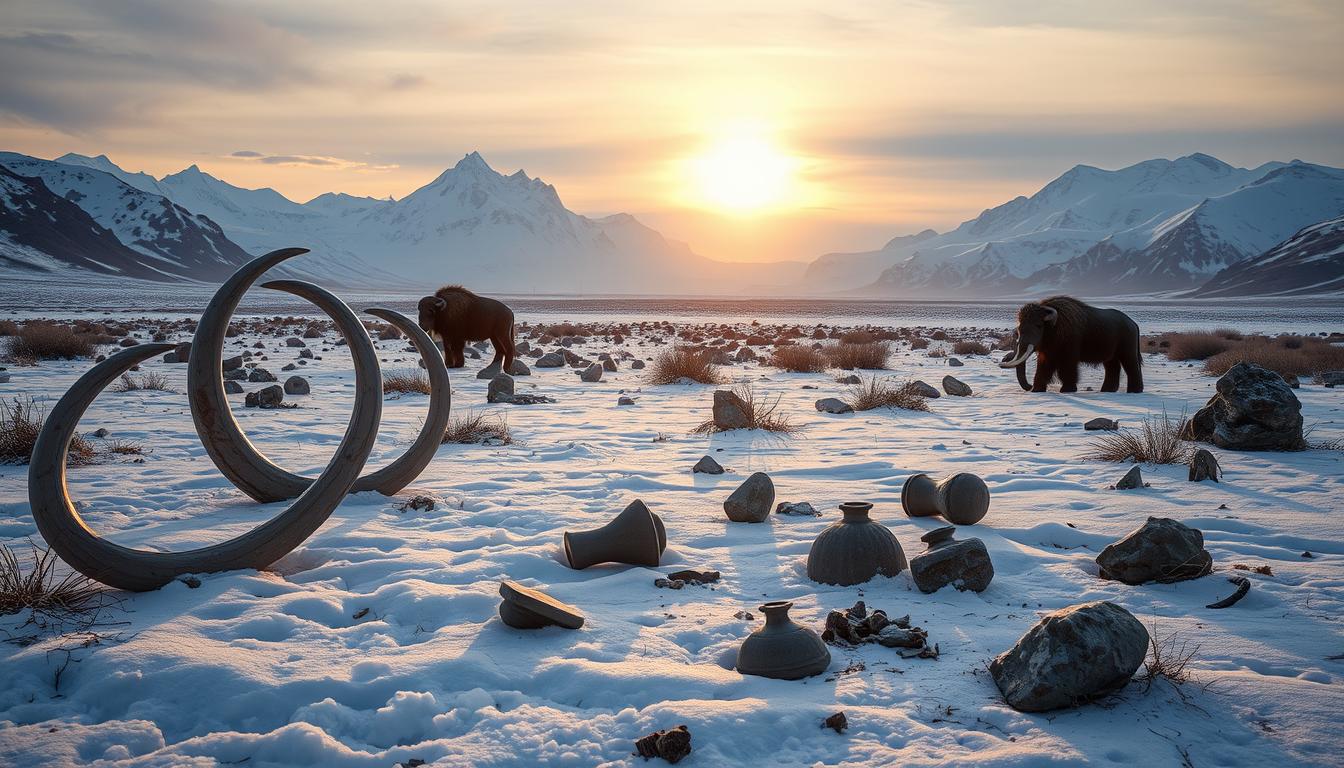
Ice age relics like ceramics, stone tools, and engravings give us a peek into life long ago. In Kisatchie National Forest, recent finds show nomadic groups lived there for over 13,000 years. A U.S. Forest Service grant of over $700,000 helped uncover these ancient artifacts buried deep.
In Louisiana, archaeologists found the first signs of permanent homes at a 100-acre site. They also discovered 4,000 other sites across 604,000 acres. In Britain, digs uncovered 300,000-year-old stone tools, including a 29.5 cm handaxe, the largest found there.
These discoveries, like those in the Medway Valley, show how humans adapted during the Earth’s coldest times. Studies in Internet Archaeology reveal how these finds change our view of Neanderthal skills and survival.
What Are Ice Age Relics?
Ice age artifacts are items left by early humans during the Ice Age. These paleolithic relics include tools, art, and everyday objects. They were made from stone, bone, and antler.
Examples like arrowheads and spear points show how ancient peoples hunted. They also reveal how they created art and adapted to harsh climates.

“The engravings on stone plaquettes from Gönnersdorf show early human creativity,” noted a study in PLOS ONE.
Scientists study these remains using radiocarbon dating. This method helps find out when ancient tools were made. For example, an atlatl dart in Yellowstone is over 10,000 years old.
Such finds help trace migration routes and survival strategies. Stone tools and art are more than just relics. They are clues to our past.
By analyzing them, experts uncover stories of how humans thrived during icy epochs. Each ancient tool or carving hints at vanished cultures. It shows the ingenuity of our ancestors.
The Significance of the Ice Age
The ice age climate changed Earth’s surface, creating valleys and changing rivers. During this time, ice sheets covered continents, forcing species to adapt or disappear. Orbital shifts, like the Holocene Thermal Optimum, show how paleolithic conditions were influenced by natural cycles.
These changes pushed humans to innovate, turning survival into a drive for progress.

“The Holocene Thermal Optimum in the Northern Hemisphere was caused by small and gradual changes in the Earth’s orbit around the sun.”
Human adaptation during this era was remarkable. People in the Upper Paleolithic made tools from ivory and stone, like the 15,000-year-old mammoth ivory spearthrower from the Berlin Collection. These finds show how communities survived paleolithic conditions through teamwork.
Public works in Europe 25,000 years ago are examples of this. Lavish burials, such as those at Sunghir, indicate early social hierarchies were forming under harsh climates.
Discoveries like Göbekli Tepe’s 9,000-year-old structures show humans adapted culturally, not just physically. The ice age climate forced resilience, leading to innovation in shelter, hunting, and art. Today, melting glaciers reveal clues, like Stone Age artifacts, showing how human adaptation turned survival into legacy.
Types of Ice Age Relics
Ice age tools like stone blades and scrapers show how early humans survived. These simple but effective items were made from flint and bone. Paleolithic weapons such as spear points and arrowheads reveal hunting advancements, proving humans adapted to Ice Age challenges.
“The newly revealed engravings on the Gönnersdorf plaquettes depict fish as well as grid-like patterns that the study’s authors interpret as illustrations of fishing nets or traps.”
Prehistoric art, such as cave paintings and engraved plaquettes, hints at symbolic thinking. These artifacts, like the fish engravings, suggest storytelling and cultural practices. Alongside these, ancient structures like post molds found in forests show early architecture. These soil circles, uncovered in digs, indicate permanent homes, a shift from nomadic life.

Organic remains, such as woven textiles preserved in ice patches, add to the picture. Together, these relics—tools, art, and structures—paint a vivid image of resilience and creativity. Each piece, from a chipped arrowhead to a faded engraving, tells a story of survival and innovation 12,000 years ago.
Notable Ice Age Sites in North America
Exploring North American ice age sites gives us clues about early human survival. In Louisiana’s Kisatchie National Forest, researchers found prehistoric Native American settlements from the Ice Age’s end. They found post molds, showing people lived in permanent homes.
This changes how we think about human adaptation. It shows how groups survived in changing landscapes.

Further west, Yellowstone and the Rocky Mountains hold secrets. A 10,000-year-old atlatl dart was found there. This American paleolithic tool shows advanced hunting skills.
These sites also tell us about climate changes. For example, the Holocene Thermal Optimum changed ecosystems.
Coastal areas once stretched further, leaving behind ancient life signs. Bones of megafauna and ancient American artifacts are found as shorelines move. From mammoth bones to stone tools, these sites show early cultures thrived across vast areas.
Each find paints a picture of resilience and ingenuity during Earth’s coldest time.
The Role of Ice Age Relics in Understanding Human History
Ice age relics tell us about ice age daily life. They show how early humans made tools and survived tough climates. For example, the Gönnersdorf engravings tell us fishing was more than just finding food—it influenced paleolithic migration and cultural practices.
These relics also show how prehistoric technology improved over time. From simple stone tools to complex spearheads, we see how humans got smarter. A 2023 study found that fishhooks and cave art prove seafood was key to early diets.
Each relic adds to our understanding of ancient human history. They tell us about diets, trade, and how people lived in cold climates. By studying spear points or hearths, archaeologists create timelines of human innovation and survival. This shows how important relics are in uncovering our shared past.
Preservation Techniques for Ice Age Relics
Natural ice age preservation has kept ancient treasures safe for thousands of years. Ice and permafrost act as cold vaults, freezing organic materials like wood and bone. This paleolithic remains preservation process has preserved items such as a 3,000-year-old Norwegian arrow in near-perfect condition. Frozen environments slow decay, creating a timeline of human and animal history.
Now, modern methods help nature’s preservation. The Ice Memory Foundation retrieves ice cores from glaciers, storing them in Colorado’s National Science Foundation facility. These labs use controlled environments to maintain artifacts like 1,300-year-old skis. Archaeological conservation teams stabilize items immediately after discovery, preventing damage from sudden temperature shifts.
Climate change makes the race against time even more urgent. Melting ice patches have revealed 4,000 artifacts at 69 global sites in the 1990s. But rising temperatures now threaten these discoveries. A 2023 study warns half of Earth’s mountain glaciers could vanish by 2100. Researchers are racing to document items like Yuka the 30,000-year-old woolly mammoth before they degrade.
Efforts focus on long-term storage. The foundation plans to ship cores to Antarctica’s Concordia Station by 2025, using insulated vaults to maintain -20°C. These measures ensure ancient artifact conservation for future study. Every year of delay risks losing clues to our past as ice retreats faster than expected.
Recent Discoveries of Ice Age Relics
Recent ice age discoveries are changing how we see prehistoric life. As ice melts, artifacts like tools and art are uncovered. For example, engravings on the Gönnersdorf plaquettes show fish in grid patterns, hinting at early fishing.
These engravings, dating back 15,800 years, suggest symbolic practices. Over 400 plaquettes at the site reveal secrets once hidden under ice.
New finds like these rely on advanced technology. Tools like reflectance transformation imaging (RTI) help scan artifacts in labs. This technology reveals engravings too faint to see before.
A study from Durham University and the Leibniz Center shows RTI’s power. It uncovered fishing net designs, changing our view of survival skills in the Upper Paleolithic era. Discoveries at Wyoming’s La Prele site also show tailored clothing helped humans survive cold climates 15,000 years ago.
“The technology’s light manipulation exposes details missed by the human eye,” noted researchers using RTI on the Gönnersdorf artifacts. “These methods let us reinterpret artifacts we’ve had for decades.”
Climate change brings both good and bad news. Melting ice reveals treasures but also speeds up their decay. Finds like the muskox lungworm’s spread in Arctic regions show ecological shifts.
Archaeologists must adapt, working with Indigenous hunters to respect local knowledge. Each discovery, from Siberian needles to the oldest hare-bone bead at La Prele, shows the past is full of surprises.
Ice Age Relics in Popular Culture
Ice age museums around the world use prehistoric exhibits to connect ancient artifacts with today’s viewers. They show everything from detailed beadwork in European sites to ancient stone tools. Places like the Smithsonian’s Hall of Human Origins mix ice age museums with modern tech.
This makes 40,000-year-old jewelry or bone carvings seem alive. It’s a way to make history touchable.
The paleolithic in media is big in movies like Ice Age and games like Assassin’s Creed Origins. But, these stories often mix fact and fiction. Documentaries, like BBC’s Britain’s Drowned World Revealed, use real artifacts and CGI to show early humans’ life in glacial times.
These stories spark interest but sometimes simplify life during the ice age in popular culture.
Recent studies, like the 2023 analysis of 134 bead types from 112 European sites, show how Ice Age cultures exchanged styles despite genetic differences. This research inspires museums to update their exhibits. They now focus on cultural diversity, not just “caveman” stereotypes.
Video games now include accurate details, like regional bead preferences in France vs. Italy. This shows how ice age in popular culture grows with science.
By combining archaeology with storytelling, these efforts make ancient relics into stories we can relate to. When a movie shows realistic prehistoric clothing or tools, it teaches viewers subtly. It shows that interest in the past drives both movies and research.
Future Research and Exploration
Future discoveries might come from places like Norway’s melting glaciers. Over 2,000 artifacts have been found there. Antarctica, with its 90-million-year-old amber, could show how ancient ecosystems lived under warmer conditions.
Ice age research is linking ancient environments to today’s climate challenges. This research is ongoing.
New tech like luminescence dating and DNA sequencing is making big strides. In Canada, the CanSeq150 project is studying the deepwater sculpin, a creature from the last ice age. By analyzing its genome, scientists can understand how ecosystems have changed.
Tools also help study plant material in amber. This gives insights into ancient microorganisms.
Archaeological ethics are important in managing discoveries. Researchers must balance preserving sites with exploring them. They must also respect indigenous communities and protect endangered species like the deepwater sculpin.
Keeping sites safe from threats like invasive species is key. This ensures artifacts are available for future studies. As technology improves, ethical practices will guide ice age research.