
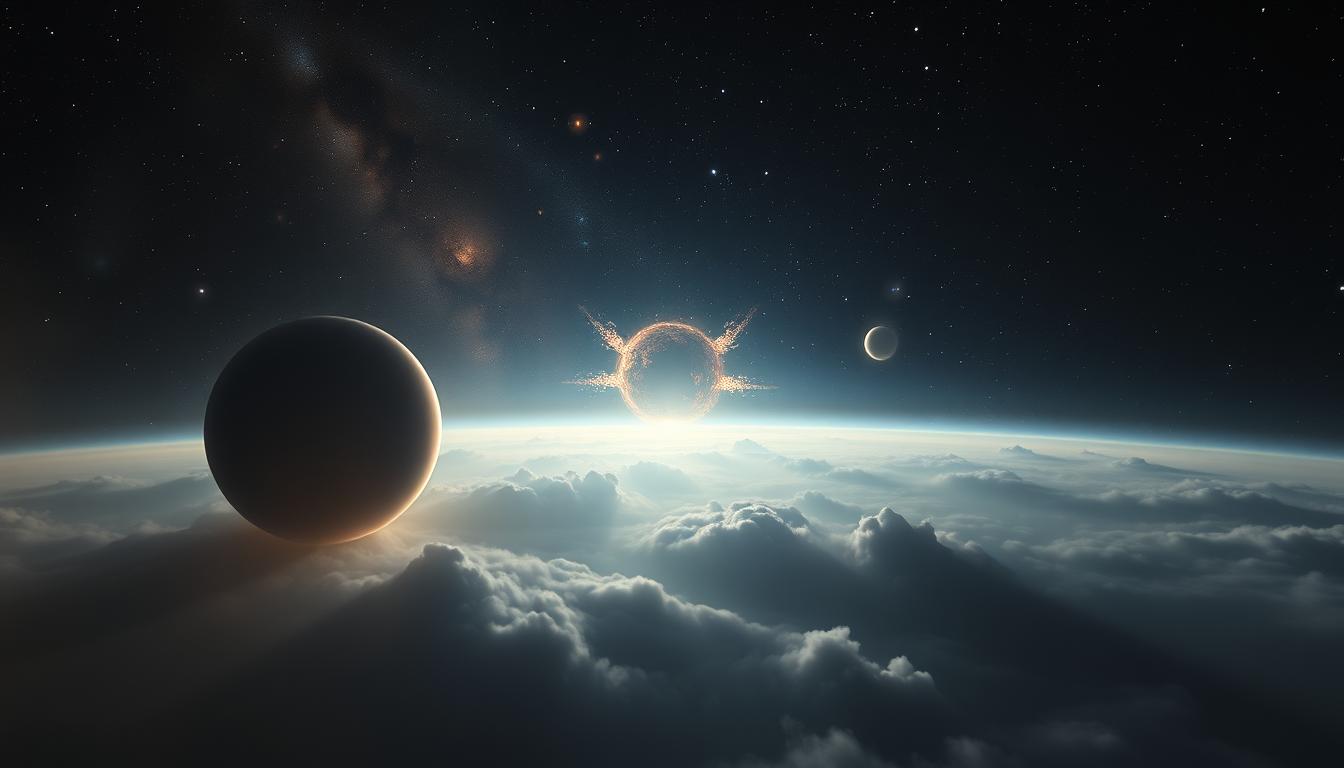
The Fermi paradox is a simple question. It wonders why, with billions of stars and planets, we haven’t found aliens. In 1950, physicist Enrico Fermi asked, “Where is everybody?”
His question shows the gap between the math suggesting aliens are common and the universe’s silence. Our galaxy has over 200 billion stars, suggesting millions of planets. But, we’ve found no signs of advanced life.
The search for aliens has lasted for decades. Tools like SETI scan for signals. The paradox deepens when thinking about time: even slow spaceships could reach the Milky Way in under 50 million years.
This is a tiny fraction of the universe’s 13.8 billion-year history. Yet, we’ve found no proof of alien life. Scientists are left wondering why the universe is so quiet.
Understanding the Fermi Paradox
Enrico Fermi’s Fermi’s question came up during a 1950 lunch at Los Alamos National Laboratory. He wondered, “Where is everybody?” This question highlighted a big mystery: if billions of stars have planets, why don’t we see any alien civilizations?
“Where is everybody?”
The Drake equation was made by astronomer Frank Drake. It looks at things like how many stars form and how many planets can support life. Early guesses said there could be up to 100 million extraterrestrial life forms in our galaxy. But, we’ve found no signals or visits from them. This lack is what makes up the Fermi Paradox.
New studies show us harsher truths. The Milky Way has billions of planets like Earth, but life might be rare. Only 0.002% of planets might have both oceans and continents, which are key for life. It seems alien civilizations could be much rarer than we thought. Even if life starts, it’s unsure if it can survive big environmental changes. Humans are the first to leave Earth, showing how fragile advanced life might be.
The Fermi Paradox makes us rethink our assumptions. If the universe is full of life, why don’t we hear from them? Finding an answer could change how we see our place in the universe.
The Search for Extraterrestrial Life
For over 30 years, the SETi program has been scanning the universe with radio telescopes. These tools look for technosignatures—repeating patterns that might be alien signals. Despite decades of listening, no clear signs have been found.
Today, projects like Breakthrough Listen use AI to search through billions of stars. But with the Milky Way having 100 billion planets, the search is like finding a needle in a haystack.

Radio telescopes focus on specific frequencies, like 1.42 GHz, where natural noise is less. Even so, we’ve only checked a small part of space. Technossignatures could also include laser flashes or megastructures, but finding them is slow.
Earth’s radio broadcasts have only reached 80 light-years away. This is tiny compared to the galaxy’s 100,000 light-year span. Why haven’t we heard from aliens yet? Maybe civilizations are rare, or their technology is beyond our detection.
Despite the progress, the silence continues. SETI program scientists say our search is like shouting into a forest and expecting an answer. Yet, there’s always hope: every new telescope expands our search. The quest goes on, one star at a time.
The Age of the Universe
The universe is 13.8 billion years old. The Milky Way formed about 13.6 billion years ago. Our solar system is only 4.5 billion years old.
This billion-year head start means older stars could have planets with life long before Earth. Even traveling at 10% light speed, a civilization could colonize the Milky Way in tens of millions of years. That’s incredibly fast compared to cosmic timescales.
Think of the universe’s history as a single year. Humans wouldn’t show up until December 31 at 11:59 PM. That leaves billions of years for other civilizations to advance far beyond us.
Yet, we see no signs of galactic colonization. If evolution of intelligence followed predictable paths, ancient aliens might rule the cosmos. But we find no evidence of their technology or signals.
Colonizing the galaxy isn’t impossible. A civilization sending probes every 100 years could cover the Milky Way in 50 million years. With a 13.8 billion-year timeline, even slow expansion would leave marks. The Fermi Paradox deepens here: ample time and resources exist, yet the universe remains eerily quiet. What blocked those early pioneers? The answer might lie in challenges we’ve yet to understand—or overcome.
Technological Barriers to Communication
Our quest for interstellar communication hits roadblocks due to technological limitations. We use radio telescopes to search for signals from nearby stars. But, signal detection assumes aliens use radio waves, a technology we’ve had for a century.
Planetary scientist Briony Horgan points out our 60-year search is tiny compared to the universe’s 13.6-billion-year history. It’s like trying to hear a whisper in a huge stadium. 
“The universe is a crowded place, but we’re shouting into an empty room.”
Even if advanced civilizations exist, their technology might be beyond our understanding. For example, a message to the Andromeda galaxy would take 2.5 million years. Our broadcasts from the 1940s have only reached 80 light-years away.
Technologies like laser-based communication or neutrino signals might be beyond our reach. The “synchronicity problem” also adds to the challenge. Civilizations might rise and fall before their signals reach us.
We’re slowly improving our ability to detect signals with AI and deep-space arrays. But, the odds are against us. The universe might be full of life, yet we’re separated by vast distances and understanding.
The Great Silence: Natural Explanations
The rare Earth hypothesis questions how common life is. Simple life forms might exist elsewhere, but complex life is rare. Earth’s unique conditions, like its orbit and moon, might be why advanced life is so rare.
Ross Andersen’s great filter theory suggests that evolution or technology might stop most civilizations. If life starting from chemicals is rare, our existence might be a big achievement. But, dangers like climate change or AI could silence other civilizations before they reach the stars.
“The silence could mean intelligence is a fleeting achievement,” noted astrobiologist David Grinspoon, pointing to Earth’s near misses with extinction events like the dinosaur-killing asteroid.
Mass extinctions could reset progress in galaxies. Even if life starts, disasters or running out of resources might stop it from growing. These threats make us wonder why we’re alone in the universe, as posed by Fermi’s paradox.
Sociological Factors in Alien Existence
“If such beings exist they would have visited Earth, and if such civilizations existed then they would have given us some sign of their existence.” — Konstantin Tsiolkovsky, 1933
The zoo hypothesis suggests advanced civilizations might observe Earth like a cosmic wildlife reserve. Proposed by Tsiolkovsky and later expanded by scientist John Ball, this idea frames humanity as an unobserved species under a non-interference directive. Like ecologists studying ecosystems without direct contact, alien societies might wait until we reach maturity before revealing themselves. Such restraint aligns with principles of interstellar ethics, where older civilizations avoid disrupting younger cultures.

Alternative theories in alien sociology propose civilizations may avoid contact to prevent conflict. The non-interference directive could be enforced by galactic councils, or societies might prioritize virtual realities over colonization. Even if billions of planets host life, ethical barriers or self-imposed silence could isolate civilizations. The zoo hypothesis remains plausible—just as humans study animals without interaction, cosmic observers might watch quietly.
While the “Dark Forest” theory suggests civilizations hide to survive, evidence shows stars are too distant for practical aggression. Societies might instead focus inward, valuing preservation over expansion. Our search—via telescopes like James Webb—continues, but answers may lie in understanding how alien ethics shape their choices. Until then, the silence could be a lesson in patience, not absence.
Potential Alien Life Forms
Earth’s life depends on carbon, but the universe might have non-carbon life. Scientists think silicon-based aliens could live in hot deserts or cold worlds. They use chemistry that Earth’s biology doesn’t accept.
Life on Titan’s methane lakes or Venus’s clouds might use ammonia instead of water. This would be powered by unfamiliar biochemistry.
NASA’s probes to Europa and Enceladus look for signs of such alternative biochemistry. Even intelligence could be different. It might be swarms of AI networks, hive minds, or beings thinking in millennia, not seconds.
Exotic intelligence might talk through quantum fields or gravity waves. This means we might not hear their signals on radio.
Imagine if advanced life moved to digital realms. Their “colonies” could be like data clouds, not starships. The Fermi Paradox’s silence might be because we only look for carbon-based life. Looking for other types means we have to rethink what life and discovery mean.
Implications of Discovering Aliens
Discovering alien life would change how we see ourselves. The alien discovery implications touch science, culture, and ethics. Religious views might change, and science could see evolution in a new light.
How would world leaders handle first contact scenarios? There are plans, but no single voice for Earth. We need to create interstellar diplomacy frameworks fast.
Alien technology could make our innovations look old. Sharing new ways to travel or heal could be amazing. But, we face big challenges like language gaps and mistrust.
After meeting aliens, we might ask new questions. Are we guardians of the universe? Or are we the only ones, trying to keep life special?
“If we’re alone, that motivates us to protect Earth and explore deeper into space,” emphasized Briony Horgan, a planetary scientist. “Either way, the search compels us to ask: What’s our role in the cosmos?”
To be ready for post-contact society, we need to work together. Ethics groups and global agreements could help. They would balance our curiosity with caution. The Fermi Paradox shows the risks, but finding aliens could answer big questions and change our purpose in the universe.
Government and Military Interest in UFOs
As a kid, I once thought a satellite was a UFO. This experience made me realize how serious militaries take such sightings. The Pentagon has looked into over 12,000 UFO reports, with 6% remaining a mystery.
Back in the 1960s, there was a push to hide UFO evidence. But today, the Pentagon is opening up. They released a report in 2021 and are planning to share more with NASA’s help.
Most UFO sightings are explained, but some are not. Military pilots have shared their encounters, showing the need for answers. The Pentagon wants to clear up what’s real and what’s not. Every UFO sighting brings us closer to understanding the universe.
The Future of Interstellar Exploration
Humanity’s search for answers to the Fermi Paradox depends on interstellar missions and space exploration. The James Webb Space Telescope is scanning distant planets for life signs. Breakthrough Starshot plans to send probes to Alpha Centauri at 20% light speed, cutting travel time to decades.

But, there are huge technical challenges. Even Breakthrough Starshot’s probes will take 20 years to reach the nearest stars. Faster options like nuclear or antimatter engines are too expensive, costing $100 billion per milligram for antimatter. The Kardashev Scale shows we’re far from harnessing star energy, a goal for Type II civilizations.
Our assumption that other civilizations are curious might be wrong. Maybe advanced life avoids detection, or faces risks that limit survival. By exploring space, we learn if we’re pioneers in an uncolonized universe or latecomers to a silent party.
Wrapping Up the Fermi Paradox
The Fermi Paradox wonders why we haven’t seen alien life, despite the universe’s vastness. Our galaxy has 100 billion stars, and the observable universe has 10^24. Yet, we hear nothing. Theories like the Zoo Hypothesis or the Great Filter offer possible answers.
Our view of the universe changes when we think about humanity’s short time here. We’ve been around for 200,000 years, while the galaxy is 10 billion years old. If life is rare, we might be special. The future of humanity depends on solving questions like sustainability and space travel.
The search for answers pushes us to innovate. Whether we find aliens or not, the journey itself teaches us a lot. Carl Sagan’s “Pale Blue Dot” vision reminds us to protect life. Looking at the stars, we see that even one civilization’s survival is important. The Fermi Paradox is more than a puzzle; it’s a call to protect our place in the universe.