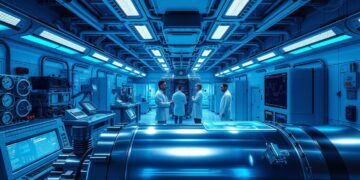
NASA is gearing up for long trips to the Moon and Mars. Feeding astronauts is a big challenge. Now, they rely on pre-made meals sent from Earth, but these meals spoil over time.
Space farming is a new solution. It combines space agriculture and food production in space to keep astronauts fed for years. Fresh food is key for their mental health and to prevent nutrient loss in stored food.
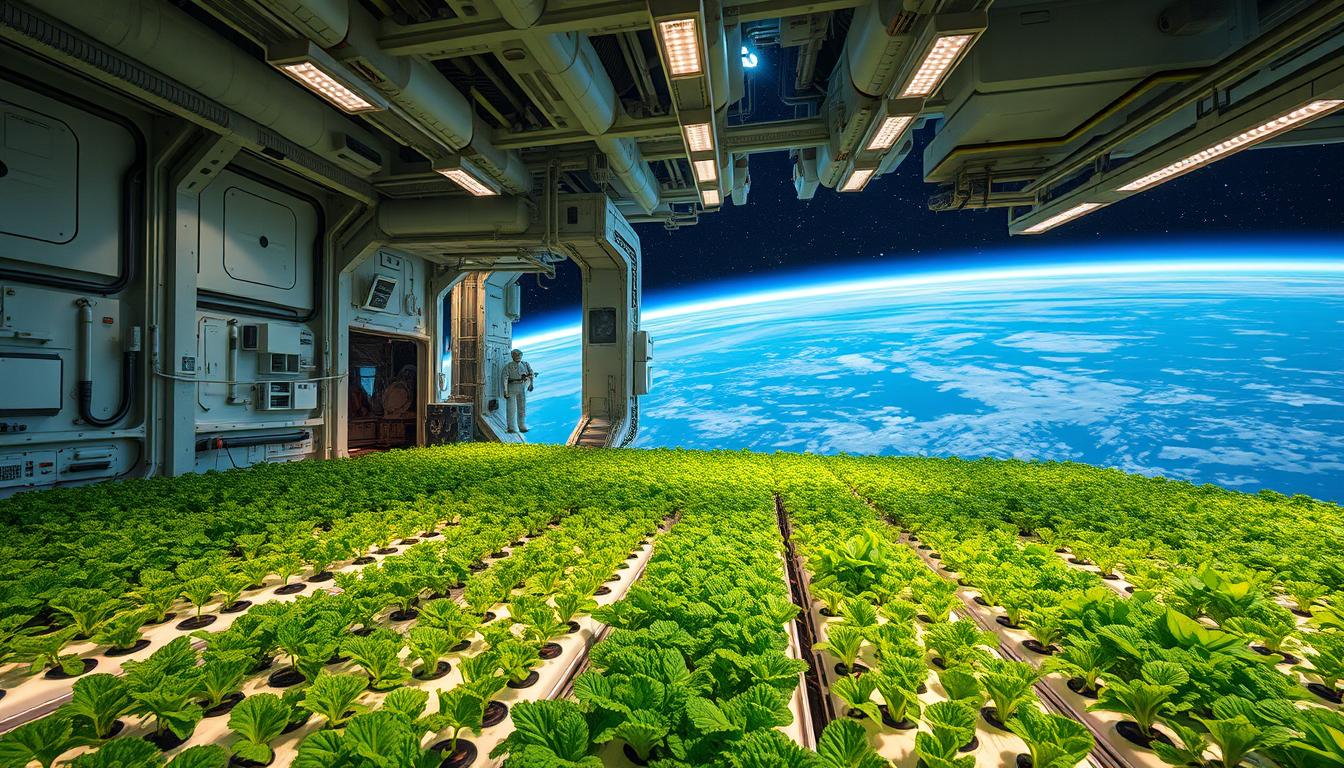
NASA’s Veggie unit is a small garden on the International Space Station. It grows lettuce and flowers, showing that astronaut nutrition can work in space. The Advanced Plant Habitat (APH) uses sensors to check on plant health, helping prepare for Mars colonies.
With missions needing 24,000 pounds of food for a crew of four over three years, space farming is vital. It’s not just for the future—it’s needed for survival off Earth.
What is Space Farming?
Space agriculture is about growing plants in space. It’s different from farming on Earth because it needs special techniques for microgravity and limited resources. Astronauts now eat prepackaged meals, but these meals lose nutrients over time, which is a problem for long missions.
Growing plants in space could offer fresh food and better health for trips to Mars or the Moon. This could be a game-changer for space travel.
Orbital gardening systems, like Veggie on the International Space Station (ISS), use hydroponics. This method delivers nutrients without soil. These systems try to mimic sunlight and manage water flow in zero gravity.
Experiments show lettuce and peppers can grow well in space. This proves that growing plants in space is possible. But, there’s a big challenge: water doesn’t move naturally without Earth’s gravity, which stresses plant roots.
There are efforts to make plant cultivation in space more sustainable. Projects like EDEN-ISS aim to grow crops using very little resources, even in harsh conditions. Success here could mean astronauts won’t have to rely on resupply missions for food on long trips. As we explore more of space, these systems could be key to sustaining life beyond Earth.
The Importance of Space Farming
Keeping astronaut health on long missions is key. Fresh food in space is more than a treat—it’s vital. Stored food’s nutrients fade, putting astronauts at risk of health issues like scurvy.
Research proves that fresh produce is packed with vitamins and minerals. This makes it critical for missions aiming to be self-sustaining in space.
“Caring for plants was a simple joy that reminded us of Earth,” said astronaut Jessica Watkins during the Veg-04A experiment. “Tending seeds felt like a small victory in the vastness of space.”
Growing plants also boosts mental health. The dullness of space can wear down crews. But, plants offer a link to nature.
Studies show that caring for plants lifts spirits and lowers stress. This is vital for teams on long space trips. Veg-05 showed that gardening in space is more than growing food—it’s about mental strength.

Without sustainable food, deep-space travel is limited. Fresh food in space cuts down on the need for resupply missions. This saves money and allows for longer trips.
Every plant grown in space brings us closer to living beyond Earth. It’s not just farming—it’s a step towards a future where humans thrive in space.
How Space Farming Works
Space station agriculture uses special plant growth systems in space because there’s no gravity. NASA’s Veggie system is like a suitcase. It has “pillows” filled with clay and nutrients for plants to grow in.
These pillows act like soil, letting roots grow in space. The Advanced Plant Habitat (APH) is even bigger. It controls light, temperature, and humidity to help plants grow well.
Microgravity farming faces challenges like water not dripping from leaves. Veggie uses LED panels to help plants grow. These panels give the right light for photosynthesis.
Plants like lettuce can grow in these conditions. But, future systems aim for higher-yield crops. Engineers also test rotating habitats to mimic gravity. This helps roots grow right.
These efforts are key for sustainable space station agriculture. They help us prepare for long missions and even Mars colonies. Every leaf grown in space brings us closer to living there independently.
Challenges in Space Farming
Space farming has unique challenges due to microgravity. Plants rely on Earth’s gravity to grow, but in space, this doesn’t work. NASA’s PESTO experiments showed wheat grew taller in space but faced oxidative damage.

Water delivery is also a problem. Without gravity, water droplets stick to roots or form air pockets. NASA uses a passive nutrient delivery system to solve this, but it’s hard to scale up.
Lighting and nutrients are also big challenges. The lunar soil lacks nutrients, which are expensive to process. Closed-loop systems must recycle water and nutrients efficiently. Sensors like the University of Illinois’ stretchy tech help track plant health without bulky equipment.
Notable Experiments in Space Farming
NASA’s Veggie system has led groundbreaking space station plant experiments. It shows plants can grow well in space. Astronauts grew lettuce, Chinese cabbage, and even zinnias. Red Russian kale showed how light and water help plants grow.
These plant growth experiments on the ISS showed how crops adapt to space. Peggy Whitson harvested Tokyo Bekana cabbage in 2016. This was a big achievement.
“The peppers tasted fresh, just like on Earth,” crew members said after 2021’s chili harvest. The Advanced Plant Habitat’s ISS crop production milestones include chile peppers. This marks progress toward sustainable space diets.
Astronaut Mike Hopkins’ 2015 transplant of struggling lettuce sprouts showed hands-on problem-solving in microgravity.
Budweiser’s barley studies tested germination in space. The ISS Cotton Sustainability Challenge explores eco-friendly crop methods. These space farming research efforts also include Tomatosphere™, letting students study seeds flown to the ISS.
Each experiment builds knowledge for long-term missions. It blends science and practicality to grow food beyond Earth.
Space Farming Technologies
Hydroponic and aeroponic farming are key in space. NASA’s Veggie system grows lettuce with 100% success. The Advanced Plant Habitat (APH) takes care of tomatoes and radishes in space.
These systems tackle space challenges like water in microgravity. They make sure plants get what they need.
The Passive Orbital Nutrient Delivery System (PONDS) feeds plants without soil. Hydroponics use 90% less water than Earth farming. Aeroponics spray nutrients on roots, a big step for space gardens.
The Leaf-β mission on the Moon will test these methods. It will see how plants handle space conditions.
Farmonaut’s AI helps crops and cuts waste, like in space. NASA’s Veggie and APH systems show plants grow 30% more in space. These advances could help Earth’s farms too, saving water in dry areas.
Over 50 crops have been tested on the ISS. The goal is to make Mars missions self-sustaining.
The Role of NASA in Space Farming
NASA’s plant research is key to space farming’s future. Their Veggie system, the size of a carry-on bag, has grown lettuce and kale on the ISS. It also grew flowers. This shows astronauts can have fresh food and scientists can study plant growth in space.
NASA works with schools through “Growing Beyond Earth.” Over 100 classrooms test growing plants in space-like conditions. Students help find plants that can grow well on the Moon and Mars.
The Advanced Plant Habitat (APH) uses 180 sensors to track plant growth. It helps improve growing plants for long missions. This research is vital for future space missions.
“Caring for plants in space is surprisingly calming—it feels like a connection to Earth.”
Experiments like DynaMoS study soil microbes in space. This is important for keeping ecosystems alive. NASA also tests how plants handle stress, like too much oxidation. This helps improve growing food in space.
NASA combines classroom learning with advanced technology. Each success brings us closer to living beyond Earth. It shows small steps today can help feed tomorrow’s explorers.
Environmental Considerations
Environmental care leads to sustainable space farming breakthroughs. In space, closed-loop systems recycle water, air, and nutrients to cut down on waste. Plants clean the air and water, making oxygen—a key part of bioregenerative systems.
These systems use 90% of water and nutrients, much like Earth’s ecosystems but on a smaller scale.

Recycling resources in space is not just useful—it’s essential. Plants like lettuce grown in space show growth isn’t stopped by microgravity. Yet, challenges like low nitrogen efficiency remain.
Scientists tweak nutrient levels to increase yields. For example, normal nitrogen levels help seeds germinate at an 85% rate. This shows we can find solutions to these problems.
These space farming methods also help Earth. They offer insights into fighting desertification and urban farming. The MELiSSA project, for example, tests algae-based cycles to reduce Earth resupply needs.
By studying plant changes, researchers aim to grow crops that can survive Mars’ harsh conditions or Earth’s degraded soils.
As we plan for long missions to Mars, sustainable practices are key to survival. Every plant grown in space teaches us to care for resources better, here and beyond.
Future of Space Farming
NASA has big plans for future space agriculture. They want to change how astronauts eat and live in space. They’re growing advanced space crops like tomatoes and peppers for Mars.
At Kennedy Space Center, scientists are testing berries and beans. These plants are full of antioxidants to protect astronauts from space radiation. They also aim to improve nutrition and reduce waste, making space missions more sustainable.
Genetic engineering for space is a game-changer. Dr. Norman Lewis’s team is working on plants that are easier to digest and compost. Their early tests show these plants grow 25% faster in space than regular ones.
This research could make Mars colony farming systems much better. It could cut down on the need for food from Earth by up to 30%.
The B.A.S.E. initiative is working on closed-loop systems for space. They use lunar and Martian soil, recycling water and waste. This could support long-term colonies.
LED lights and hydroponics are key to these systems. They use much less water and energy than traditional farming. This innovation could also help solve Earth’s food problems, like droughts and poor soil.
Imagine greenhouses on Mars using local soil and solar power. This future space agriculture could make science fiction a reality. It would feed astronauts and help solve environmental issues on Earth.
The journey to grow food in space is about survival and innovation. It’s about finding new ways to nourish life across the cosmos.
Educational Opportunities
NASA’s Growing Beyond Earth program links classrooms with real-world space farming. It started in 2015, letting students across the U.S. test crops in space-like habitats. Their work helps NASA improve space farming for future missions.

Teams like the Arizona-based Saguaro Snakes have made big contributions. They studied how microclover grows in zero-G, helping solve Mars colony challenges. These projects mix classroom learning with advanced science, showing how students can influence space agriculture careers.
There are more than just lab opportunities. The space agriculture market is expected to hit $11.51 billion by 2032. This growth creates jobs in engineering, biology, and tech design. NASA’s Veggie system and USDA partnerships offer internships, courses, and citizen science projects for students.
Schools can join the Growing Beyond Earth program online for free. They get guides and experiment kits. This combines traditional farming with space technology, preparing the next generation for Earth’s and space’s challenges.
Conclusion: The Future of Food Beyond Earth
Space exploration food systems are leading us to a new era. Growing food in space is now possible, thanks to NASA’s Veggie Project. This project has grown over 1,000 lettuce plants aboard the ISS.
These achievements are key for self-sufficient space colonies and Mars agriculture. Earth-dependent systems are not practical due to long resupply delays of over 200 days.
Technologies tested in space, like aeroponics and LED lights, are already helping Earth’s farms. NASA’s Advanced Plant Habitat and SpaceX’s Mars experiments aim to solve space challenges. They could also improve crops and urban farms on Earth.
Future missions to the Moon and Mars need self-sustaining ecosystems. NASA’s Artemis program plans to establish lunar bases by the 2030s. Automated greenhouses and genetically optimized crops will support these bases.
Partnerships between SpaceX and researchers will speed up progress. Funding for space research is expected to increase by 30% in the next decade.
Space farming is more than just survival—it’s a path to resilience. By growing food in space, we’ll not only feed explorers but also inspire sustainable practices on Earth. The journey to becoming a multi-world species begins with a single seed in zero gravity.