
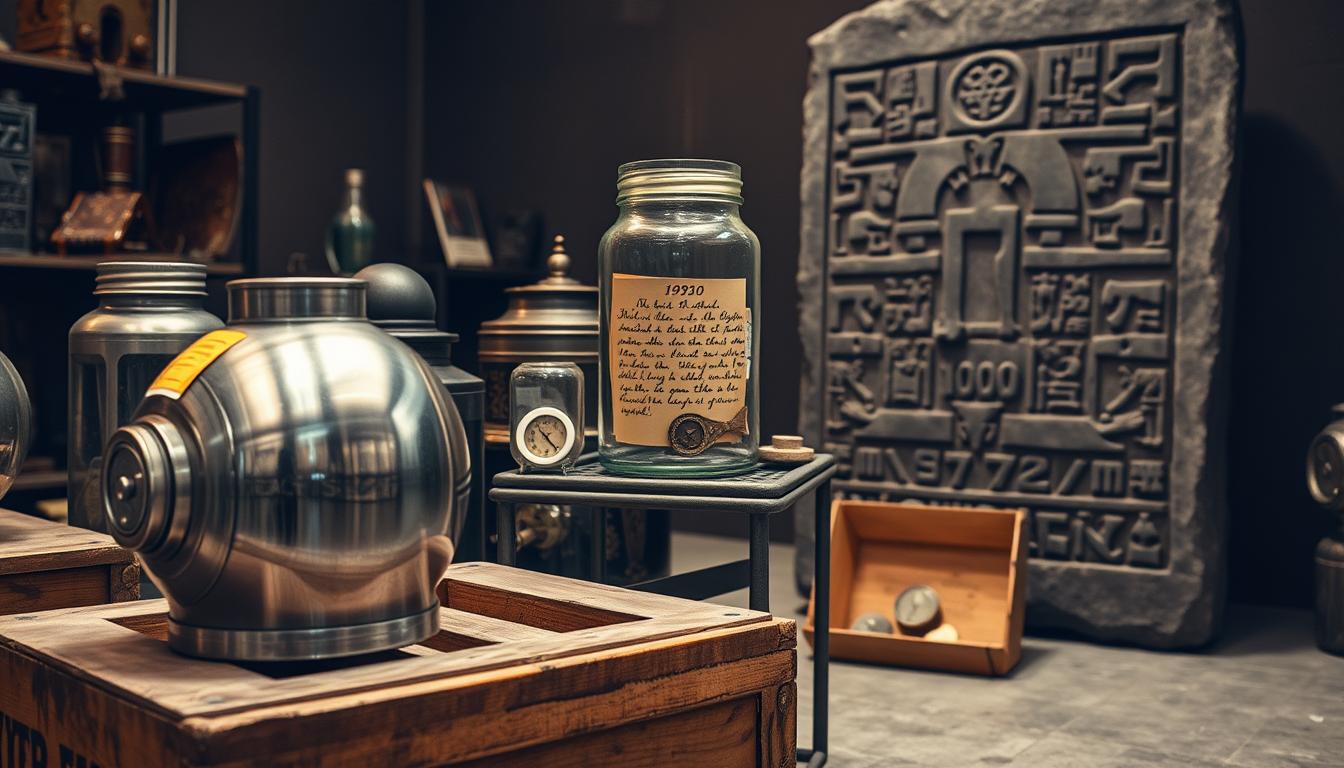
Time capsules have been a way for us to talk to the future. The first one, the “Century Safe” by Anna Deihm in 1876, had items like a gold pen and photos of President Ulysses S. Grant. This idea goes back thousands of years, even mentioned in the Epic of Gilgamesh.
Today, over 10,000 time capsules are buried, but 95% are forgotten by their fifth year.
Some finds are truly surprising. A 1944 time capsule in Lebanon, New Hampshire, had whiskey and a penny, plus a 1935 note predicting Mussolini’s plans. In Osaka, Japan, a 1970 Expo capsule had a Hiroshima survivor’s fingernail, a symbol of survival.
A 1795 time capsule by Samuel Adams and Paul Revere was found in 2014, after 219 years. These discoveries mix nostalgia with mystery.
From a student’s 1968 note “I am dead” in Albuquerque to a 6,970-year-old Osaka vault, these capsules connect past and present. The most unusual ones, like a survivor’s thermos diary or a 1.5-tonne box, share unique stories. What will future generations think of our world when they find these treasures?
What is a Time Capsule?

Time capsules are special collections of items and messages meant for the future. They are not like accidental finds but are intentionally left for others to find. The Epic of Gilgamesh, written on clay tablets around 2100 B.C., is one of the oldest examples. It had instructions for readers in Mesopotamia’s Great Wall of Uruk.
Today, we have time capsules like the Westinghouse ones buried in 1939 and 1964. They are meant to be opened in 6939 A.D. and contain seeds, microfilm, and everyday items. The International Time Capsule Society keeps track of these, making sure they are preserved as intended. Adrienne Waterman, the society’s chair, sees them as “guardians against collective forgetting,” protecting our cultural memories.
Good time capsules mix practical items with symbolic ones. The National Millennium Time Capsule in D.C. has a Berlin Wall fragment and a Twinkie. It shows how history and pop culture can be combined. Materials like copper or microfilm help them last, and clear dates like the 45-ton Seward, Nebraska capsule guide when they should be opened. These capsules turn everyday things into keys to the past for future generations.
The Oddest Time Capsules in History
Some unique time capsules are truly bizarre. Take Tulsa’s 1957 Plymouth Belvedere, a car buried as a time capsule. It had gasoline, beer, and tranquilizers in its trunk. The glove compartment had unpaid parking tickets and a $2.73 cash prize.
The car was sealed in a “nuclear-proof” vault for 50 years. But water got in, damaging it. Despite this, its mix of everyday items and odd relics made it memorable.

Not all oddest time capsules were successful. In New Zealand, a 1995 capsule was meant to hold historical documents but had only muddy water and a button. A Victorian pharmacy in Somerset was untouched for 78 years, preserving 1900s medicine bottles.
Even failures like the Michigan Capitol’s water-damaged 1873 newspapers show the challenges of preserving history. These oddities tell stories that only time could create.
A Secret Underwater Capsule: The Florida Keys
Imagine finding a time capsule not buried in soil but hidden beneath the waves. In the Florida Keys, divers uncovered an underwater time capsule that changed how we think about preserving history. It was placed 322 feet deep, where it was safe from erosion or human harm.
This hidden time capsule shows how extreme environments can keep secrets for decades. It’s a remarkable example of how the ocean can protect history.

Engineers used special metals and seals to withstand the pressure. At 100 feet, the pressure is 4x atmospheric. Saltwater, though corrosive on land, helped preserve items by blocking oxygen.
Scientists found handwritten letters and tools in better condition than many buried time capsules left on dry land. Divers faced risks like rapid ascents to recover items safely. They used methods tested in past deep-sea missions.
Why hide treasures underwater? The cold, dark ocean depths slow decay. Unlike buried capsules, which face soil acidity or digging, submerged capsules avoid these issues. The Florida Keys example proves the ocean’s power as a guardian of history.
As 95% of the ocean remains unexplored, who knows what other secrets lie waiting beneath the waves?
The 1940s Capsule in Time Square
In the heart of New York’s Times Square, a hidden relic from the 1940s lies buried. It’s a story of resilience. Commissioned during the 1939 World’s Fair, this historical time capsule was a joint effort by Westinghouse and fair organizers. It’s a bronze cylinder filled with over 20,000 items, from a dollar bill to seeds and microfilm.
Buried to show future generations “how life unfolded during war and progress,” it captures the 1940s spirit. It shows survival and innovation.

Inside, you’ll find everyday objects like ration coupons and movie tickets. There are wartime newspapers and photos too. A letter from then-Mayor Fiorello La Guardia calls it a “mirror of our age.”
This famous time capsule even includes a tiny vial of penicillin, showing medicine’s leap during the war. Plans are for it to stay sealed until 6939—over 5,000 years later. Yet, urban growth poses risks: subway expansion or construction might disrupt its rest.
Despite its fame, this time capsule remains unopened, preserving its time capsule discovery moment for millennia. Its contents, like a 1940s radio tube or a pack of Lucky Strike cigarettes, show the decade’s contradictions—both triumph and tension. As Times Square evolves, this buried artifact stays a silent witness to history, embodying the hope that future generations will someday uncover its secrets.
The 1996 Houghton College Time Capsule
In 1996, Houghton College buried a time capsule to celebrate its 100th year. Students, faculty, and staff picked items that showed campus life. This capsule, like others, became a mystery over time, but it holds a special place in the college’s history.
The time capsule had VHS tapes of campus events and letters from students. It also had a faded yearbook, a list of 1996 tuition, and a floppy disk. These items are now nostalgic reminders of college life in the 1990s.
Years went by, and people forgot where the capsule was. But in 2010, a search found it again. This rediscovery made the capsule a symbol of connection between past and present. Now, the college is deciding whether to open it or keep its secrets for future students.
The capsule is more than just relics for Houghton. It’s a living piece of history. Its story shows how time capsules connect past traditions with future curiosity.
The Mysterious Capsule of 1938
In 2016, workers in Vermont found a hidden time capsule inside a statue of Ceres. The statue is of the Roman goddess of agriculture. The small copper box, buried in 1938, had newspapers, photos, and coins.
These items showed life just before World War II. This find made people curious about historical time capsules from that time.
“Only 1 out of every 1,000 time capsules is ever found,” noted the International Time Capsule Society, highlighting how many remain buried or forgotten.
In 2016, the 1938 Westinghouse Time Capsule was sealed near the 1939 New York World’s Fair. It had everyday items like a Kewpie doll and microfilm of the Bible. It was meant to last for 5,000 years.
Yet, its contents, meant to show “modern life,” made people wonder what future generations would value.
That same year, Oglethorpe University’s Crypt of Civilization was sealed in 1940. It shared the urgency of that time. Both projects were made as nations faced rising tensions.
They showed a common worry about saving culture before it might be lost. The Vermont discovery, though small, shows the same desire to capture moments for the future.
Experts wonder why creators of historical time capsules often kept their messages secret. Did they fear their messages would disappear? Or did they hope future societies would find and understand their hopes and fears?
As new capsules like the Crypt of Civilization’s 8113 opening date approach, the 1938 Vermont find reminds us. Every buried box has a story to tell—and sometimes, it’s found by chance.
Famous Time Capsules and Their Mysteries
Some famous time capsules have become legends for their intriguing stories. Take the 1795 Boston State House deposit by Paul Revere and Samuel Adams. This unique time capsules relic held coins, newspapers, and a Washington medallion. Rediscovered twice, it guards secrets like what was added in 1855. Historians debate if its layers reveal more about the past or future.
The 1979 Napa Valley capsule surprised experts with its wine and business cards. The 1907 Paris Opera capsule unveiled 19th-century tech like a typewriter. Even modern ones like Yahoo!’s 2006 digital time capsule, with 170k entries, sparks curiosity about how today’s trends will look decades later.
Mysteries linger: The 1894 Scottish capsule’s whiskey bottle contrasted with others’ dry records. The 1944 Lebanon capsule’s missing whiskey note and the 1934 Arlington capsule’s WWI trench lighter hint at human quirks lost to time. Each time capsule mystery invites us to ponder what future generations might find—and misinterpret—about our world.
From 5,000-year Japanese capsules to the 50,000-year KEO satellite, these sealed relics turn history into a game of anticipation. Every discovery, like the cracked MIT capsule rescheduled for 2957, reminds us that time’s passage is both a puzzle and a promise.
How Time Capsules Are Made Today
Modern time capsules combine advanced science with personal stories. They use stainless steel or waterproof containers to last long. Amazon offers kits for families or schools to make their own, priced from $26 to $68.
Digital storage has changed how we keep memories. Sites like Trust & Will store emails, videos, and voice notes safely. FutureMe.org even lets you send emails to your future self, with over 140,000 messages stored.
But, keeping today’s formats like JPEGs or MP3s readable for centuries is a big challenge.
Archivists today mix old and new methods. The White House Millennium Time Capsule, buried in 1999, had a WWII helmet and Ray Charles’ sunglasses. It also had a 2000s cell phone.
Today, creators use silica gel packets and airtight seals to keep things fresh. Schools and libraries use glass jars with acid-free paper to protect items like drawings or pandemic masks.
Whether it’s physical or digital, today’s time capsules aim to capture life’s moments. They bridge generations with science and creativity.
Future Time Capsules: What Will We Leave Behind?
As technology gets better, future time capsules will mix old traditions with new ideas. Japan’s century-long capsules, like those buried in 1970 to open in 2070, show how updates keep culture alive. NASA’s Voyager Golden Records, launched in 1977, already share Earth’s story with space—showing modern time capsules can reach far.
Today’s time capsules focus on lasting a long time. The Future Library in Norway collects stories every year, with books kept until 2114. Lunar Mission One plans to send messages to the moon in 2024. These efforts show how today’s makers mix creativity with science to make sure messages last.
Choosing what goes into time capsules is important. The Rosetta Project’s 1,000-language disk and Sweden’s environmental samples show the value of diverse materials. But, items like food or rubber bands can spoil, like the Scotts found with 1920s newspapers during repairs. Experts suggest avoiding perishables and using high-quality paper instead.
Future historians will study these capsules to understand our time. The International Time Capsule Society advises against burying capsules, citing lost ones like MIT’s 1957 box now under a particle accelerator. Instead, keeping them safe and using strong materials helps messages last.
What will mark our era? From climate data to digital art, every choice shows our world. Like Samuel Adams’ 1795 capsule in Boston, today’s efforts will speak across centuries. Will your generation’s legacy include a viral meme, a climate treaty, or a photo of a loved one? The future will judge what we choose to remember.