
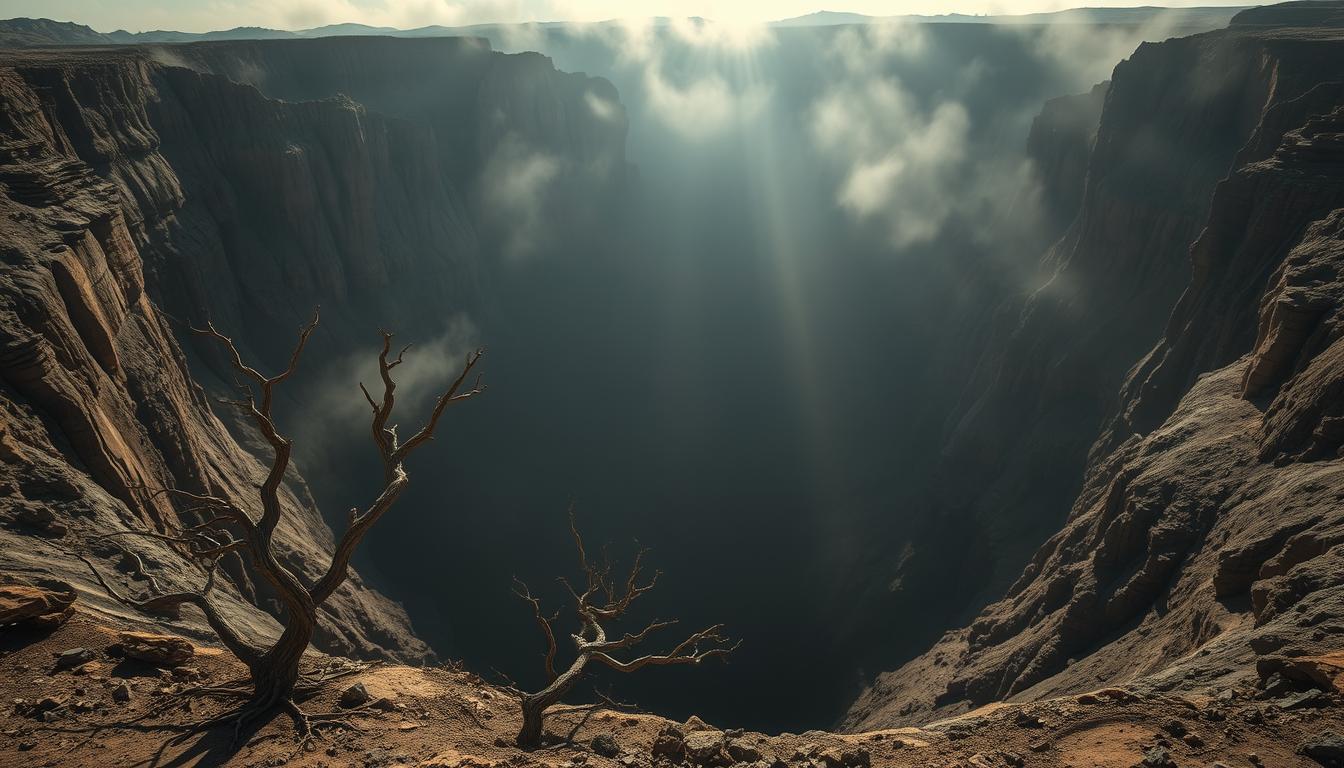
Nature’s most dramatic massive holes in the ground show Earth’s hidden power. The deepest sinkholes like China’s Xiaoxhai Tiankeng are 660 meters deep. They have a volume of 130 million cubic meters.
Mexico and Belize’s Taam Ja’ Blue Hole is now confirmed deeper than 420 meters below sea level. These giant sinkholes amaze scientists and explorers. They vary greatly, with some dropping hundreds of meters and others covering city block-sized areas.
Xiaoxhai Tiankeng, the world’s deepest sinkhole, is much deeper than Guatemala’s 2010 disaster. That disaster was a 90-meter-deep crater that shocked everyone. The Taam Ja’ Blue Hole, now confirmed over 400 meters deep, is in the ocean’s mesopelagic twilight zone. It challenges exploration limits.
Even urban areas aren’t safe. The 2016 Florence sinkhole in Italy became a 200-meter-wide spectacle. The 2014 National Corvette Museum sinkhole in Kentucky swallowed eight classic cars. These largest sinkholes in the world are not just curiosities—they’re urgent scientific puzzles.
From the Bahamas’ Dean’s Blue Hole to South Africa’s Boesmansgat, these formations hint at Earth’s hidden geology. The 2022 Tierra Amarilla sinkhole in Chile grew to 50 meters wide in days. This shows how quickly massive holes in the ground can form.
Each sinkhole tells a story of erosion, water, and shifting rock. They remind us of our planet’s dynamic forces. As we explore these wonders, their depths hold secrets waiting to be uncovered.
What Are Giant Sinkholes?
Imagine a hole carved by nature over centuries. Giant sinkholes are massive depressions or holes formed through sinkhole formation processes. These wonders arise from karst processes where water dissolves limestone, creating underground voids. Limestone sinkholes are common in regions like China’s Guangxi province, where over 200 giant sinkholes, called tiankengs, exist. The Leye tiankeng, for instance, plunges 192 meters deep and holds a forest older than many ancient trees.
Scientists classify sinkholes by how they form. Collapse sinkholes happen when bedrock caves in suddenly. Cover-subsidence sinkholes grow slowly as soil sinks into cracks. Blue holes, underwater versions, hide beneath oceans or lakes. The 2020 discovery in Leye County revealed a 630-foot-deep sinkhole with trees taller than 100 feet, showing how ecosystems thrive in these voids.
Regions like Florida and China’s karst landscapes are hotspots. About 20% of U.S. land and 13% of China’s terrain host these formations. These natural marvels aren’t just gaps in the ground—they’re time capsules preserving rare species like flying squirrels and ancient plant varieties. Understanding their science helps protect these fragile environments for future exploration.
Famous Giant Sinkholes Around the World
Earth’s surface holds secrets like the famous sinkholes that change landscapes and amaze us. Asia’s Xiaozhai Tiankeng is a standout with its 2,200-foot depth. It’s a double-crater wonder home to clouded leopards and ancient trees.
This tiankeng, or “heavenly pit,” has a unique ecosystem. It’s a place where life thrives in a way we rarely see.
“Tiankeng’s cliffs plunge into a netherworld of biodiversity,”

Underwater wonders like the blue holes add to their allure. The Great Blue Hole in Belize is a 984-foot-wide marine marvel. It contrasts with the South China Sea’s Dragon Hole, the deepest submarine sinkhole.
These sites attract divers but are also dangerous. Dahab’s Blue Hole has claimed over 130 lives, showing their beauty comes with a price.
Mexico’s cenotes of Mexico turn the Yucatán Peninsula into a cave explorer’s dream. The Yucatan sinkholes like Sistema Sac Actun stretch over 170 miles. They hide Mayan artifacts.
On the other hand, the Hranice Abyss in the Czech Republic drops 454 feet. Its depths hold secrets of ancient climates.
From Croatia’s Crveno Jezero (Red Lake) to Guatemala’s sudden urban chasms, these formations are both dangerous and fascinating. Each famous sinkhole tells a story of erosion and survival. They reshape our planet’s face, one crater at a time.
The Largest Sinkholes in the United States
Florida’s sinkhole alley runs between Tampa and Orlando. This area is at high risk due to its soft limestone bedrock. The Devil’s Millhopper, near Gainesville, is a huge bowl-shaped pit. It’s a National Natural Landmark where visitors can explore ancient limestone walls.
In 2014, a sinkhole at the National Corvette Museum in Kentucky took eight classic cars. This shows that sinkholes in America can happen anywhere. The Bayou Corne sinkhole in Louisiana, caused by drilling, forced people to leave in 2012. The 1980 Lake Peigneur disaster in Louisiana turned a freshwater lake into saltwater after a drilling accident.
The Golly Hole in Alabama is 325 feet long and 120 feet deep. In 2023, a soccer field in Illinois was swallowed by a sinkhole over a limestone mine. Texas saw a 2008 oil field sinkhole grow again in 2023. These incidents show how sinkholes in America affect both nature and people. Florida alone has thousands of sinkholes every year, causing over $300 million in damages nationwide.
Human actions increase the risk of sinkholes. Most subsidence cases come from groundwater depletion or mining. Even small tremors, like a freeze in 2010, caused over 110 sinkholes near Dover, Florida. While deaths are rare, a 2013 collapse near Tampa was fatal. A 2023 Florida sinkhole reappeared but didn’t harm anyone.
The Deepest Sinkholes on Record

Xiaozhai Tiankeng in China is the deepest land-based deepest sinkholes, dropping 662 meters into the earth. It’s also 511 meters wide, making a huge underground space. This space holds 130 million cubic meters of air and rock.
The Taam Ja’ Blue Hole off Mexico’s coast is the deepest underwater underwater sinkholes, reaching over 420 meters. Its bottom is uncharted, suggesting it could be even deeper. This makes it a strong contender among record-breaking sinkholes.
Scientists used CTD profilers to study the Taam Ja’ Blue Hole. They found it’s deeper than the 300-meter Dragon Hole in the South China Sea. On land, the Hranice Abyss in the Czech Republic goes down 404 meters. It might have hidden chambers.
Explorers use ROVs to explore these voids. The Xiaozhai Tiankeng and the Taam Ja’ Blue Hole are mostly unexplored. They hold secrets about Earth’s geology. As technology gets better, we might find even deeper sinkholes.
The Environmental Impact of Sinkholes
“Tiankeng means the ‘The Heavenly Pit’, and its sheer sides plummet to a veritable netherworld that’s home to a thriving ecosystem of some 1,285 plant and animal species – including the rare gingko and clouded leopard.”
Sinkholes like China’s Xiaozhai Tiankeng are home to unique biodiversity. But their impact goes beyond just hosting rare species. Sinkholes near human activity can lead to disasters. In Florida, a 220-foot-deep sinkhole leaked 215 million gallons of polluted water into the groundwater.
This 2023 incident was similar to a 1997 spill that killed millions of fish in the Alafia River. Such events show how sinkholes can contaminate water, threatening our drinking water and marine life.
Sinkholes can also cause habitat loss by fragmenting forests or wetlands. In Florida, a 1994 spill and a 2004 hurricane destroyed 150 acres of mangroves in Tampa Bay. These disruptions stress ecosystems and alter food chains.
Acidic waste mounds in Florida pose a long-term danger, slowly leaking toxins into the soil. Scientists say we need to act now. We must monitor groundwater systems linked to sinkholes to prevent contamination.
As seen at the Taam Ja’ Blue Hole, these pits connect to larger hydrological networks. This makes contamination a regional crisis. We must find a balance between preserving biodiversity in sinkholes and protecting communities.
Safety Concerns Related to Giant Sinkholes
Urban sinkholes are a big danger to communities everywhere. In 2010, a sinkhole in Guatemala City swallowed a three-story factory. This shows how fast and deadly these collapses can be. Similar disasters, like the 2007 Guatemala City sinkhole, were caused by sewage failures.
Cities like Bayou Corne, Louisiana, had to evacuate when a sinkhole hit in 2012. This displaced people and damaged buildings. It’s clear that sinkholes can cause a lot of harm.
To fight these dangers, scientists use sinkhole prediction tools. They use ground-penetrating radar and satellite imaging to find underground changes. But, fast-growing cities in areas like Florida’s limestone bedrock need constant monitoring.

Florida’s history shows the risks. There, over 16,000 sinkholes have been found, showing where dangers lie. In Missouri, 55% of the land is at risk, but many incidents go unreported.
When cities grow without thinking about the land, sinkholes can form faster. This puts lives and buildings at risk. It’s important to plan carefully to avoid these dangers.
Prevention means smart planning. In Florida, buildings must be checked for geologic risks before construction. There are also public warnings about sinkhole dangers, like cracks in foundations.
Even with science helping, sinkholes can be unpredictable. This means we must always be ready and watchful in areas at risk.
Scientific Research on Sinkholes
Scientists use advanced tools like ROVs and specialized sonar for sinkhole mapping and cave exploration. Techniques like LiDAR and CTD profilers reveal hidden details of underground systems.
Research teams now plan to deploy robots and submarines to map the Taam Ja’ Blue Hole, overcoming earlier challenges in navigating treacherous underwater passages.
Studies of karst geology explain how water dissolves bedrock, creating voids that lead to collapse. Hydrogeology research tracks groundwater flow, which is key for predicting sinkhole risks. In China’s Xiaozhai Tiankeng, underwater cave research found unique ecosystems in its 2,000-foot depths.
Sinkhole research also explores paleoclimate clues in sediment layers. By studying these features, experts link human activities like irrigation to increased sinkhole formation. Innovations like 3D modeling help visualize connections between surface and underground systems.
Despite progress, many questions remain. How do karst geology processes interact with urban development? Can new tech like AI improve sinkhole mapping accuracy? These questions drive ongoing projects worldwide, pushing the boundaries of earth science and exploration.
Legends and Folklore Surrounding Sinkholes
Sinkhole myths are found all over the world. They turn natural wonders into mysterious doors. The Maya saw cenotes like Chichen Itza’s Sacred Cenote as gates to the underworld. They made cenote sacrifices and offered things to honor their gods.
Archaeologists found jewelry, weapons, and even human remains in these sinkholes. This shows the ancient Maya sinkhole rituals.
In northern England’s Boggart Hole Clough, sinkhole legends speak of spirits called Boggarts. They say these spirits live in the 200-acre site. A beech tree buried roots-up is said to mark their lair.
On the other hand, Turkmenistan’s “Door to Hell”—a flaming sinkhole—fuels modern myths. It’s seen as a fiery gateway.
“Boggarts are solitary spirits that dwell in sinkholes,” according to Northern folklore dating back five centuries.
Kansas also has its own sinkhole legends. In 1952, people said “Sink Hole Sam” came out of a 15-foot-long depression. Though there’s no proof, the story has sparked merchandise and podcasts. It shows how nature’s oddities spark our imagination.
The Role of Climate Change in Sinkhole Formation
Climate change and sinkholes are now closely linked. Changes in weather patterns create conditions that lead to these hazards. Drought and heavy rain both cause the ground to collapse.
Dry soils expose unstable rock layers, leading to sinkholes. Heavy storms flood weak areas, making sinkholes more common in places like Florida’s karst landscapes.
Sea level rise puts more pressure on coastal sinkholes. Saltwater makes limestone dissolve faster, creating new dangers. Florida’s Gulf Coast and the Yucatán Peninsula face increased risks as seawater invades freshwater.
Coastal sinkholes are forming at alarming rates, threatening homes and ecosystems.
“Climate shifts are rewriting the rules for sinkhole safety,” warned researchers Maria Torres in a 2023 study, noting how rising seas and storms amplify risks. “Communities must adapt to these new realities.”
Extreme weather and sinkholes are now linked in scary ways. Drought-stricken areas experience ground subsidence, while hurricanes cause sudden collapses. Scientists see a rise in sinkhole frequency in dry zones like the Mediterranean.
With climate models predicting more intense storms, we need to act fast. Managing these threats is urgent.
As temperatures rise, we must adapt to these changes. This includes smarter land-use and monitoring. Coastal and inland sinkholes show our planet is changing, with climate change and sinkholes reshaping our ground.
How to Prevent Sinkholes
Effective sinkhole prevention begins with knowing the land. Subsurface mapping uses radar or boring tests to find hidden voids. Builders in karst areas should use karst-aware construction like deep pilings to avoid unstable ground.
Proper groundwater management is also essential. Grade soil at a 5% slope to drain water away from homes. Fixing leaking pipes is also important. Avoid using gravel in fill materials to prevent collapse.

Sinkhole mitigation includes filling weak spots with grout or compacting soil. Homeowners in high-risk areas like Florida or Kentucky should check their sinkhole insurance coverage. Policies vary by state.
Sealing old wells or septic tanks stops erosion. Updating aging pipelines also reduces risks. Old systems often cause collapses.
Proactive steps like subsurface mapping and regular inspections save money in the long run. Local agencies, like the Fairfax County Health Department, help with abandoned well removal. Staying informed and following geotechnical advice helps avoid damage from these hazards.
Conclusion: The Fascination with Giant Sinkholes
Giant sinkholes amaze us as geological wonders and natural phenomena. The Qattara Depression and Venezuela’s Sarisarinama Sinkholes show Earth’s hidden surprises. The Dead Sea and Florida’s sinkholes, like the 325-foot Golly Hole, display their power.
Today, geological research and earth sciences use advanced tools. Robots and submarines explore places like the Taam Ja’ Blue Hole. These efforts aim to understand sinkhole formation and predict collapses.
Sinkhole tourism is also growing, attracting adventurers to places like Mexico’s cenotes. Scientists are working on warning systems to protect communities. Yet, challenges persist, like the impact of human activities on land subsidence.
Even as we learn more, sinkholes remind us of Earth’s complexity. It’s important to balance exploration with conservation. This way, these geological wonders will be preserved for future generations to study and enjoy.