
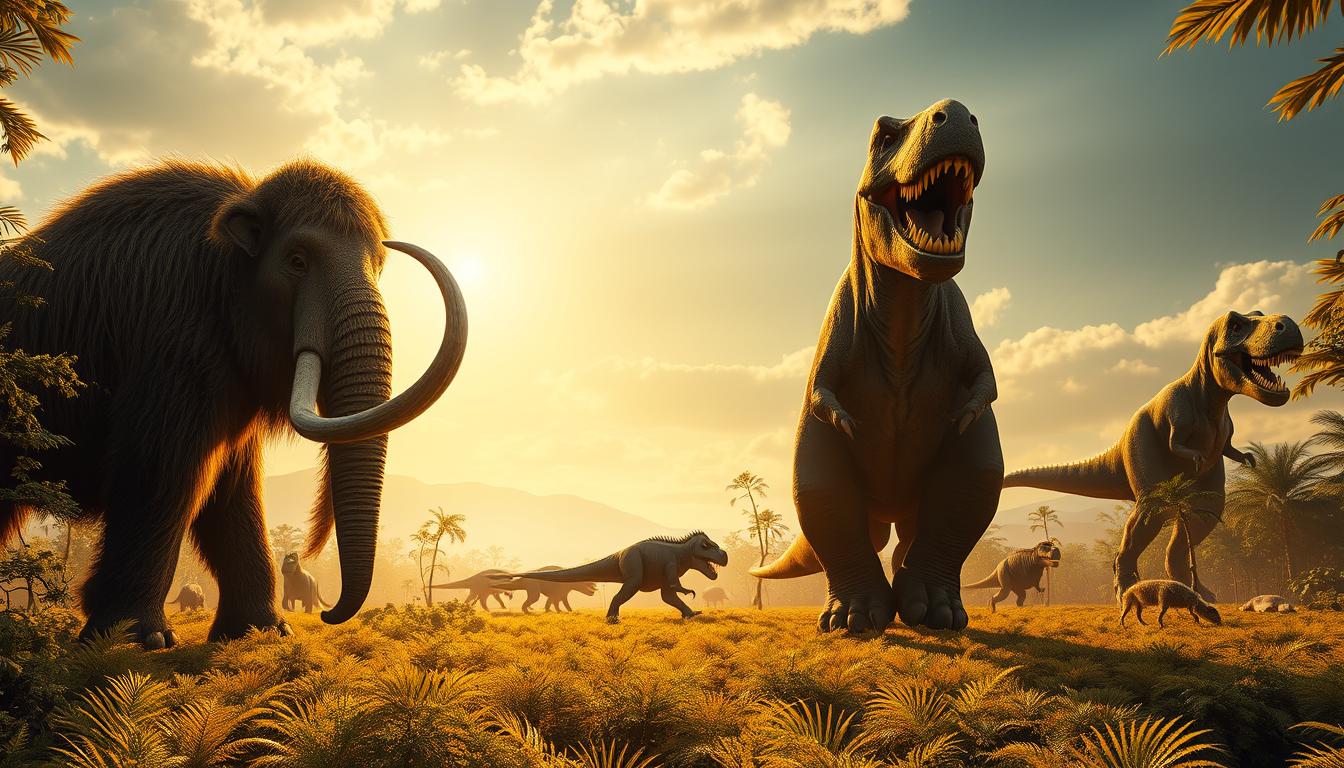
Long before humans walked upright, ancient creatures shaped Earth’s landscapes. Animals like woolly mammoths, 12 feet tall, and saber-toothed cats, 750 pounds, ruled the earth. These giants, such as the 60-foot-long Basilosaurus and 10-foot Komodo dragon ancestors, lived in a world far different from ours.
Ice age animals like giant sloths, weighing 2,200 pounds, lived alongside early humans. They left fossils that tell us about their lives and disappearances.
From car-sized Glyptodonts to dragonflies with 28-inch wingspans, these creatures left a mark on Earth. Human arrival 2 million years ago met species like Arctodus smilus, a 12-foot-tall bear that hunted daily for 35 pounds of meat. Learn how these animals, now part of Earth’s history, reveal clues about climate change, human impact, and ancient ecosystems.
What is Prehistoric Megafauna?
The megafauna definition refers to animals over 45 kg (99 lbs) that lived during the Pleistocene. These prehistoric large animals included giants like woolly mammoths and saber-toothed cats. They thrived in various environments, from cold tundras to warm forests, for millions of years.

Many extinct large mammals, like giant bears and mastodons, disappeared by 10,000 years ago. Their loss changed ecosystems, as they shaped habitats through grazing and spreading seeds. Ice age giants like woolly rhinos and dire wolves are examples of species lost in this extinction.
Scientists look at their fossils to understand climate changes and human effects. Even now, fossils tell us about these massive creatures’ past lives. They left a lasting mark on Earth’s history.
Notable Species of Prehistoric Megafauna
Imagine a world where bears were as tall as modern elephants and tigers had fangs as long as a kitchen knife. The giant short-faced bear was 14 feet tall on its hind legs and weighed over a ton. It hunted with speed and power.
The saber-toothed tiger had 7-inch canines and could open its jaws to 130 degrees. It used these to take down prey. The woolly mammoth was a gentle giant, with 15-foot tusks and a height of 12 feet, dwarfing today’s elephants.
The giant ground sloth was 20 feet long and weighed 3,000 pounds. Its claws were three feet long, used for stripping leaves, not fighting. In the oceans, megalodon was the top predator, reaching 50 feet in length with teeth the size of a human hand. It hunted whales as easily as a cat plays with a toy.

Even plant-eaters were huge. Prehistoric rhinos like Paraceratherium were 16 feet tall and weighed 17 tons, the largest land mammal ever. Giant beavers and other relatives also existed, their sizes beyond what we can imagine today. Their fossils tell us about a world that once was, full of life beyond our dreams.
The Evolution of Megafauna
The evolution of megafauna changed ecosystems as gigantism in mammals became key to survival. During the ice ages, animals like the woolly mammoth grew thick fur and fat. The giant ground sloth reached 12 feet tall to reach high plants.
These traits helped them survive in the cold, following Bergmann’s rule. This rule says bigger animals can handle colder temperatures better.
Adaptations in prehistoric animals were extreme. Saber-toothed cats had seven-inch canines for quick kills. Dire wolves had 12-inch skulls for strong bites.
The cold climate favored special traits. The woolly mammoth had subcutaneous fat and small ears to keep warm. These traits allowed the 3,000-pound ground sloth to rule North America until it mysteriously disappeared.
Body size varied by region, showing different ecological niches. In South America’s Gran Chaco, moist habitats supported large herbivores. Plants evolved defenses like spiny leaves and dense wood to fight grazing.
This led to an evolutionary battle. Today, fossils like Arizona’s ground-sloth dung show how these giants shaped landscapes. They left marks on biodiversity and ecological balance.
The Role of Megafauna in Ecosystems
Prehistoric giants like Scutosaurus and mammoths changed landscapes with their size and actions. A mammoth’s daily food needs of over 300 pounds turned forests into open grasslands. Their poop spread nutrients, helping plants grow, and their footprints made homes for amphibians.
These huge animals played a key role in keeping ecosystems balanced. They were essential for the health of prehistoric food webs.

Predators like Anomalocaris kept herbivore numbers in check. This prevented forests from being overgrazed and helped plants survive. Without these predators, ecosystems could collapse, like when sea otter hunting led to sea urchin explosions, harming kelp forests and starving Steller’s sea cows.
Megafauna also helped plants spread by carrying their seeds. This allowed plants to grow in new areas. Without these animals, plants may not have the genetic diversity they need to thrive.
“Losing megafauna is like removing a keystone—the whole arch collapses,” said extinction ecologist Felisa Smith.
The impact of megafauna went beyond just biology. Their grazing helped keep Arctic forests from growing, reflecting sunlight and cooling the Earth. Today, projects like reintroducing bison aim to mimic these effects. But, ecosystems are missing the megafauna’s influence: Amazon nutrient levels have dropped 90%.
Their legacy shows how these giants were not just animals but forces shaping Earth’s past. They offer clues for restoring its future.
Causes of Megafauna Extinction
TheQuaternary Extinction Eventled to the loss of 65% of large mammals worldwide. Scientists are unsure ifhuman impact on megafaunaorclimate change extinctioncaused this crisis.

When humans arrived in the Americas 13,000 years ago, 72% of megafauna disappeared. Tools from the Clovis era and hunting sites suggest overkill was a factor. Yet, rapid cooling 12,800 years ago also disrupted habitats, but Africa’s megafauna survived better due to long-term human coexistence.
Thequaternary extinction eventresulted in 100% loss of giants in Australia and the Americas. While debates continue, evidence points to human arrival as a cause. Hunting, climate shifts, and disease all played roles in this ancient ecological shift.
Regions like North America lost 80% of megafauna as humans expanded. This shows howhuman impact on megafaunaled to extinctions. Today, most agree it was a mix of factors that reshaped Earth’s ecosystems.
Discoveries in Paleontology
Paleontological discoveries are rewriting Earth’s ancient history. In Australia’s South Walker Creek, fossils of giant kangaroos and 16 other species were found. These finds show that climate changes, not just humans, led to extinctions.
Excavations started in 2008 and have uncovered jawbones, teeth, and huge limb bones. These discoveries are changing how we see ancient ecosystems.
“This is a coelacanth! A fish thought extinct for 65 million years!” declared ichthyologist J.L.B. Smith in 1938. His shock echoed decades later with Siberia’s 2013 “Buttercup” mammoth excavation, where frozen blood and muscle tissue survived 40,000 years. Such finds fuel extinct animal reconstruction through 3D models and DNA analysis.
Modern technology is turning fossils into stories. CT scans look inside dinosaur skulls, and isotope tests show what they ate. In Alaska, 100-million-year-old footprints of a theropod were found. In Texas, fossils of aetosaur armor were discovered.
These discoveries, like the 15-meter Vasuki Indicus snake or the 4-meter Gaiasia salamander, show Earth’s past diversity. Each find, like the 274-kg giant kangaroo or the 25-meter ichthyosaur, proves science is always finding giants in rock and ice. Every fossil has a story waiting to be told.
The Significance of Megafauna in Culture
The tales of mammoths and saber-tooths live on through mammoth cave paintings and ancient animal folklore. In Lascaux’s chambers, 17,000-year-old murals show woolly rhinos and bison. These images suggest these animals were more than just food. They were symbols of power or spiritual guides, as seen in Spanish caves.
“Megafauna in mythology often blend reality and reverence,” note researchers. They point to Aboriginal Australian tales of the “mihirung paringmal”—a giant emu-like creature tied to the extinct Genyornis. Similar stories, like North American legends of earth-shaking monsters, may reflect encounters with fossils or lingering memories of long-vanished giants.
Today, the megafauna cultural impact is big in pop culture. Films like Ice Age and BBC’s Walking with Beasts make mammoths stars. Museums, from the American Museum of Natural History’s mammoth family displays to Australia’s megafauna exhibits, let us marvel at their legacy. Even extinct species like the glyptodon inspire art, reminding us of their lasting impact.
Modern-Day Relatives of Megafauna
Today, we find modern megafauna relatives with ancient DNA. African elephants, for example, are more closely related to mammoths than we thought. Studies show they diverged from mammoths 6 million years ago, similar to humans and chimps.
Modern sloths are a glimpse into their massive past. Today’s sloths are descendants of giant ground sloths, as big as elephants. They kept slow metabolisms from their giant ancestors, who roamed until 10,000 years ago. Even capybaras, a large rodent, are more like extinct giant beavers than modern beavers.
The spectacled bear in South America is a small but significant relative of giant short-faced bears. Dire wolves are genetically closer to jackals than today’s gray wolves. These discoveries show how some species adapted while others went extinct.
Elephants, rhinos, and hippos are the last of their kind. The coelacanth fish, thought to be extinct for 66 million years, was found alive in 1938. These living fossils give us insights into ancient worlds and how some species survived.
Studies of modern sloth ancestors and fossils show how size changed over time. Even small animals like the Andean bear carry genetic traits from Ice Age predators. These connections remind us of the enduring legacy of megafauna, found in jungles and labs alike.
Conservation Lessons from Megafauna
Looking into the past teaches us about the importance of saving big animals today. Over the last 50,000 years, big mammals disappeared, changing ecosystems. This left gaps that smaller animals can’t fill. Stuart Fiedel, an archaeologist, says, “The North America we know today is not a normal, natural landscape.” This shows how human actions change habitats.
“The earliest evidence of megafaunal decline shows how slowly reproducing giants are specially at risk,” say experts. Today, animals like elephants and rhinos face similar dangers. Efforts to restore ecosystems, like rewilding programs, aim to bring back lost roles. For example, wolves in Yellowstone show how top predators can balance nature, and scientists are looking to bring back mammoth relatives to revive old ecosystems.
Studies from 2013 show the big impact when big animals disappear. Without them, plants grow too much, soil gets less nutrients, and fires change. A study in Texas found that without big animals, ecosystems lost their complexity. This leaves gaps that need to be filled.
Now, we’re working to fill these gaps. Programs in Europe and Africa are testing how to bring back old ecological processes. Saving big animals and bringing back lost species could stop biodiversity loss. As we face the sixth mass extinction, learning from the past is key to avoiding lasting harm.
Fun Facts About Prehistoric Megafauna
Interesting megafauna facts show us how ancient creatures surprised us. Anomalocaris, a top hunter from the Cambrian era, was almost 3 feet long. It used claw-like mouthparts to catch its prey.
Arthropleura, a 9-foot-long millipede, roamed Carboniferous forests. It thrived in the oxygen-rich air of that time. Meganeura, a dragonfly with a 28-inch wingspan, also soared above.
Mammoth fun facts tell us woolly mammoths lived until 4,000 years ago. They even lived during the time of ancient Egyptian pyramid builders. Thomas Jefferson once thought Megalonyx fossils were from a lion, showing early paleontology’s oddities.
Glyptodonts, like modern armadillos, had strong shells. South Americans used them as shelters during storms.
Dunkleosteus, a 13-foot armored fish, could bite with 80,000 psi—strong enough to snap steel. Titanis, an 8-foot-tall terror bird, could run 45 mph. It used its beak as a weapon.
These facts show how ancient life shaped our world. Exploring these creatures teaches us about evolution’s creativity. Next time you see a rhino or eagle, think of their prehistoric cousins.