
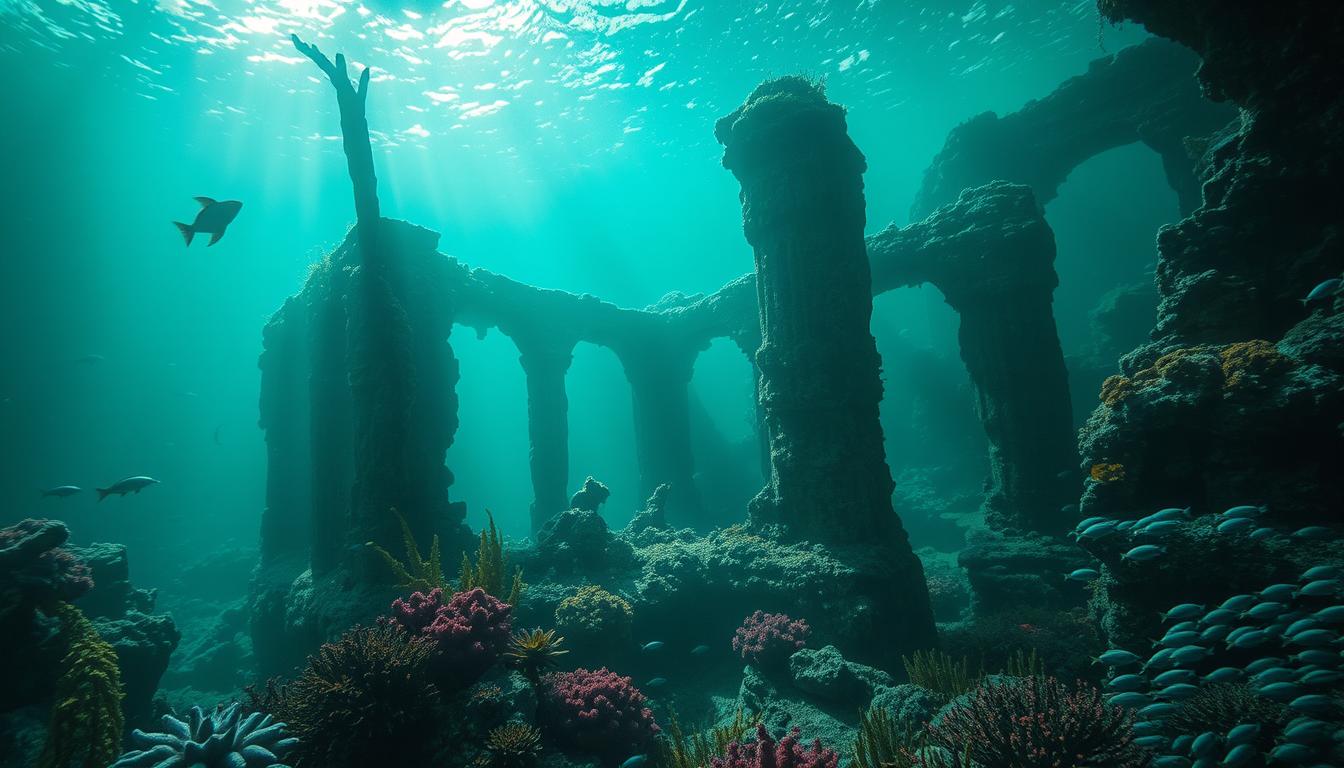
Bizarre underwater ruins and submerged ancient cities once thrived above sea level. Rising tides, earthquakes, and tsunamis buried entire civilizations. Now, over 2,600 such sites are hidden across 19 countries.
From the Cosquer cave’s 100-foot-deep entrance near Marseille to Pavlopetri, Greece—the world’s oldest known submerged city. These sites are a testament to the power of nature.
Underwater archaeology has unlocked these secrets. Modern tech reveals structures like Thonis-Heracleion, where Cleopatra’s-era coins and monolithic statues rest 30 feet deep. Pavlopetri’s 5,000-year-old buildings, found in 1967, show streets and courtyards now 13 feet underwater.
Earthquakes like the 365 A.D. disaster that hit Alexandria or tsunamis that drowned Helike in 373 B.C. reshaped coastlines. They buried thriving ports and trade hubs.
From Japan’s Yonaguni Monument—older than Egypt’s pyramids—to Pavlopetri’s Mycenaean-era ruins, these sites rewrite history. Each submerged ancient city tells a story of human ingenuity and the forces that submerged them.
This article explores how underwater archaeology uncovers these lost worlds. From Greece to Iraq’s Zakhiku, rediscovered in 2022 after droughts exposed its 3,400-year-old towers.
The Fascinating Discovery of Underwater Ruins
Exploring underwater archaeological sites is a precise and innovative task. Techniques like sonar mapping and robotic submarines uncover secrets deep in the ocean. These methods pinpoint the locations of submerged cities, from ancient trade paths to hidden temples.
Pavlopetri, Greece, is one of the oldest underwater sites. It’s 5,000 years old and lies just 9–13 feet underwater. Here, streets and pottery are well-preserved. Nearby, Cleopatra’s palace is 16 feet deep, holding treasures like gold hairpins.
These finds show how rising seas engulfed ancient settlements over time. Scientists have found over 2,600 underwater sites globally. France’s Cosquer Cave, for example, has 30,000-year-old paintings 100 feet under.
These paintings show early humans lived by the coast before the sea levels rose. Recent discoveries, like Mahabalipuram’s temples after the 2004 tsunami, reveal history. But, exploring underwater is tough due to dark waters and high pressure.
New technology, like 3D scanning, helps map ruins safely. Each find, like China’s 2,000-year-old Fuxian Lake structures, adds to our knowledge of ancient civilizations. These efforts are rewriting our view of human history.
The Atlantis Legend: Truth or Myth?
For over two millennia, the story of Plato’s Atlantis has sparked debate. The ancient Greek philosopher first described it in Timaeus and Critias as an Atlantis underwater city swallowed by the sea. Plato’s account described a powerful empire ruling over parts of Europe and Africa, destroyed by natural disasters. But was this a real lost civilization of Atlantis or a moral fable?

Modern sunken island theories suggest possible real-world inspirations. Some link Atlantis to the Minoan civilization, which collapsed after a volcanic eruption near Santorini in 1600 B.C. Others point to the Black Sea Flood or Spain’s Doñana wetlands. Yet no physical evidence confirms these claims—only Plato’s writings survive.
“A myth? Or a warning against hubris?”
Scholars debate whether Plato invented the story to teach lessons about power’s fragility. Archaeologists have scanned oceans, from the Azores to the Bahamas, but found no structures matching his description of concentric rings of land and water. Even the 2023 discovery of ancient seamounts near Spain’s coast, dubbed “Los Atlantes,” dates to 34 million years ago—far older than Plato’s timeline.
While no proof exists, the legend endures. Its legacy fuels books, films, and expeditions, proving humanity’s timeless curiosity about what lies beneath the waves.
The Yonaguni Monument: Japan’s Underwater Mystery
In 1986, diver Kihachiro Aratake found the Yonaguni underwater ruins. This massive Japanese underwater monument is near Japan’s westernmost island. It stands 25 meters tall and covers 45,000 square meters.
Its terraced steps and sharp angles suggest human design. But, many argue it could be natural or an ancient structure. Divers often see hammerhead sharks here, attracted by the deep waters and strong currents.
Some, like Masaaki Kimura, believe it shows signs of human work. He thinks it might be from the Jomon civilization, which existed 12,000 years ago. But, others like geologist Robert Schoch say it could be natural, shaped by tectonic shifts and erosion.
The bedrock is 20 million years old. But, carvings could be 10,000 years old, from when the area was land. Despite 37 years of study, no consensus has been reached. Japan’s cultural agencies haven’t officially recognized it, keeping the mystery alive.
Divers continue to explore its depths. They find walls and passageways that look like sunken architecture. Whether created by nature or humans, the Yonaguni Monument remains a mystery, challenging our understanding of ancient history.
Dwarka: The Submerged City of India
Off India’s western coast, the submerged ancient Indian city of Dwarka lies hidden under the Arabian Sea. India’s National Institute of Ocean Technology has been exploring the Gulf of Cambay. They’ve found stone layouts, anchors, and pottery there.
Sonar scans have shown walls and pillars, hinting at a bustling port city. Some artifacts are over 9,500 years old. This challenges what we thought we knew about history.

“Dwarka, the golden city of Lord Krishna, vanished beneath the waves after the great battle of Mahabharata,” say ancient texts.
Legends connect Dwarka to Lord Krishna’s city, a fortified port in the Mahabharata. It’s said the sea took back the land around 1500 B.C.E. after Krishna’s death. Modern research has found coral-encrusted structures and pottery from 3,520 years ago.
This supports the myths. The underwater Dwarka ruins link Hindu epics with science. This has sparked debates about the roots of myths.
Teams of Indian underwater archaeology face challenges like funding and deep-sea technology costs. But each dive brings new discoveries. They’ve found anchors and stone tools that suggest a complex society.
These finds remind us of other discoveries, like Mahabalipuram. The 2004 tsunami waves briefly showed ancient temples. For millions, these ruins prove ancient stories are rooted in real events.
Bimini Road: A Controversial Structure
In 1968, divers found the Bimini underwater road in the Bahamas. It’s a J-shaped arrangement of limestone blocks in 18 feet of water near North Bimini Island. The mysterious pathway stretches half a mile long, with stones that are 6 to 9 feet thick.
Some blocks are as big as 12 feet across. This makes it seem like a man-made structure. Nearby, there are smaller linear formations that add to the mystery.
Geologists say these formations are natural beachrock made by waves. They used radiocarbon dating on shells nearby. This shows the rock is about 2,800 years old.
But some people believe Edgar Cayce’s 1930s prophecy about Atlantis. He said Atlantis remnants would appear near Bimini by 1968. This matches the discovery timing. They point out the right angles and uniform edges, suggesting human design.
But scientific studies show similar patterns happen naturally. Places like Florida and Tasmania have them due to erosion and tectonic shifts.
Uranium-thorium dating shows the bedrock is over 14,000 years old. This is long before humans could build such structures. Despite its regular shape, most experts think it’s a natural result of erosion on limestone.
Yet, its mysterious layout keeps the debate going. It mixes science and myth, seeking to uncover Earth’s hidden secrets.
The Lost City of Heracleion in Egypt

Deep beneath the Mediterranean Sea lies the Egyptian underwater city of Heracleion. It was rediscovered in 2000 by explorer Franck Goddio. This ancient Egypt port was lost to time until its discovery.
Located 6.5 kilometers offshore, the ruins are 10 meters under the sea. They were buried under silt and sand for over a thousand years. Modern technology uncovered its secrets, revealing temples, statues, and treasures.
Artifacts like 16-foot statues of Hapi, the Nile god, were found. A stele with Greek and hieroglyphs shows it was known as Thonis to Egyptians and Heracleion to Greeks. Over 700 anchors and 79 shipwrecks suggest it was a major trade hub.
Gold coins and jewelry reveal its wealth. Colossal temple columns show its religious grandeur. Franck Goddio’s team used sonar and sub-bottom profilers to uncover these treasures.
“We’ve only explored 5% of this site,” says Goddio, highlighting the city’s untapped history. “Every dive reveals new clues about its fall.”
Earthquakes and soil collapse in 101 BCE sent Heracleion into the sea. This ended its reign as Egypt’s gateway to the Mediterranean. Its story, once told only in myths, now emerges through statues, coins, and shipwrecks.
This Egyptian underwater city reshapes our understanding of ancient trade and religion. It shows how interconnected the ancient world truly was.
Ancient Shipwrecks and Their Mysteries
Explorers keep finding secrets in the deep. Preserved underwater vessels show us what life was like long ago. In the Black Sea, shipwrecks from thousands of years ago are found untouched.
Recently, a 1st century B.C. warship was found near Russia’s Black Sea coast. Its wooden hull is intact, with amphorae sealed with their cargo. This shows how deep water stops things from rotting, keeping history alive.
Discoveries like sunken trade ships with Roman wine and the Antikythera mechanism change how we see history. In 2012, a find near Phanagoria showed Roman-era trade networks. Underwater archaeology has found 25 bronze naval rams from a battle, showing old ship designs.
ROVs now explore the sea floor, covering 5km a day. This is much more than humans can do. There are over 3 million shipwrecks waiting to be found, but only 10% are discovered each year.
The Black Sea has over 40 ancient wrecks, some 2,500 years old. These ancient shipwreck discoveries tell us about battles and sailors’ lives. New tech like AI sonar is helping to find more secrets.
Every artifact, like pottery and warship rams, has a story to tell. Saving these costs millions, but it’s worth it. The film Diving in the History of the Aegean shows how these finds connect us to the past.
Underwater Archaeology: Techniques and Technologies
Modern marine archaeology has changed how we uncover the past. From Jacques Cousteau’s scuba diving to today’s advanced tools, we’ve come a long way. Now, sonar mapping lets us scan the seafloor without harming sites.
In 2009, Chrysanthi Gallou and Jon Henderson used robots to explore Pavlopetri, an ancient Greek city. Their robots took thousands of photos, creating 3D maps. This shows how technology and robotics help uncover history.

Today’s sonar systems uncover structures hidden for centuries. LiDAR and acoustic sensors map depths we couldn’t reach before. At the Antikythera shipwreck, photogrammetry helped rebuild the Antikythera Mechanism, a 2,000-year-old device.
These tools let scientists study artifacts safely. They help preserve things like bronze statues and wooden hulls. Even simple items, like Roman fishing tools, tell us about ancient life.
New technology also helps protect underwater sites. Divers use suction dredges and brushes, and 3D scanning creates digital records. As climate change threatens these sites, these tools help us study them before they’re lost.
The Impact of Climate Change on Underwater Ruins
Rising seas and storms are changing our cultural history. Ancient settlements, once hidden by ice age floods, now face new threats. Sea level rise archaeological impact puts sites like Alexandria’s temples and Mediterranean villages at risk.
Stronger storms and acidic waters speed up decay. By 2050, 150 million people will live in flood zones. Mumbai and Vietnam show how people and heritage are linked to the environment.
Protecting these sites requires new ideas. UNESCO offers guidelines and artificial reefs to save threatened underwater heritage. Coastal archaeologists use barriers to protect artifacts, facing modern dangers.
In Thailand, 10% of the population might lose their homes. The IODP’s Antarctic research warns of landslides and tsunamis, a big coastal archaeology protection challenge. “Rising waters threaten not just ruins but entire coastal cultures,” says a 2023 IODP report.
Preserving submerged ruins needs worldwide action. From Shanghai to New Zealand, solutions must blend science and policy. Every meter of sea rise makes saving these sites more urgent.
Future Discoveries: What Lies Beneath?
Explorers have only scratched the surface of Earth’s underwater secrets. Oceans cover 71% of the planet, hiding countless undiscovered underwater cities and submerged ruins. Ancient coastlines, now 100 meters underwater, once had human settlements during the last Ice Age.
Sites like Cuba’s Gulf of Guanahacabibes and the Aegean’s Minoan ruins hint at treasures waiting to be found. Even the Mediterranean’s sunken harbors, noted in ancient texts, could rewrite history if located.
Future marine archaeology will use advanced tools. Autonomous vehicles and AI-powered sonar scan depths beyond human reach. The Lost City Hydrothermal Field, 2,300 feet under the Atlantic, shows how technology uncovers lifeforms thriving without sunlight.
Innovations like ambient pressure labs and sediment DNA analysis could soon unlock clues about ancient climates and human migration. Yet, threats like deep-sea mining—like Poland’s 2018 claim near the Lost City—highlight the urgency to balance exploration with preservation.
Every discovery, from Pavlopetri (1000 B.C.) to Heracleion (buried 2,000 years ago), shows how much we’ve yet to learn. As tech advances, expect more surprises. The deep ocean exploration technology of tomorrow might soon reveal cities swallowed by rising seas or forgotten trade routes.
With 95% of the ocean unexplored, the next century could transform our understanding of human history—one dive at a time.