
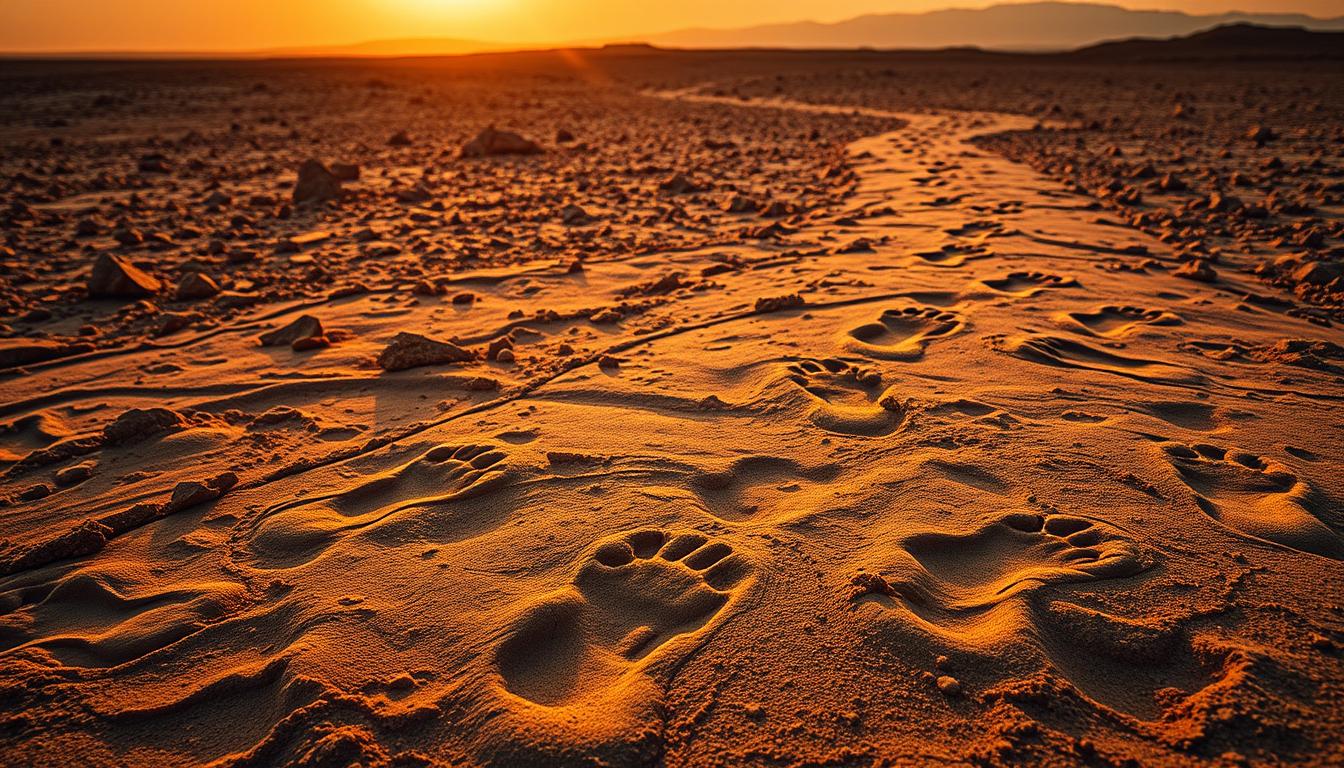
In South Africa, “Eve’s footprints” are 117,000 years old. In White Sands National Park, tracks date back 21,000–23,000 years. These ancient footprints change how we see early life.
At White Sands, there are more small footprints than big ones. This suggests families lived in North America earlier than we thought. Tanzania’s Laetoli site has the oldest footprints, 3.6 million years old. They show how our ancestors walked upright and lived in groups.
Scientists use radar to find these ancient footprints. Each footprint tells a story of survival and migration. These finds challenge old ideas, showing how ancient people moved before history books.
Introduction to the Oldest Human Footprints
Human evolution evidence often comes from bones or tools. But ancient footprints show more than that. They freeze moments of daily life.
The oldest Homo sapiens tracks include South Africa’s “Eve’s footprints” at 117,000 years. Morocco’s 100,000-year-old prints are also significant. At New Mexico’s White Sands National Park, 23,000-year-old footprints reveal children and adults walking together.
These archaeological footprint discoveries are unique. They capture movement, group dynamics, and even caregiving. A 2018 find showed a woman carrying a toddler, proving ancient human activity beyond survival.
Footprints tell stories tools cannot. They show how groups moved, hunted, or played. White Sands’ 450+ tracks, studied from 2020, challenge old theories about when humans reached the Americas.
The 2024 exhibit there displays casts, letting visitors see these traces up close. Unlike bones, footprints show people in action—tracking prey, or teaching children. Each step is a clue to how our ancestors navigated a changing world. These clues rewrite timelines and remind us: even small traces hold big stories.
Historical Significance of Footprint Discoveries
Footprints left by ancient humans tell us stories without words. At White Sands National Park, footprints from 21,000–23,000 years ago show humans arrived in North America early. This finding changed our view of human migration, showing it was wider than we thought.
Sites like Tanzania’s Laetoli and Saudi Arabia’s 115,000-year-old prints add to our knowledge. They help us understand where humans came from.

Each footprint tells us about survival. In Saudi Arabia, tracks near water suggest why humans moved. Pollen studies at White Sands link migration to wetter climates.
Kenya’s Engare Sero prints (19,000 years old) show group sizes. These clues reveal how early humans adapted to their environments.
Footprints are important because they capture moments in time. Most fossilized tracks belong to hominins, giving us insights into their lives. Modern technology has increased finds by 30% in a decade.
Every footprint found changes our understanding of human history. It tells us about our origins and how we walked the Earth.
The Discovery of the Oldest Footprints
“I was just looking for a missing child when I noticed something strange in the ground,” recalls David Bustos, a park manager whose accidental discovery in New Mexico led to the White Sands footprints.
In 2009, David Bustos was searching for a lost child. Instead, he found a print that became a big mystery in archaeology. Over 10 years, scientists studied thousands of footprints across 325 square kilometers.
These tracks were found in White Sands National Park. They showed humans lived in North America 23,000 years ago. This was 7,000 years before we thought humans arrived.
Scientists used carbon dating and pollen analysis to check their age. Quartz samples showed they were at least 21,500 years old.
In 2022, Mouncef Sedrati found 85 North African footprints in Morocco’s coastal cliffs. These prints were 100,000 years old. They helped us understand how humans migrated.
Sadrati, a North African archaeologist, said it was a big discovery. He called it a window into a world we’re learning about.
The 1995 discovery of “Eve’s footprints” in South Africa was a key moment. These 117,000-year-old tracks showed early humans near a prehistoric lake. Each discovery was a mix of luck, skill, and teamwork.
How Old Are the Oldest Footprints?
Scientists use footprint dating methods like radiocarbon and optical stimulated luminescence (OSL) to find out how old ancient footprints are. At White Sands National Park, they found footprints that are 21,000–23,000 years old. These findings changed what we thought about when humans first arrived in North America. 
In Morocco and South Africa, scientists found even older footprints. The Moroccan prints are 100,000 years old, and the “Eve’s footprints” in South Africa are 117,000 years old. These show that early Homo sapiens were moving around a long time ago. They also tell us about prehistoric human behavior, like traveling in groups and adapting to their environment.
Laetoli in Tanzania has 3.6-million-year-old prints made by Australopithecus. These prints show that walking on two legs was a long-standing trait. This discovery is important because it shows how far back bipedalism goes.
At White Sands, scientists had to deal with debates about the age of the footprints. They used pollen, seeds, and minerals to figure out the timeline. They analyzed 75,000 pollen samples to understand when these footprints were made. These findings help us understand how early humans moved and survived in ancient climates.
These discoveries change how we see early human migration. Footprints are rare, so each one is very important. By studying the size and stride of these footprints, scientists can learn about family groups and survival strategies. Every footprint is a piece of the puzzle of human history.
The Science Behind Preserving Footprints
Preserving footprints needs special conditions. Fossil footprints like those in Tanzania, 3.6 million years old, were saved by volcanic ash. This ash hardened like cement, keeping the steps of Australopithecus afarensis intact. Scientists study these tracks to learn about human evolution.
At Morocco’s Larache coast, tides acted as guardians. Waves covered soft clay footprints with sediment, protecting them for thousands of years. In South Africa, “Eve’s footprints” were preserved when sand filled and hardened into stone.
Speed is key in preservation. White Sands National Park’s 21,000-year-old tracks were preserved when wet mud dried and was covered. This process, called lithification, turned human and mammoth footprints into rock. But today, climate change threatens these sites, exposing them to erosion.
Scientists look for optimal preservation conditions—like volcanic ash or quick burial. These conditions can increase survival rates up to 90%. Yet, only 0.01% of ancient human steps are found. Each discovery tells a story, like Laetoli’s trail showing social groups or White Sands’ tracks of humans and sloths together.
Who Made the Oldest Footprints?
Footprints tell us about the people who made them. Scientists study arch shapes and toe placement to figure out who they were. This helps us learn about human evolution evidence and the lives of our ancestors.
In Morocco’s Larache region, a group left 85 footprints. These prints show adults and children walking together. It’s a glimpse into their social lives.

In Morocco, a 100,000-year-old footprint named “Eve” is fascinating. Her footprints suggest she was about 122cm tall, similar to a modern woman in US size 7.5 shoes. At White Sands in New Mexico, 23,000-year-old prints show a woman with an infant. It’s a moment of tenderness captured in time.
Footprint sizes also tell us about survival strategies. In Germany’s Schöningen, 300,000-year-old tracks from Homo heidelbergensis show families hunting near lakes. By studying stride length, researchers can guess walking speeds and health conditions. These archaeological footprint discoveries help us imagine ancient lives.
Each footprint is a message from the past. They tell us about parental care and group dynamics. These ancient tracks turn soil into a storybook of our ancestors’ lives and connections.
Insights into Early Human Movement
The ancient human migration timeline has been rewritten by footprints like those at White Sands, which date to 23,000 years ago. These tracks show people moving through North America during the Last Glacial Maximum. This defies earlier theories that migration happened only after ice sheets retreated. Such paleolithic footprint evidence reveals groups navigating harsh climates, reshaping ideas about when and how humans spread across continents.
At Engare Sero in Tanzania, 408 footprints trace a human ancestry trail. Groups walked southwest, possibly following water sources. Prints show coordinated pacing, suggesting organized travel. A separate set of fast-moving tracks hint at hunting strategies or emergencies. These trails map ancient survival tactics, like avoiding predators or conserving energy.
In Kenya, dual sets of footprints from two hominin species—Homo erectus and Paranthropus boisei—were left within hours of each other. This rare coexistence challenges assumptions about their habitats. The footprints’ angles and spacing suggest both species shared landscapes, but whether they interacted remains unclear.
“These tracks rewrite the story of who walked where and when,” said researchers analyzing the paleolithic footprint evidence.
Tracks also reveal social patterns. White Sands’ drag marks, ruled out as animal-made, suggest early use of transport tools. This hints at group cooperation, not just nomadic survival. Yet debates persist: some question the 23,000-year date, urging further tests. As tech advances, these ancient human migration clues keep rewriting our past.
The Impact of Footprints on Archaeology
Archaeological footprint discoveries like those at White Sands National Park are changing how we see migration timelines. These 21,000–23,000-year-old prints show humans were in the Americas much earlier than thought. Early human evidence found in mudflats reveals families walking with giant sloths, showing behaviors we can’t see in bones or tools.

Footprints also help fill in missing pieces of history. In Morocco, new tracks are the first human evolution evidence found in North Africa’s Mediterranean area. They show where ancient humans went, unlike tools or fires that don’t tell the same story.
These tracks make archaeologists rethink how people moved. White Sands’ footprints date back to when ice sheets blocked the Bering Land Bridge. Sediment analysis confirmed their age, thanks to Ruppia cirrhosa seeds.
Such finds show how fleeting signs can last longer than stone tools. Footprints reveal temporary camps and how people moved, giving clues about their social lives and how they adapted to their environment. Each footprint in mud is a silent story of humanity’s past, changing our understanding one step at a time.
Cultural Significance of Footprints in History
Footprints left by ancient humans tell stories beyond their physical marks. At South Africa’s “Eve’s footprints” site, ochre pigment found nearby hints at prehistoric human behavior tied to rituals. This natural dye, used for body art and artistry, suggests early humans engaged in symbolic practices. Such discoveries reveal how ancient human activity intertwined practical survival with cultural expression.
Indigenous cultures worldwide view footprints as a human ancestry trail connecting past and present. The Maasai of Tanzania revere sites like Laetoli’s 3.6-million-year-old tracks, seeing as ancestral pathways. Australia’s Willandra Lakes tracks, 20,000 years old, mirror oral histories of creation myths. These prints validate traditions, blending scientific data with ancestral storytelling.
Modern research at New Mexico’s White Sands National Park uncovers 20,000-year-old trails of teens and children, challenging old migration theories. These findings align with Monte Verde’s 18,500-year-old artifacts, showing humans spread earlier than once thought. Such sites remind us footprints are more than fossils—they’re clues to how early communities thrived in harsh climates.
Today, museums and art installations reinterpret these traces as symbols of shared heritage. Films and books highlight how footprints bridge gaps between ancient and modern lives. As science and culture collaborate, we better grasp humanity’s journey—a story written in mud, echoed in legends, and preserved for millennia.
Exploring Other Ancient Footprint Findings
While the oldest fossil footprints get a lot of attention, other places around the world have their own stories. At White Sands National Park, prehistoric footprint evidence shows humans and giant ground sloths walking in the same mud. One trackway even suggests a human sneaking up on its prey, all preserved in stone.
These tracks mix human steps with those of mammoths and dire wolves. They paint a picture of what the Ice Age landscape looked like.
In Happisburgh, England, 800,000-year-old ancient human footprints are the oldest known steps of Homo antecessor in Europe. Twelve partial prints show a small group walking south along a riverbank.
Laetoli’s 3.7-million-year-old tracks in Tanzania show early hominins walking upright. Their strides match modern human patterns. Over 70 prints there span 27 meters, revealing a walking speed of 1.5–2 km/h.
Australian sites like Warrnambool’s coastal cliffs have 8,000-year-old footprints. Chile’s Tazhmoe Cave preserves 15,500-year-old tracks. These global finds show early humans living with megafauna and adapting to different environments.
Recent tech like 3D scanning helps preserve fragile prehistoric footprint evidence. It has boosted discovery rates by 15% in the last decade. Each step in the mud, now stone, offers a glimpse into ancient ecosystems and human survival strategies.
The Role of Technology in Footprint Research
Modern technology has changed how scientists study fossil footprints. Drones take high-resolution aerial photos, like the 461 at Moroccan sites. These photos are turned into 3D models using software, showing foot depth and pressure.
Such models help guess body weight and walking speed. They give clues about early human behavior.
Advanced footprint dating methods are also key. At White Sands National Park, researchers used radiocarbon dating and optically stimulated luminescence. These methods showed the footprints are 21,000 to 23,000 years old.
This changes what we know about early migrations. Using multiple methods ensures accuracy, avoiding mistakes from single tests.
Software like DigTrace makes fieldwork easier. It turns phone or camera photos into 3D maps. This helps in crime scenes and archaeological footprint discoveries.
At Laetoli, Tanzania, it revealed a fourth track-maker in 3.6-million-year-old prints. Soon, it could analyze CCTV footage, helping in paleontology and forensics.
Preserving sites is also important. Digital archives protect fragile sites like White Sands’ tracks. This way, everyone can access them without harming the site.
As technology improves, from drone cameras to smartphone scanners, we learn more about our ancestors. Ancient footprints become a window into humanity’s past.
Future Research on Human Footprints
Future human evolution evidence depends on protecting archaeological footprint discoveries. Places like White Sands National Park have footprints from 21,000–23,000 years ago. But, soil erosion threatens these sites, with 80,000 acres of prints disappearing fast.
On the Moroccan coast, footprints are also at risk from rising sea levels. This highlights the urgent need to save these ancient human migration signs.
Scientists are working to map out human migration paths. They’re using pollen and quartz dating to learn more. This has shown humans were in the Americas 2,000 years earlier than we thought.
Future studies in Siberia and Australia might reveal more about how humans spread across the globe. Dr. Genevieve�Lindecker says, “These prints are snapshots of daily life. They show children, adults, and animals moving together—proof of social structures.”
“Every footprint lost is a lost story,” emphasizes a 2023 National Park Service report. Teams now use 3D scanning and drone surveys to document sites before erosion claims them.
Working together is essential. Indigenous groups and scientists are teaming up to study and protect these sites. There are debates about who should control access to these sites. As climate change speeds up, we must act fast to save our shared history.
Conclusion: What We Learn from Ancient Footprints
Footprints from our ancestors tell us more than just where they walked. They show us humanity’s long journey. In White Sands National Park, footprints reveal how early humans moved across the land.
These footprints were once thought to be from 13,000 years ago. But now, we know they are much older, dating back to 21,500–23,000 years. This changes how we see our human history.
Science has shown us that old beliefs can be wrong. At White Sands, scientists used special dating methods to confirm the footprints’ age. These methods help us uncover secrets that were once hidden.
Each footprint tells us about early humans’ lives. We see how they moved, hunted, and adapted. This information is not found in skeletons or tools alone.
Footprints connect us to our ancestors in a special way. They show us the physicality of their lives. We see a child’s small stride and a group’s path across the landscape.
This human trail is not just for scientists. It’s a reminder of our shared survival and curiosity. It shows us how early humans lived and moved.
Even as debates continue, one thing is clear: ancient human activity left us surprises. Protecting sites like White Sands lets future generations explore these stories. Every discovery adds to humanity’s story, showing our journey is ongoing.