
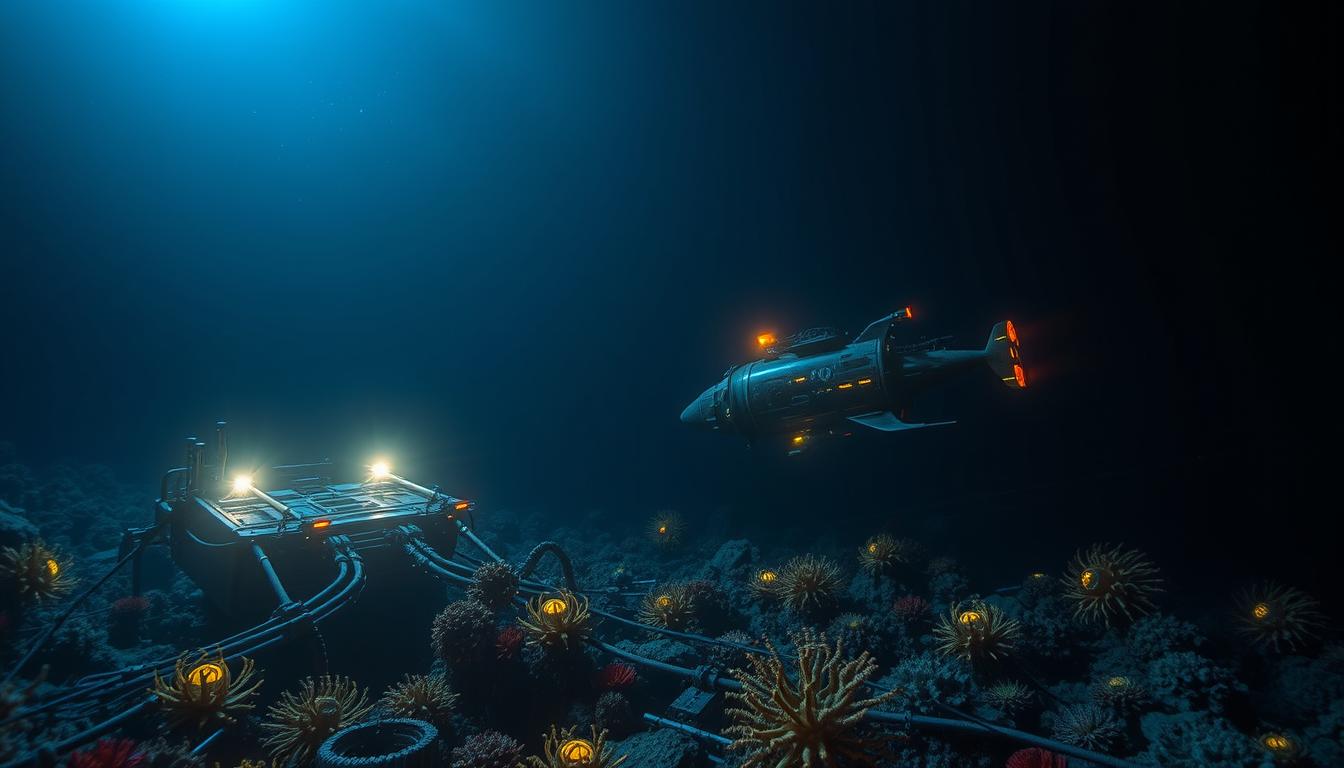
The hadal zone is the deepest part of our ocean, going from 19,700 to 36,000 feet below sea level. It’s named after the Greek underworld and is barely explored. China’s Fendouzhe submersible recently went over 35,700 feet, finding 7,564 microbial species.
Most of these microbes were new to science, showing the hadal zone’s incredible diversity. This discovery is changing how we see life’s limits and humanity’s reach.
Even in the Mariana Trench’s extreme pressure, life finds a way. Fish with special genes live over 1.8 miles deep. There are also seapigs and giant xenophyophores on the seafloor.
But, human actions have left their mark. Plastic bags and soda cans pollute these deep places. This article looks at the amazing discoveries and the impact of human actions in the hadal zone.
Understanding Ocean Depths and Their Importance
Ocean depth classification divides the ocean into zones based on light penetration and pressure. The epipelagic zone, from the surface to 200 meters, is the sunlit layer where most marine life thrives. Below this, the mesopelagic twilight zone extends to 1,000 meters, where sunlight fades and bioluminescence becomes common.
Deeper, the bathypelagic zone reaches 4,000 meters, where temperatures stabilize near freezing and pressure exceeds 5,850 pounds per square inch. The abyssopelagic zone continues to 6,000 meters, covering vast ocean floors. The hadalpelagic zone, below 6,000 meters, defines trenches like the Mariana Trench—home to hadal ecosystems surviving under extreme conditions.
Deep sea pressure in these zones challenges life yet fosters adaptation. Hadal ecosystems in trenches host creatures like the Abyssobrotula galatheae, a fish found nearly 8,400 meters deep. Marine research reveals how these environments influence global nutrient cycles and climate.
Studying trenches also uncovers species like foraminifera in the Mariana Trench’s Challenger Deep, showing life persists even where sunlight never reaches. Such discoveries highlight the ocean’s untapped biodiversity and the importance of continued exploration.
“Trenches are Earth’s last frontiers, holding clues about life’s limits and evolution.”
Understanding these zones helps scientists map the deep-sea’s role in carbon storage and ecosystem balance. Every meter explored advances knowledge of how these environments shape our planet’s health.
The Mariana Trench: The Deepest Known Place

The Mariana Trench is the lowest point on Earth, located near Guam in the Pacific. It stretches 1,580 miles long. The Pacific Plate sinks under the Philippine Plate, creating this deep trench.
At its bottom, Challenger Deep is 36,070 feet deep. That’s even deeper than Mount Everest is tall.
Scientists are curious about life in this extreme environment. They face pressures 1,000 times greater than on land. In 1960, Don Walsh and Jacques Piccard showed it was possible for humans to survive here.
In 2012, James Cameron went solo to the bottom. He brought new technology that showed us creatures living in the dark. Now, we know even microplastics and synthetic materials have reached the deepest parts of the ocean.
Despite being very far away, the trench is not untouched. In 2019, a survey found plastic bags and candy wrappers. But in 2009, it was made a US National Monument to protect it for future explorers.
The Mariana Trench is a unique place for studying Earth’s extremes. It shows us the wonders of the deep and the limits of our technology.
The Challenger Deep: Measuring the Abyss
Scientists have long tried to measure the Challenger Deep depth. The 1960 Trieste dive found 10,916 meters. Today, we know it’s between 10,898 and 10,994 meters. This shows how far we’ve come in deep ocean measurement tools.
The pressure here is extreme, over 16,000 psi. That’s more than 1,000 times what we feel on the surface. Machines like the DSV Limiting Factor and ROVs have to be incredibly strong to work here. The 2022 R/V Falkor mission even found 85% of sediment life forms.
Big moments include the 2019 Vescovo dive at 10,925 meters and Cameron’s 2012 record. Sonar surveys from 2009 have mapped the oceanic trenches with great detail. These efforts show our determination to explore the unknown.
The Role of Technology in Deep-Sea Exploration
Advances in deep-sea submersibles and hadal landers have changed ocean exploration. China’s Fendouzhe submersible went 10,900 meters deep into the Mariana Trench. It brought back samples from areas scientists couldn’t reach before.
The HADES expedition used five hadal landers to study depths from 5,000 to 10,600 meters. They gathered data on life and geology. These tools can handle pressures over 596 atmospheres at 6,000 meters, like 1,000 elephants on a car tire.
ROV technology like the Deep Discoverer has 27 LED lights and high-definition cameras. It lights up the dark below 1,000 meters. Its temperature probes measure heat up to 400°C at hydrothermal vents.
Pressure-resistant equipment lets vehicles collect samples at crushing depths. Innovations like AUVs map trenches with sonar and sensors. They create 3D images of the seafloor.
Future systems will combine pressure-resistant equipment with real-time data. This will help us understand life in the hadal zone better. As technology improves, we discover new worlds, like giant amphipods and microbial communities thriving in extreme conditions. Each dive opens up new areas for us to explore.
The Biological Wonders of the Deep Ocean
Deep-sea creatures live in places where sunlight never reaches. Recent expeditions have uncovered a hidden world. This world includes creatures like translucent snailfish and gelatinous jellies.
More than 89% of microbial species found in trench samples are new to science. This shows how life can thrive in extreme conditions.
At 8,143 meters, scientists filmed a new snailfish species. It has wing-like fins and can survive under 1,100 atmospheres. Nearby, Dumbo octopuses glide using ear-like fins.
Giant larvaceans filter particles through gelatinous “houses” up to 3 feet wide. These creatures are found in the deep ocean.
Bioluminescence lights the way for some deep-sea creatures. The bloody-belly comb jelly glows to lure prey. Eel lineages colonized these depths 100 million years ago.
Hydrothermal vents host chemosynthetic ecosystems. Heat-loving microbes form the base of unique food webs. These ecosystems are found in the deep ocean.
Even in the deep ocean, human impact is felt. Microplastics now litter the Mariana Trench. This intrudes on ecosystems that evolved in isolation.
Protecting these zones is important. The deep ocean covers 95% of Earth’s living space. Yet, less than 5% is mapped. As technology advances, we learn more about these biological marvels.
Sea Floor Mapping and Its Importance
Imagine exploring a landscape deeper than the highest mountains. Bathymetric mapping reveals this hidden world, using sonar technology to chart the seafloor topography. Tools like multibeam and sidescan systems have changed submarine mapping a lot. They paint detailed pictures of trenches and ridges.
Today, only 23% of the ocean is mapped in high detail. This leaves vast regions unexplored.

Modern ships and autonomous vehicles now map swaths wider than the ocean’s depth itself. NOAA’s surveys, like those in the Mariana Trench, uncovered volcanic rocks from 50 million years ago. These rocks are clues to Earth’s history.
These maps guide conservation efforts, too. Coral reefs near Tahiti and the 1915 Endurance shipwreck were found using advanced sonar. This shows how mapping uncovers life and history.
Why does this matter? Seafloor topography shapes currents and habitats. Without maps, we can’t protect fragile ecosystems or understand tectonic shifts. The Nippon Foundation-GEBCO Seabed 2030 project aims to finish global mapping by 2030.
It’s a project that unites nations to chart the remaining 77%. The future of exploration depends on it. Each scan reveals secrets older than the Grand Canyon, hidden beneath the waves.
Impact of Human Activities on Ocean Depths
Human actions are making a big impact, even in Earth’s deepest trenches. Recent trips to the Mariana Trench found plastic bags, soda cans, and even a laundry basket. Scientists like Weishu Zhao from Shanghai Jiao Tong University say it’s “deeply shocking.”
These discoveries show how deep ocean pollution reaches even the most hidden ocean areas. Plastic waste gets to these depths through currents and marine snow. It settles in trenches, lasting for centuries.
Now, microplastics are common in trenches, found in creatures like amphipods. Studies found 89% of debris in trenches are single-use plastics. For example, a plastic bag was found at 10,898 meters, showing how human impact on deep sea ecosystems is growing fast.
Mining projects, like Nautilus Minerals’ deep-sea operations, threaten these habitats. Bottom trawling and climate-driven acidification also stress these slow-growing species. Over 3,000 pieces of debris were recorded in 5,010 dives, showing how urgent the situation is.
Deep-sea species take centuries to recover, so protecting these ecosystems is critical. Marine conservation efforts need to reduce plastic waste, control mining, and expand protected areas. Only by working together can we prevent irreversible damage to these ecosystems.
The Science of Deep-Sea Ecosystems
Deep-sea food webs exist in the dark, far from sunlight. Instead of photosynthesis, life depends on chemosynthesis. Microbes turn chemicals like methane into energy. This supports communities near hydrothermal vents, creating unique marine food chains.
Imagine a world where “marine snow”—decaying matter from above—becomes a feast. Giant amphipods and other creatures have evolved to survive. They turn rare food falls into lifelines.

Carbon cycling plays a hidden role. Trenches trap organic carbon, which could affect global climate. Scientists like Dr. Jeff Drazen say we should study entire ecosystems, not just the deepest spots.
“It’s like studying a mountain by only looking at its peak,” he says. New tools help us see how carbon moves through these systems. This shapes our planet’s climate balance.
Despite covering over 60% of Earth’s surface, 90% of deep-sea species are unknown. The Deep-Seafas group’s research in the South Atlantic and Southern Ocean shows how trenches store carbon and sustain life. Yet, with only 0.002% fully mapped, mysteries await.
Understanding these systems isn’t just about discovery. It’s about protecting our planet. Even the deepest trenches connect to life above.
Future of Deep-Sea Research
Exploring the ocean’s deepest trenches is a major challenge for humanity. New marine science technology will change how we explore the ocean. Tools like autonomous vehicles and environmental DNA will help us discover new areas.
“The questions scientists will answer next will redefine how we view life’s limits,” said Wendy Schmidt of Schmidt Ocean Institute. “These depths aren’t untouched—they’re part of our planet’s fragile system.”
AI will help us understand climate changes and biodiversity. But, we face challenges like extreme pressure and energy limits. Solar-powered gliders and charging stations might solve these problems.
NASA’s Subsea program compares deep trenches to places like Europa. They share similar extreme conditions. This comparison could lead to new discoveries.
Projects like Seabed 2030 aim to map the ocean by 2030. Trench monitoring systems will track pollution and changes in ecosystems. With 80% of the ocean unexplored, the next decade will reveal much about life and Earth’s resilience.
Insights from Marine Geology
Marine geology uncovers Earth’s secrets through trench formation and submarine volcanism. By studying deep-sea sediments, researchers learn how underwater eruptions and plate movements shape the ocean’s depths. These processes created the Mariana Trench’s dramatic landscape.

Rock samples from the Mariana Trench’s inner slope reveal clues to ancient submarine volcanism. Mud cores collected by tools like the Free Vehicle Coring Respirometer (FVCR) show microbial activity in deep-sea sediments. This life thrives in extreme conditions, influencing carbon storage in the deep ocean.
Features like the Maug Caldera, a volcanic site in the Northern Mariana Islands, highlight submarine volcanism’s role in shaping trench ecosystems. Each discovery in marine geology expands our understanding of Earth’s dynamic systems, connecting geology to the planet’s climate and biology.
Conclusion: Our Responsibility to the Deep
Explorers and scientists have found life in Earth’s deepest trenches. This shows we must focus on deep ocean conservation. The Hadalpelagic Zone, once seen as empty, is now full of life, with 90% of species unknown.
Protecting these areas is key to saving biodiversity and finding new medicines and climate science breakthroughs. Bioluminescent and extremophile organisms could change biotechnology. But, their survival depends on how we explore the ocean.
Human activities have reached the Mariana Trench’s bottom, 10,911 meters deep. Plastic and mining threaten these ancient habitats. We need global rules to protect the ocean while we explore it.
Technologies like submersibles help us discover and save the deep sea. But, we need worldwide agreements to stop harm. The deep sea, covering 45% of our oceans, holds secrets of life’s strength.
The deep sea stores carbon and helps control the climate. Yet, 90% of its species are unknown. Saving these areas means future generations can learn from them. Small actions, like protecting more areas and controlling seabed mining, can help.
The deep ocean’s secrets give us hope. Creatures like amphipods and snailfish live in extreme conditions. Our job is to explore and protect these wonders. Sustainable exploration and ocean protection are not just right; they’re essential for our future.
By taking care of the ocean today, we honor science and nature for tomorrow. Marine stewardship is our duty to the deep sea’s mysteries.