
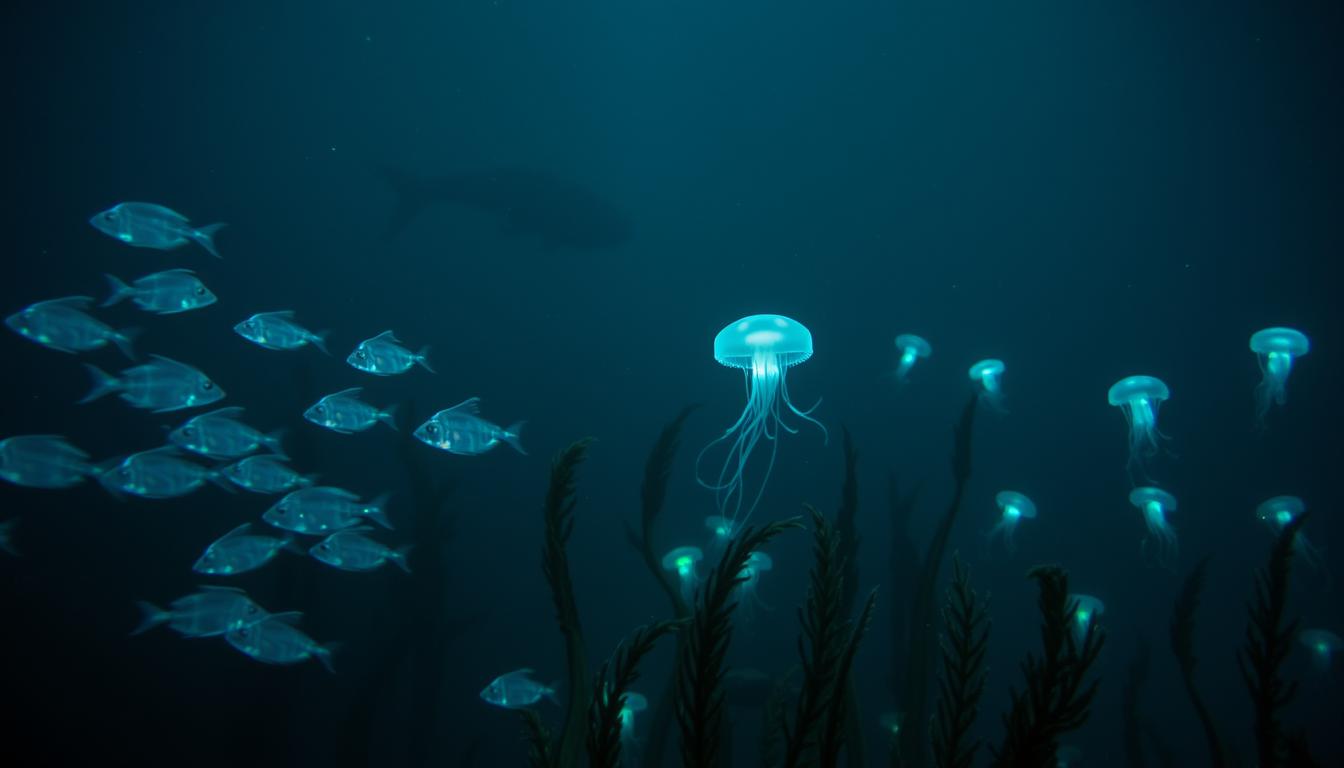
Nature’s most dazzling displays aren’t just for show. Bioluminescent organisms light up oceans and forests with cold light. This light is created by chemical reactions inside their bodies. It produces less than 20% heat, making it energy-efficient for glowing animals like fireflies or deep-sea fish.
While fireflies are familiar, 76% of ocean animals—from jellyfish to sharks—rely on bioluminescence to survive.
Deep sea bioluminescence shapes life in darkness. Over 1,500 fish species glow to hunt or hide. The Hawaiian bobtail squid partners with Vibrio fischeri bacteria for camouflage, while the American pocket shark uses bioluminescent fluid to lure prey.
Blue-green light dominates these ecosystems because sunlight fades below 100 meters. Even on land, organisms like fireflies and scorpions glow. They use light to communicate or defend themselves. This hidden world of bioluminescent organisms holds secrets for science and survival alike.
What Are Bioluminescent Organisms?
Bioluminescent organisms are living beings that create light through chemical reactions. These glowing creatures include bioluminescent bacteria, fish, and jellies. Over 50% of jellyfish species use marine bioluminescence for survival.
Most thrive in oceans, with some on land like fireflies. Freshwater habitats have almost none.

Bioluminescent bacteria like Vibrio fischeri partner with creatures such as the bobtail squid. Unlike biofluorescence—where light is absorbed and re-emitted—true bioluminescence is self-made.
Fireflies flash to attract mates, while deep-sea anglerfish use glowing lures to hunt.
Over 200 lanternfish species use light organs to hide from predators. Tropical fungi glow to attract insects, aiding spore spread. These adaptations show how light helps survival in dark environments like the ocean depths.
The Chemistry of Bioluminescence
Bioluminescent chemistry relies on two main compounds: luciferin and luciferase. Luciferin is the molecule that produces light. It reacts with luciferase, an enzyme that makes the reaction faster. When oxygen is added, energy is released as light, a process that doesn’t produce much heat.
This is why it’s called cold light. Unlike a flashlight, which loses 90% of its energy as heat, bioluminescence turns almost 98% of its energy into visible light.

Fireflies use luciferin to glow yellow at 600–650 nanometers. Deep-sea creatures like dinoflagellates emit blue light at 474 nm with a different luciferin. Each species has its own bioluminescent chemistry suited to its environment.
Squid and jellyfish use coelenterazine, which glows blue-turquoise when charged with oxygen. In 2008, scientists won a Nobel Prize for studying green fluorescent protein (GFP) from crystal jellyfish. This discovery changed medical research, allowing scientists to track cells in living organisms.
The unique luciferin–luciferase pair in each organism ensures precise light production. This is much more efficient than human-made lights.
Types of Bioluminescent Organisms
Fireflies are like nature’s flashlights. They light up to find mates, with over 2,000 kinds. Their glow comes from special organs in their bellies. But, the ocean has even more light-makers.
Anglerfish use glowing lures to catch food in the deep. Glowing algae like Noctiluca scintillans make waves sparkle in coastal areas.

Bioluminescent plankton light up the ocean. Dinoflagellates in Puerto Rico’s Mosquito Bay flash blue when waves hit. Glowing algae like Pyrodinium brighten beaches all over. Even fungi, like foxfire, glow green from decaying wood.
“Bioluminescence evolved 50 times independently across species,” says marine biologist Edith Widder. “This trait unites jellyfish, sharks, and even tiny shrimp.”
From fireflies to anglerfish, these creatures light up their worlds. Lanternfish hide with light, and Aequorea victoria jellyfish helped scientists discover glowing proteins. Even deep-sea clams and squid add to the light show, showing light is a universal language.
How Bioluminescence Works in Nature
Bioluminescent reactions create the chemical light we see in nature. This starts when luciferin, a light-producing molecule, meets oxygen. An enzyme called luciferase then sparks a reaction, releasing energy as visible light emission.
Some creatures make their own luciferin. Others get it from their diet or from glowing bacteria.

Photoproteins are key in this process. Dinoflagellates, tiny marine plankton, use these proteins to create their blue-green glow. When waves crash or predators stir the water, millions of these microbes light up instantly.
This light is a defense tactic to startle attackers. Their chemical light is so efficient that 98% of the energy becomes visible light. This is unlike regular bulbs, which waste a lot of heat.
Bioluminescence has evolved 27 times in ray-finned fish alone, showing how vital this trait is for survival.
Some animals control their glow with special organs. The lanternshark, for example, uses light-emitting cells to blend into the ocean depths. Others, like the bobtail squid, host bioluminescent bacteria in their bodies.
These partnerships help creatures hide from predators or lure prey. The color of their light—usually blue or green—depends on their photoproteins and environment. Even land species like New Zealand’s glowing snail use light emission to deter threats, emitting neon slime when touched.
From deep-sea fish to glowing plankton, bioluminescence shows nature’s ingenuity. These reactions aren’t just pretty—they’re survival tools honed over millions of years.
Fascinating Examples of Bioluminescent Creatures
Deep sea bioluminescence is amazing, with creatures like the anglerfish. This predator has a glowing lure to catch prey in the dark. The lure glows thanks to bacteria living inside, making it a deadly trap.
Fireflies light up forests, sending coded messages to find mates. Each species has its own pattern, like Morse code. Bioluminescent bays, like Puerto Rico’s Mosquito Bay, glow when dinoflagellates are disturbed. These tiny organisms light up the water, making it shimmer.
The Hawaiian bobtail squid works with Vibrio fischeri bacteria at night. It dims its light to match the moon, hiding from predators. The American pocket shark, found in 2010, releases glowing fluid to confuse attackers.
Dragonfish in the abyss emit red light, a rare trait in the deep sea. This helps them hunt, as most deep-sea animals can’t see red. The green bomber worm, discovered in 2009, releases glowing “bombs” to scare off predators.
Glowing millipedes in California and the luminous chains of salps show how creatures use light to survive. Bioluminescence’s variety shows nature’s creativity, solving many challenges.
Bioluminescence in Human Culture
For centuries, bioluminescent organisms have amazed humans. Ancient Greeks and Romans talked about glowing fireflies and the “burning sea.” The Māori of New Zealand saw these creatures as spirits or omens. Today, places like Puerto Rico’s bio bay draw visitors to see nature’s light.
“The sea is a dark place, but it’s also a place of light.” — Marine biologist Edith Widder
Humans have tried to copy natural light from these creatures. In the 1700s, anglers used dried glowing creatures to catch fish. During WWII, Japanese soldiers used “umi hotaru” (sea fireflies) to read maps secretly. Now, we have glow sticks and emergency lights inspired by this.
Art and science find inspiration in bioluminescence. Jules Verne’s 20,000 Leagues Under the Sea had glowing jellyfish. The Nobel Prize-winning discovery of green fluorescent protein (GFP) from jellyfish changed lab research. Today, projects like the Glowing Plant Project mix nature’s light with human creativity.
Bioluminescence has inspired both wonder and practical uses. As we learn more, these bioluminescent organisms light the way for new discoveries.
The Role of Bioluminescence in Science
Green fluorescent protein (GFP) is key in bioluminescent research. Found in jellyfish, it glows and helps scientists. They use it to see what genes are doing in living cells.
This scientific applications breakthrough won the Nobel Prize in 2008. It lets scientists study diseases and cell processes in real time.
In environmental science, bioluminescence has many uses. For example, plants that glow when stressed can alert farmers to drought. Bacteria that light up can find water toxins.
Companies are even looking to use bioluminescent trees as streetlights. This shows how bioluminescent research connects biology and technology.
Bioluminescence is great for medical research too. Scientists use it to track cancer cells or study the brain. It lets them turn living things into tools for discovery.
Challenges Facing Bioluminescent Organisms
Places like Puerto Rico’s glowing bays and Malaysia’s “blue tears” are delicate. They need special conditions to survive. Pollution and rising temperatures threaten these bioluminescent environments.
Human actions harm these ecosystems. They disrupt the water and openings these organisms need. This puts their survival at risk, as they use defensive bioluminescence to avoid predators.
Light pollution from cities and boats messes with natural cycles. Fireflies and deep-sea creatures struggle to hide. They use counterillumination to blend in, but it’s harder now.
Nutrient runoff causes toxic algal blooms. These blooms turn bioluminescent algae into harmful red tides. This harms marine life and coastal communities, even though it’s part of their defense.
Marine conservation aims to protect these habitats. Scientists monitor dinoflagellate health to gauge ecosystem stress. Research shows that toxic metals and warming waters weaken their light.
This signals a bigger environmental problem. Saving these species is not just about their beauty. It’s also about the medical and tech breakthroughs they could lead to.
Future Prospects in Bioluminescent Research
Bioluminescent research is opening up new paths. Scientists are diving into deep-sea ecosystems, where most creatures already light up the dark. This could lead to green technologies like glowing trees or crops that signal when they need water.
Medical advancements are also on the horizon. Bioluminescent imaging (BLI) is helping doctors track tumors and viruses in real-time. By tagging viruses like herpes simplex virus (HSV-1), researchers can see how diseases spread. This could pave the way for treatments that glow inside the body, tailored just for you.
Bioluminescent tech might also change farming. Plants that light up when stressed could save farmers money. In labs, new systems are 150 times brighter than before, making drug tests better. While there are hurdles like light scattering, combining BLI with other scans could solve these problems. Scientists are working on making these markers brighter and more stable.
The future of bioluminescent technology is bright. It could light up cities and change healthcare. As we learn more about glowing organisms, we’ll find new ways to solve big problems. The journey to unlock their secrets is just starting, and their light could be the answer to many challenges.