
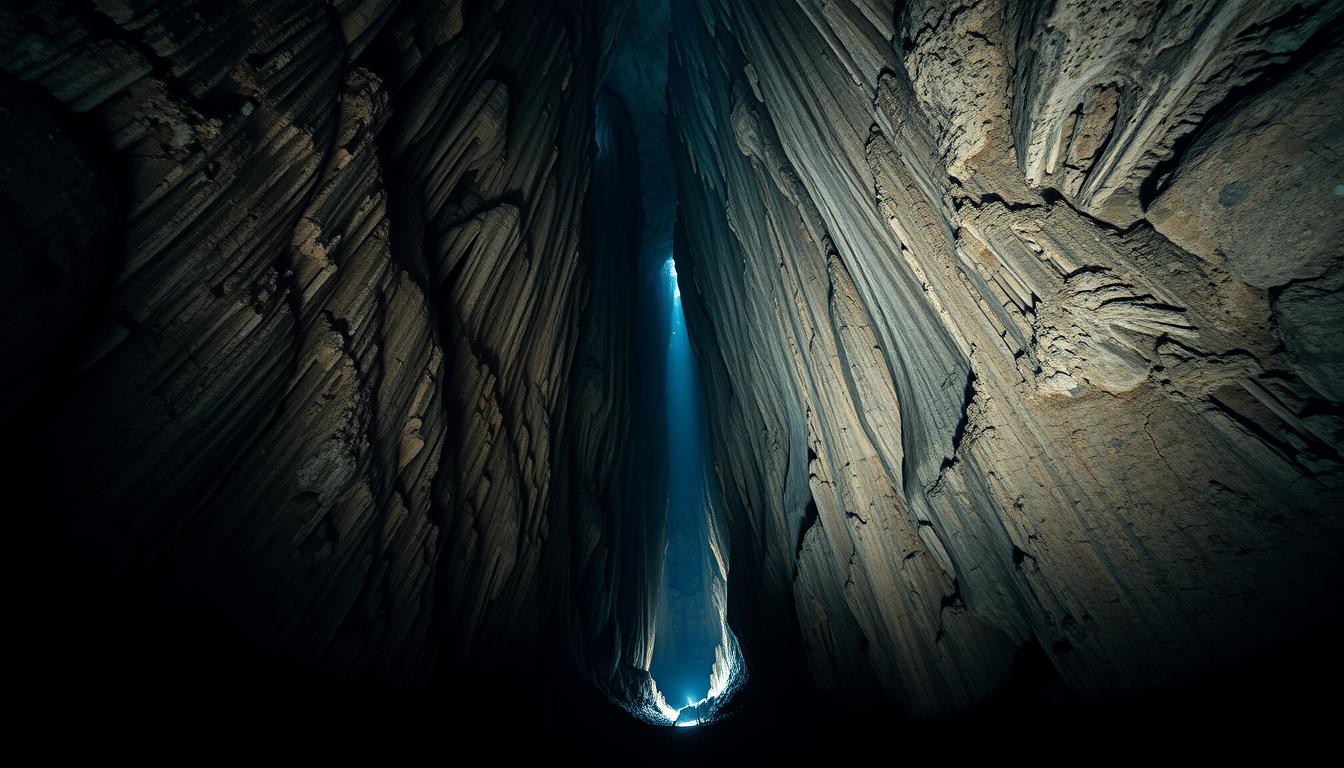
Earth’s deepest caves are like hidden labyrinths, filled with secrets. Places like Veryovkina and Krubera-Voronja are so deep, they challenge explorers. These caves are formed by water carving through limestone over millions of years.
Some caves, like Lamprechtsofen, stretch for 61km. They have chambers untouched for ages. These underground worlds are truly mysterious.
Édouard-Alfred Martel started studying caves in the early 1900s. But today, we’re finding new species in these depths. In Veryovkina, scientists found a shrimp that lives without sunlight.
Even famous caves like Sistema Huautla, which is 89km long, have parts yet to be explored. But, there are dangers too. A 2018 flood trapped cavers in Veryovkina for 20 hours.
These caves show us Earth’s hidden beauty. From the Eisriesenwelt Ice Cave to Vietnam’s Hang Son Doong, each cave has its own story. Exploring these depths, we learn how much is hidden beneath our feet.
The Allure of Unexplored Caves
Unexplored caves draw explorers with their mystery and scientific curiosity. In the 1960s, teams like Georgian geographer Levan Maruashvili’s explored the Ortobalagan Valley. They found deep shafts, like the 60-meter Alexander Kruber shaft.
These early cave exploration efforts set the stage for today’s adventures. Every new discovery changes how we see Earth’s hidden parts.
Exploring caves means stepping into darkness and silence. The constant temperature creates an eerie feel. Explorers face dangers like deep drops and long stays underground.
Yet, the excitement of discovering new places is worth the risk. Caves in Europe, like the SMK and Schonenberg systems, stretch for over 137 and 156 kilometers. They could be part of a global sixth-longest cave system if connected.
The quest to explore caves has lasted for generations. In Venezuela’s Imawarì Yeuta system, unique species like the Roraima bush toad live in isolation. Even microbes in these caves reveal new bacterial species, changing our scientific understanding.
Explorers brave flooded passages and cold temperatures for these discoveries. Each find shows us new possibilities for life.
From limestone karst to ancient tepuis, caves are Earth’s last unmapped areas. Every step and survey line brings us closer to understanding our planet’s secrets. The journey continues, driven by the allure of the unknown.
Famous Caves That Stil Hold Secrets
Hidden beneath the surface, the deepest caves on Earth continue to baffle and inspire. The Veryovkina Cave in Georgia is the world’s deepest, reaching 2,212 meters. It was discovered in 1968, but its full depth was only confirmed recently.
The Krubera-Voronja Cave is close behind, with a depth of 2,199 meters. Its cave systems are like a maze, with paths like the Nekuybyshevskaya section. Even famous caves like Mexico’s Sistema Huautla (1,560 meters) are always revealing new secrets.

Europe’s Lamprechtsofen Cave in Switzerland is a 15-minute hike to icy chambers. Romania’s Movile Cave, sealed for 5.5 million years, has species found nowhere else. These deepest caves test explorers with narrow passages and uncharted paths.
From North Dakota’s Ice Caves to Mexico’s Pyramid of the Moon cave, these sites mix ancient history with modern mysteries. Every trip into these cave systems brings us closer to understanding Earth’s hidden stories. The search goes on—because even the most famous caves have secrets waiting to be discovered.
Unexplored Caves Around the World
From Vietnam’s jungles to Georgia’s mountain ranges, unexplored caves are mysteries waiting to be solved. Son Doong Cave in Vietnam is a 5-kilometer wonder, with 70% of its paths yet to be found. Exploring these caves requires extreme cavinging, a mix of science and bravery to uncover secrets millions of years old.
In Georgia’s Arabika Massif, caves like Veryovkina and Krubera suggest even more to discover. Their paths, shaped by ancient geological forces, test the limits of cave explorers. Mexico’s Sistema Sac Actun and Turkey’s karst landscapes also hold secrets, with many passages untouched for centuries.
“Every turn in these caves could rewrite Earth’s history.”
Climate changes sometimes uncover hidden entrances, like Asik-Asik Falls after a 2008 typhoon. But, deforestation poses a threat to these fragile ecosystems, risking the loss of undiscovered sites. Today, underground exploration uses advanced tools like LiDAR and drones, merging old-school courage with modern technology to open up new discoveries.
Challenges of Exploring Caves
Exploring caves is not just about bravery. It’s about mastering narrow paths and steep drops. Risks include rockfalls, floods, and getting too cold. In 2016, a speleologist named Stefan D. lost his life in Hirlatz Cave, showing the dangers.
Teams often crawl through spaces as small as 2 feet for 150 feet. Caves underwater are even harder, with 80% of divers struggling in the dark. During Hurricane Harvey, caves in Kentucky flooded, trapping explorers.

Explorers must also worry about harming the cave’s delicate formations. They wear suits to protect them. Places like Carlsbad limit access to keep the caves safe. Rescue missions, like the 2018 Thailand cave rescue, show the challenges of reaching trapped people.
Yet, explorers keep going, facing each challenge head-on. They check their gear, work together, and respect nature. The risks are high, but so are the rewards of discovering the unknown.
Technologies Used in Cave Exploration
Modern cave research relies on cutting-edge tools. LED headlamps and rebreathers allow explorers to venture deeper into Earth’s hidden spaces. In 2005, diver Ulrich Meyer set a record in Mexico’s Sistema Huautla, diving 11,500 meters with advanced equipment.
Today, technologies like laser scanners and digital clinometers map caves with great accuracy. This has changed how we study underground systems.
Underwater robots are now used in underground exploration. In Florida’s Orange Grove caves, they collect data in dangerous areas. These robots check water quality in karst aquifers, which supply water to a quarter of the world’s population.
In Texas, Southwest Research Institute (SwRI) tested a 270mm drone with 3D sensors. This drone is smaller but more precise. It can navigate through narrow passages, opening up new areas for exploration.
Recent advancements are promising. At the 2023 International Planetary Caves Conference, drones with thermal vision and AI were shown. They save energy and could explore faster in the future. These tools help in cave diving and protect fragile ecosystems, making it safer to explore Earth’s unmapped areas.
Caving vs. Canyoning: The Distinctions
Caving, also known as spelunking, is about exploring underground places like the Arabika Massif. Teams like the Kiev Speleological Club have been doing extreme caving there for over 40 years. Canyoning, on the other hand, is about going through canyons above ground, using rappelling and swimming.
Both activities need ropes and skills to use them. But, they use different gear. Cavers use headlamps and harnesses for climbing, while canyoneers wear wetsuits and water gear.

Exploring caves technically is very challenging. The Kiev team showed how hard it is by digging through boulders in the 1980s. Canyoning, though, often follows trails and doesn’t need as much equipment.
There are different risks in each sport. Cavers might face floods or accidents with ropes. Canyoneers worry about flash floods or slipping on rocks.
Getting good at caving takes a lot of practice and training. The National Speleological Society and International Union of Speleology give rules for safe extreme caving. They teach about vertical rigging and staying warm. Canyoning has its own training, focusing on water and quick escapes. Both sports love adventure but are very different.
Environmental Concerns of Cave Exploration
Cave conservation is key to keeping Earth’s hidden worlds safe. Unexplored caves are home to unique life forms, like the 12 arthropod species in Krubera-Voronja. This includes four springtails found nowhere else. These caves also host creatures like Plutomurus ortobalaganensis, a blind millipede that lives 2,000 meters deep.
Explorers can harm these places by damaging formations, bringing in harmful microbes, or changing the air flow. This can threaten the very existence of these unique species. Also, 95% of the world’s accessible freshwater comes from karst cave systems. Messing with these habitats could pollute our water sources and lose valuable scientific data.
To protect these areas, conservation efforts include strict rules like “leave no trace” and limited access to sensitive zones. UNESCO is now protecting sites like the Grand Canyon’s caves. Rolex is funding projects, like the 2023 Greenland expeditions. Researchers like Wynne push for education and responsible exploration to safeguard species that tell us about the climate.
As the climate changes, caves give us clues about the past. Speleothems in Arctic caves show us what the climate was like long ago. This helps scientists create better climate models. By finding a balance between exploring and preserving, we can ensure these environments are here for future generations to study.
The Mystery of Cave Creatures
Cave creatures live in the dark, developing unique traits. In Krubera-Voronja Cave, scientists found cave creatures like Plutomurus ortobalaganensis, a springtail that lives 1.98 miles deep. These subterranean discoveries show how life can thrive in extreme conditions.

In Mystery Cave, Minnesota, researchers found Bathynellacea, tiny blind crustaceans, in 2021. These findings show how creatures like the eyeless amphipod Kruberia abchasica adapt to complete darkness. The olm salamander in Slovenia’s Postojna Cave can live for decades without food.
But these fragile ecosystems face dangers. White-nose syndrome killed 94% of Mystery Cave’s bats by 2018.
Urban pollution and deforestation disrupt cave water sources, threatening species like the olm.
Research in caves also reveals microbes with medical benefits. Climate changes, though, push species to extinction. Saving these hidden worlds could teach us about life’s limits and help solve Earth’s problems.
How to Get Involved in Cave Exploration
Starting cave exploration begins with learning the basics. Beginners should first take courses from certified instructors. These courses teach knot-tying, rope work, and emergency procedures.
Spelunking clubs like the National Speleological Society (NSS) offer training programs. These programs teach safe techniques for navigating vertical pits and tight passages.
Essential gear includes a Petzl or Black Diamond helmet, three light sources, and a harness. Joining a local caving group provides mentorship from experienced explorers. They’ve navigated systems like Kentucky’s Mammoth Cave.
“Every expert started as a novice,” says one NSS leader. “Start with beginner-friendly caves like those in Washington’s Boulder Cave Trail.”
“Take nothing but pictures, leave nothing but footprints, and kill nothing but time.”
Advanced cavers gain skills through projects like mapping uncharted passages or documenting rare cave species. The USDA Forest Service partners with groups like the Southeastern Cave Conservancy. They organize surveys in sensitive ecosystems.
Even weekend trips require teamwork—groups of four to six people minimize risks. In environments where 52 documented hazards exist.
Extreme caving demands specialized training for vertical drops or submerged passages. Courses in cave diving or sump exploration prepare adventurers. They prepare for systems like Lechuguilla Cave, which now extends over 150 miles.
Volunteers can contribute by cleaning trash during surveys or recording bat populations affected by white-nose syndrome.
Beginners can start by joining NSS trips to parks like Alaska’s El Capitan Cave. Always follow Leave No Trace principles—caves are fragile systems. Even footprints can disrupt microbial communities.
Whether mapping passages or conserving ecosystems, every participant plays a role. They help preserve Earth’s hidden wonders.
Future of Cave Research and Discovery
Advances in cave research are set to reveal Earth’s hidden depths. In places like the Black Sea, boreholes have uncovered karst systems over 2,000 meters deep. This suggests vast, unexplored networks beneath us.
Submarine springs and deep groundwater circulation point to subterranean worlds yet to be mapped. These discoveries could change how we understand geology and climate history. Speleothems, for example, hold clues to ancient atmospheric conditions.
Underground exploration is not just about Earth anymore. Lunar caves, like Wulff Land Cave, a 100-meter-deep pit near the Apollo 11 site, could house future colonies. Robotic probes and ground-penetrating radar may soon uncover their full extent, protecting us from space hazards.
Technologies like drones and 3D scanning are helping explorers in places like Mexico’s J2 system. In 2015, expeditions found speleothems over half a million years old there.
Subterranean discoveries rely on global teamwork. Scientists, engineers, and local communities must work together to explore and protect caves. Funding, like the $400,000 2023 mission to Wulff Land, shows the power of partnerships.
As climate studies and biodiversity surveys grow, caves could become key labs for predicting environmental changes. Every new passage explored, from Papua’s biodiverse tunnels to lunar lava tubes, adds to humanity’s story. It also safeguards our planet’s hidden wonders for future generations.