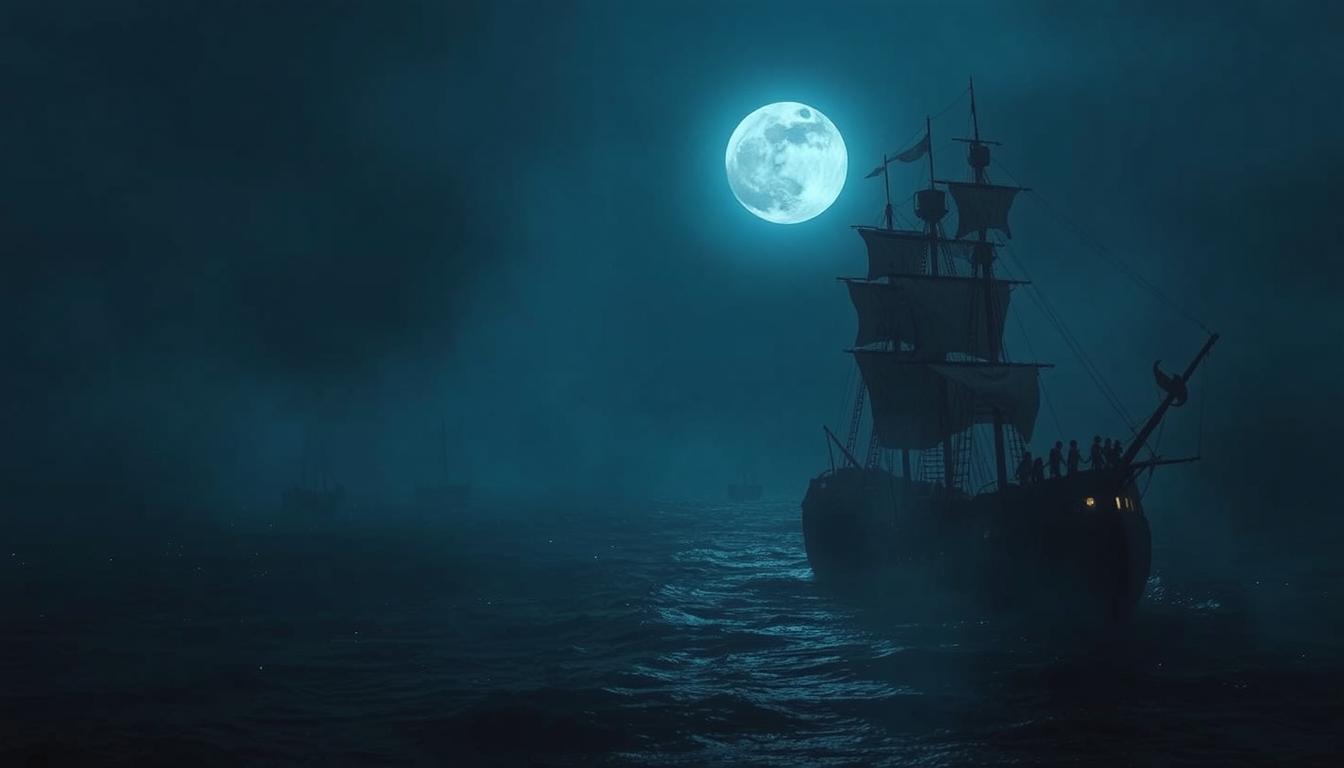
The Mary Celeste was found alone in 1872, with no crew in sight. The Flying Dutchman has been seen for centuries, adding to the sea’s mysteries. These ghost ships and sunken treasures have been a part of ocean tales for ages.
The SS Valencia sank in 1906, taking 143 lives with it. The Ourang Medan’s crew was found dead, with looks of terror. These stories add to the shipwreck legends.
Even today, secrets like the Revolutionary-era wreck near the World Trade Center in 2010 are found. With over three million shipwrecks waiting to be discovered, the mysterious shipwrecks show the ocean’s power to keep its stories hidden.
Introduction to Mysterious Shipwrecks
Shipwrecks are more than just sunken ships. They are time capsules filled with clues from the past. The Thunder Bay National Marine Sanctuary protects over 40 mysterious shipwrecks. Each one has a story to tell, thanks to maritime archaeology experts.
Understanding shipwreck terms is key to solving oceanic enigmas. A shipwreck definition might seem simple. But, the mystery grows when ships disappear without a trace. Cases like ships found adrift with no crew raise questions of storms, sabotage, or human error.
Marine archaeologists use sonar and robots to uncover these mysteries. Tools like Autonomous Underwater Vehicles (AUVs) help find wrecks. Artifacts like buttons or barrels reveal the lives of those who sailed.
The Kyle Spangler, found in 2003 after 143 years, carried 15,000 bushels of corn. Its discovery shows how stories can be lost until rediscovered. Each find, like a 1779-dated mess kid, links us to history, showing shipwrecks’ importance.
Historical Context of Shipwrecks
Throughout history, mysterious shipwrecks have shaped maritime history. They give us clues about ancient vessels and the dangers sailors faced. The 3,300-year-old Uluburun shipwreck, found off Turkey’s coast, shows how Bronze Age traders moved goods like glass and ivory across the Mediterranean.
Such ancient vessels reveal early shipbuilding techniques and the risks of long voyages.

Nautical disasters like the Battle of the Aegates in 241 BC left behind bronze weapons and helmets. These were found near Sicily. They prove ancient naval conflicts.
These relics show how shipbuilding evolved over centuries. From wooden galleys to ironclads, each era tried to avoid past tragedies. Yet, storms, collisions, and war kept claiming lives.
Shipbuilding evolved in response to disasters. The 1912 sinking of the Titanic led to safety reforms like mandatory lifeboats. Ancient wrecks like the Mary Rose (1545) teach us about medieval ship design flaws.
Today, modern technology lets researchers scan seabeds. This uncovers how maritime history connects past and present. Every sunken hull tells stories of trade, war, and survival, shaping our seafaring world.
Famous Ghost Ships Around the World
From ancient tales to today’s mysteries, mysterious shipwrecks like the Flying Dutchman and Mary Celeste have scared sailors for ages. The Flying Dutchman, a ghost ship from Dutch stories, is seen in storms as a sign of danger. Sailors say it’s seen today, linked to a captain’s bold promise:
“I’ll round the Cape, though I sail till Doomsday!”
The Mary Celeste was found floating in 1872, but its crew was gone. The ship was found with its cargo and personal items, including Captain Benjamin Briggs’ family things, adding to the mystery. Its discovery is one of the most famous abandoned ships in history, leading to many theories, from mutiny to ghosts.
The list of phantom vessels includes the SS Ourang Medan, found in 1947 with crew members frozen in fear, and the Carroll A. Deering, found on a North Carolina beach in 1921, with its logbook and gear missing. Even the Baychimo, an abandoned ship that drifted for decades, is a ghostly reminder. These stories mix truth and legend, leaving us with more questions than answers.
Recent finds like the 2006 discovery of the Jian Seng, a rusted ship found near Indonesia with no crew, show the mystery is ongoing. Whether cursed or just a coincidence, these ghost ships make us wonder: What made crews leave their ships, and why do some ships keep sailing today?
The Science Behind Shipwrecks
To understand mysterious shipwrecks, we must explore naval architecture and underwater science. Storms like those that sank the Edmund Fitzgerald in 1975 and the Sovinto show how weather impacts maritime disasters. Ship design flaws, such as weak hull points and poorly secured cargo, often lead to tragedies.
The 1894 sinking of the Ironton, carrying 1,000 tons of grain, is a prime example. It shows how cargo can destabilize even strong ships.

Shipwreck preservation involves chemistry and biology. Off North Carolina’s coast, the USS Huron (sank 1877) and the 17th-century Corolla wreck demonstrate how saltwater corrosion and marine organisms damage metals. Yet, anaerobic environments slow down decay.
The Corolla’s wooden hull, built with treenails instead of iron bolts, survives better in certain conditions. This offers insights into ancient construction techniques.
Today, underwater science employs advanced technology. ROVs scan polar ice to find the Endurance (1915). Satellites spot sediment plumes marking wreck sites. These methods help map the “Graveyard of the Atlantic,” where over 300 wrecks lie near NC shores.
Treasure Hunting: The Pursuit of Sunken Riches
Shipwreck salvage has long fueled dreams of wealth. From the 1715 Treasure Fleet’s gold scattered off Florida’s coast to the Flor de la Mar’s legendary $2 billion haul, these sunken treasures remain elusive prizes. Modern divers find coins from the 1715 fleet washing ashore. Companies like Mel Fisher’s Treasures recover millions in artifacts from the Nuestra Señora de Atocha. Over 3 million mysterious shipwrecks lie undiscovered, yet only a fraction have been explored for treasure recovery.
The SS Central America’s 1857 sinking—carrying $2–$3 million in gold—sparked a modern treasure hunt that netted investors $100 million in 1988. Yet ethical debates persist. UNESCO warns against shipwreck salvage without underwater archaeology standards, as seen in the 2012 court ruling forcing Odyssey Marine to return Spanish coins. Even the HMS Gloucester, discovered after a four-year search, faced ownership disputes.
Treasure hunters face legal minefields. The Barnwell brothers’ decade-long search for sunken treasures often clashes with preservation laws. Divers like Bobby Pritchett secure permits to explore 260 sq km off Cape Canaveral, balancing profit with heritage protection. With $500 million unclaimed from the Atocha wreck, the allure of treasure recovery endures—but so does the challenge of preserving history’s secrets.
The Role of Technology in Finding Shipwrecks
Over three million mysterious shipwrecks lie hidden on the ocean floor. Today, sonar technology and underwater robotics are changing how we find them. These tools have turned old mysteries into shipwreck discovery successes.
They scan deep depths and map old hulls. This technology unlocks secrets once hidden.

Sonar systems, like synthetic aperture sonar (SAS), create detailed seabed images. The Edmund Fitzgerald, lost in 1975, was found 530 feet deep with this technology. Remote sensing tools also find hidden relics, like the 2,400-year-old Black Sea shipwreck found in 2018.
These scans show details we can’t see with our eyes.
Underwater robots explore depths humans can’t reach. The Sabertooth robot dove 10,000 feet to find the Endurance after 107 years. Now, autonomous vehicles create 3D models with great accuracy, letting experts study wrecks without disturbing them.
The SA Agulhas vessel, a 440-foot research ship, used this tech to solve old mysteries.
Tomorrow’s technology promises even more. Engineers are working on fully autonomous underwater drones that can map wrecks without human help. As tools get better, every shipwreck discovery brings history’s stories to life, showing how innovation keeps the ocean’s past alive.
The Environmental Impact of Shipwrecks
Shipwrecks like the USS Arizona leak oil daily, showing their double role. Over 87 U.S. wrecks hold millions of gallons of oil, risking marine ecosystems. These mysterious shipwrecks can harm coastlines, as seen with the Jacob Luckenbach’s oil spill.
Yet, nature can turn dangers into life. The Superior Producer in Curaçao and HMS Maori in Malta now support coral and fish. They become artificial reefs in underwater habitats.
Scientists study the balance between harm and benefit from corroding wrecks. A 2013 NOAA report showed the threats. But, efforts like removing 450,000 gallons from the Coimbra show proactive shipwreck conservation.
Projects like RULET track risks, while the North Sea’s REMARCO initiative tackles toxic residues. These efforts aim to protect history and the seas.
Famous Shipwreck Sites in the U.S.
America’s coasts and lakes are filled with stories of adventure and tragedy. The Edmund Fitzgerald is a famous Great Lakes wreck. It sank in Lake Superior in 1975. Its story continues to intrigue divers and historians, highlighting the region’s rich maritime history.
The Carroll A. Deering’s 1921 grounding near Cape Hatteras is a mystery. It was found abandoned and crewless. The Whydah Gally, Blackbeard’s confirmed shipwreck, also draws explorers to Cape Cod. Over 3,000 wrecks lie hidden in its waters.

Coastal sites like the Harlem River’s PT-59 add to U.S. maritime history. This WWII craft is linked to John F. Kennedy. Lake Superior’s depths also hold the Edmund Fitzgerald, a reminder of the Great Lakes’ dangers.
These sites are a mix of history and tourism. Visitors can explore museums or dive tours to connect with America’s maritime past. Efforts to conserve these underwater relics ensure future generations can learn from these sunken ships.
Folklore and Legends Surrounding Shipwrecks
For centuries, mysterious shipwrecks have sparked maritime legends that mix truth and myth. The ghost ship folklore of the Flying Dutchman is a classic tale. It tells of a ship doomed to sail forever.
Sailors used to share nautical superstitions to avoid bad luck. They believed eating bananas was unlucky, for example.
Stories like Chile’s Caleuche, a ghost ship carrying the dead, add to these legends. The Carroll A. Deering, found empty in 1921, is another mystery. These tales have captivated people for years.
The shipwreck stories of the Edmund Fitzgerald, known through Gordon Lightfoot’s song, are unforgettable. They show how disasters become legendary:
“The legend lives on from the Chippewa Valley…”
Today, mysteries like the Lake Michigan Triangle and the Bermuda Triangle keep these tales alive. Even the 2006 find of the Thomas Hume after 115 years left many questions. These stories show that the sea’s secrets are endless.
Legal and Ethical Considerations in Salvage Operations
Legal fights over mysterious shipwrecks like the Lusitania show the tension between maritime salvage law and saving history. The Irish government’s strict rules for the Lusitania came after years of shipwreck ownership debates. This highlights the need for worldwide cooperation to protect underwater cultural heritage.
Laws like UNESCO’s 2001 convention try to find a balance between finding treasure and preserving history.
In 1986, the DeBraak salvage operation damaged artifacts, leading to the 1988 Abandoned Shipwrecks Act. This law gives states ownership of wrecks in U.S. waters. But, there are gaps in laws for international zones.
The Odyssey Marine Exploration v. U.S. case over a Spanish treasure ship has been ongoing for years. It has cost millions in legal fees.
“Salvage awards depend on voluntary assistance to property in peril,” per Supreme Court rulings.
Archaeological ethics require careful handling of sites like the Belitung wreck, which held Tang Dynasty artifacts. But, treasure hunters often focus on making money, risking damage. The 2004 Sunken Military Craft Act protects U.S. naval wrecks, but over 2,000 U.S. Navy ships lack clear title.
Legal gaps continue: the Titanic’s 1985 discovery led to years of court battles. The USS San Diego was looted before SMCA protections. With 3 million undiscovered wrecks worldwide, debates over maritime salvage law will grow as technology improves recovery efforts. Finding a balance between treasure hunting and preserving history is a big challenge for future explorers.
Future of Shipwreck Exploration
New underwater exploration tools are changing how we find and protect shipwrecks. AI and robots can now scan deep oceans, finding wrecks without putting divers at risk. They might even find the 3 million vessels lost at sea, many hidden for centuries.
Shipwreck conservation is urgent. The Titanic could disappear by 2030 due to bacteria. Scientists are working on new materials to slow down decay. They also use 3D scanning to save fragile sites.
Climate change is making things worse. Rising temperatures and storms could destroy sites before we can study them.
New tech like VR and AR lets people explore wrecks online. This reduces damage to real sites. Now, people can help by analyzing data, making them part of the discovery.
Shipwrecks are also key for scientific research. They contain old lead, useful for dark matter studies. But, there’s a fight between saving wrecks and using them for technology.
Most of the ocean is yet to be explored. The challenge is to find and protect wrecks. Every step forward brings us closer to solving old mysteries and keeping these treasures safe for the future.
Conclusion: The Enduring Fascination with Shipwrecks
Mysterious shipwrecks like the Titanic and the Black Sea’s 60+ ancient vessels keep us intrigued. From the Atlantic to Arctic waters, they tell stories from long ago. Tools like ROVs and 3D scans help us see these stories clearly, showing how technology changes our view of history.
But each discovery raises a question: how do we protect these treasures while learning from them? Shipwreck preservation is key to honoring both science and heritage. The Franklin expedition’s HMS Erebus and Terror, found with Inuit help, show how cultures work together to uncover the truth.
Salvage efforts, like the SS Port Nicholson’s phantom platinum cargo, highlight the tension between profit and preservation. These sites are more than treasure; they’re living history, home to marine life and ecosystems.
Oceanic mysteries continue, from the HMS Eurydice’s ghostly sightings to the Mardi Gras wreck’s hidden coins. As climate change reveals new wrecks in the melting Arctic, explorers must balance curiosity with care. From 18th-century frigates to modern tech, these sunken tales remind us that the seas hold answers and responsibilities. Protecting them ensures future generations can explore without erasing the past.