
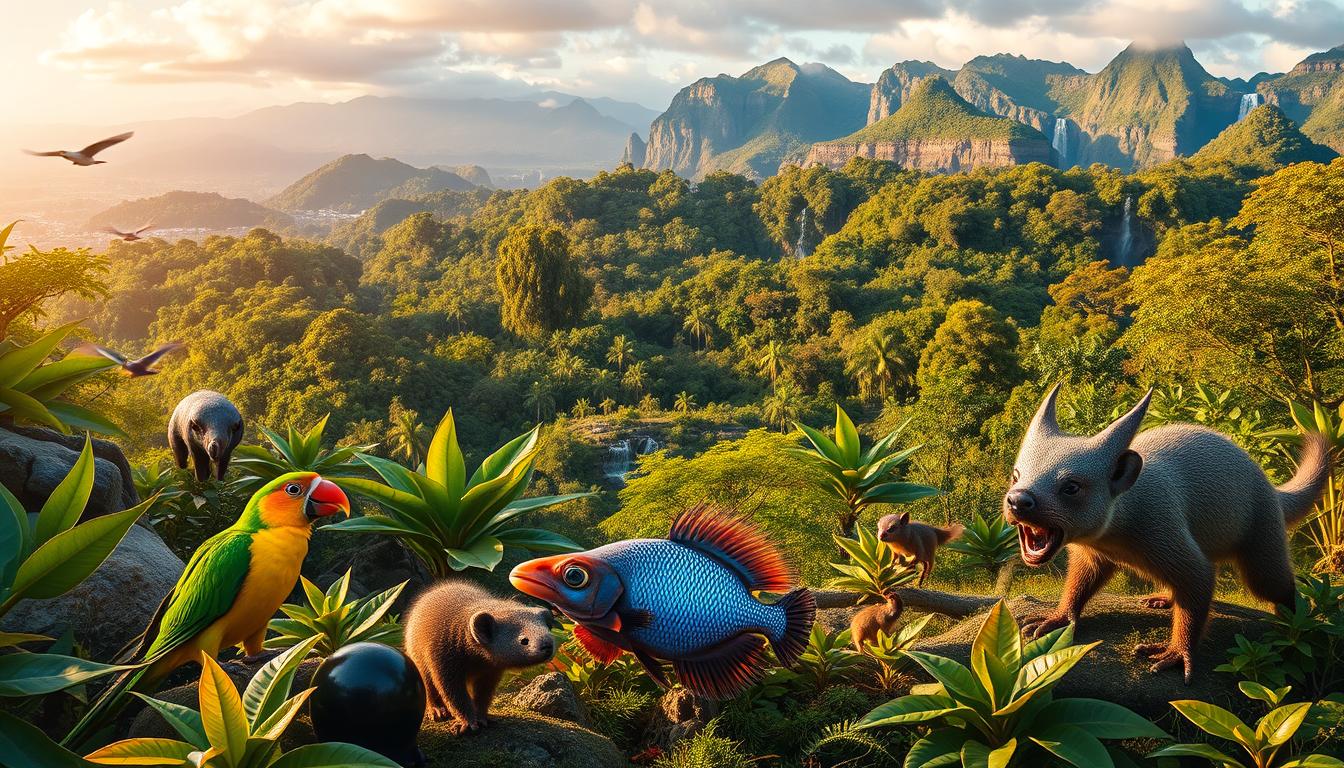
Wildlife discoveries over the past ten years have changed how we see Earth’s biodiversity. Scientists have found new species at an incredible rate. For example, 11 new moth varieties were found, linked to Alfred Russel Wallace’s work. Also, a 237-million-year-old predatory reptile was found in Brazil.
These discoveries show how much we don’t know. Only 14% of land species and 9% of ocean life have been identified. This means 86% of land species and 91% of ocean life are yet to be found.
Biodiversity research has uncovered incredible creatures. There’s the 4-meter-long Leviathanochelys aenigmatica, a giant turtle, and the 7.7-millimeter Paedophryne amauensis, the smallest vertebrate. The Amazon alone has given us 381 new species in one study.
Yet, with 86% of species undiscovered, there’s much to learn. From the 560-million-year-old Auroralumina attenboroughii to the leggiest millipede with over 1,000 legs, each find helps us understand more. But, we must act fast: 40% of plants are at risk of extinction, and species are disappearing at a rate of 273 per day in the worst cases.
Every new discovery, from deep-sea starfish to Philippine gymnures, highlights the need for conservation. It shows how much biodiversity research has yet to achieve.
The Exciting World of New Species Discoveries
Taxonomy research has brought us wonders like the Venemius tomhardyi, a spider named after Tom Hardy. It has black spots that look like Venom’s head. DNA barcoding proved it was unique, showing how genetic tools change how we identify species.
Scientists mix fieldwork with advanced methods to classify life. They make sure each discovery meets strict scientific rules.

Many discoveries happen in places like the Amazon and Eastern Arc Mountains. In Tanzania, six new pygmy chameleons were found. But, habitat loss is a big threat to their survival.
A neon-blue tarantula in Thai mangroves and a 12mm squid show how small species can reveal a lot. Over 80% of Earth’s species are unknown, with only 10-20% documented by Western science.
“Traditional knowledge often predates scientific discovery,” noted experts, stressing collaboration with Indigenous communities. Recent studies show 153 species described by the California Academy alone, proving taxonomy’s pace is accelerating.
Every named species is important. From Sri Lanka’s leafless orchid to Timor-Leste’s bent-toed gecko, each find helps conservation. DNA barcoding and fieldwork keep revealing life’s diversity. We must protect these species before they disappear.
Notable Marine Discoveries
Recent years have brought amazing discoveries in marine life. In the Coral Sea and South Pacific, scientists found three new nautilus species. These differ in shell patterns and where they live. Near Okinawa, they found two tiny sea creatures: the Ryukyuan pygmy squid and Hannan’s Pygmy Squid. These tiny beings live in coral reefs, helping us learn more about the ocean.
Exploring the ocean is more exciting than ever. The Nippon Foundation-Nekton Ocean Census, with over 800 scientists, found 866 new sea species. They discovered the Duobrachium sparksae comb jelly at 12,795 feet, seen first on video. Also, the E.T. sponge (Advhena magnifica) was found at 6,560 feet and was one of the top ten marine species in 2020.

Even in shallow waters, surprises await. A new sea star, Sibogaster bathyheuretor, was found in the Gulf of Mexico. The discovery of the guitar shark shows how vulnerable some species are. Only 10% of marine life is known, leaving millions to be discovered.
Despite the progress, there are big challenges. It can take over 13 years to register a species, and funding is often lacking. Yet, the Census plans to do 10 more expeditions by 2025. They aim to explore depths from 10 to nearly 5,000 meters. It’s vital to protect these deep-sea creatures and their homes to keep the ocean’s balance.
Remarkable Terrestrial Finds
Deep in the world’s wildest forests, land animals keep surprising scientists. The 2017 find of the Tapanuli orangutan in Sumatra is a big deal. With only about 800 left, saving their rainforest home is key to their survival.
“If we’re finding great apes, imagine what else we’re missing,” said Erik Meijaard. He points out how much we don’t know about rainforest species.

Even tiny creatures are making big waves. In Tanzania’s Eastern Arc Mountains, six tiny pygmy chameleons were found. They show how rich reptile diversity can be.
The Paedophryne amauensis frog from New Guinea is the smallest vertebrate. It’s just 7.7mm long. And in 2023, the Vangunu giant rat, over two pounds, was discovered in the Pacific.
Recent trips to Southeast Asia’s Greater Mekong region found 234 new species. This includes three mammals, like the 8-gram shrew mole. But, deforestation and climate change threaten 90% of these species in decades.
Even finding species we thought were lost, like the Mayr’s honeyeater bird, shows we must act fast. Every discovery, from blind spiders in Papua to the snake named after Harrison Ford, changes how we see life on land.
As we try to save these creatures, we learn that Earth is full of secrets. We’re racing against time to find them all.
Insects and Their Surprising Diversity
Hidden in mangroves and museums, insect species keep surprising scientists. For example, the electric-blue tarantula in Thailand has its color from light, not pigments. This shows the arthropod diversity in even familiar places.
“If there is going to be a Lady Gaga bug, it’s going to be a treehopper, because they’ve got these crazy horns, they have this wacky fashion sense about them.”

The Lady Gaga Treehopper isn’t just named for fun. It shows the bold shapes of insects. A millipede with 112 legs and beetles changing how we see stick insects are part of this. In French Polynesia, fifth graders named 17 new insects, showing how learning and discovery go hand in hand.
This project made students 97% more knowledgeable. But, there are challenges. Only 2% of French Polynesian land is protected, putting new species at risk. With 351 insect species found in 2022, every discovery is urgent.
Many invertebrate discoveries come from museum collections. But, habitat loss threatens these finds. Scientists think millions of species are yet to be named, and 25% of plants and insects are at risk of extinction. Saving arthropod diversity is not just science—it’s protecting entire ecosystems.
Avian Marvels: New Bird Species
Ornithology findings keep rewriting the story of birds. In 2002, scientists spotted a bald parrot in South America—the first species with a featherless orange face. This discovery challenged bird classification systems, proving even well-known habitats hide surprises. Though rare, such finds highlight gaps in our grasp of avian diversity.
Fossil records add to these breakthroughs. The Navaornis hestiae, an 80-million-year-old bird, was uncovered in Brazil’s William’s quarry. Its skull, preserved in 3D, revealed flight adaptations unseen in older species. CT scans helped map its brain structure, showing how early birds navigated evolutionary paths.
In China, the Baminornis zhenghensis fossil pushes timelines back further. Found in Jurassic deposits, this quail-sized bird hints at advanced avian traits evolving 150 million years ago. Its wishbone links it to modern birds, suggesting key bird classification shifts. These fossils force scientists to rethink how flight and feathers evolved.
Birdwatching discoveries also drive progress. Modern tools like DNA testing reveal cryptic species—birds visually similar but genetically unique. Even remote forests hide species like the Baminornis, proving avian diversity remains underestimated.
Conservation battles accompany these finds. Many newly named species face habitat loss before they’re even studied. Each discovery, from bald parrots to ancient fossils, shows the need to protect ecosystems. As technology advances, bird classification and avian diversity studies will only grow—opening skies full of unexpected wonders.
The Role of Technology in Discoveries
Scientific equipment and exploration technology are changing how we find Earth’s hidden life. In 2015, a deep-sea jelly was found just by watching high-definition video. This was thanks to NOAA’s underwater robots.
This showed us how cameras and drones can explore places we couldn’t before. A researcher said, “Its movement was like a balloon tethered to the ocean floor.” This shows how tech helps us see species live.
Genetic analysis has also changed the game. DNA barcoding found four new daisy species in South Africa. Before, it took years to find new species, but now, it’s done in hours with 400,000 DNA samples.
The Smithsonian and London’s Natural History Museum used these methods to split a malaria mosquito into four species. This helps fight diseases by targeting the right mosquitoes.
Now, anyone can help discover new species with apps. Machine learning makes data analysis fast. Even in cities, like Austin, we find surprises, like porcupines, with camera traps.
These tools don’t replace biologists but help them reach more places. They help us track species before they disappear.
As tech gets better, we learn more about life’s variety. From underwater robots to DNA scanners, these tools make sure no species stays hidden.
Conservation Efforts Following Discoveries
When a new species is found, it often leads to quick action to save it. The Hyloscirtus tolkieni, a frog in Ecuador, was protected in 2018. This shows how fast action can help new species survive.
In Peru’s Alto Mayo Landscape, over 34 species, including 10 butterflies, need help. They face wildlife conservation efforts to avoid extinction.
Scientists have to decide whether to share new species discoveries. Sharing can raise awareness but also attract poachers. To protect places like the Congo Basin, researchers sometimes keep locations secret.
Between 2013 and 2023, 742 new species were found in the Congo Basin. Over 300 of these are now key for biodiversity protection. In Cameroon, 238 plants are being protected.
Local communities are also important in conservation. In Peru, Conservation International works with Indigenous groups. They help protect over 600 plant species in the Alto Mayo.
In Gabon, forests with sustainable practices have 30% more mammals than unprotected areas. This shows that caring for nature works.
But, there are big challenges. Over 49 species in the Alto Mayo are threatened, including a critically endangered frog. Saving these species needs worldwide effort. Scientist Walter Jetz says ignoring these species is wrong and a failure to protect nature.
The Human Element in Discoveries
Every scientific breakthrough is built on human teamwork. Indigenous elders share indigenous ecological knowledge with the world. At the same time, citizen scientists use apps like iNaturalist to explore. This shows how the naturalist community grows from shared curiosity.
Many species thought to be new to science are well-known to local communities. These communities have used these species for generations.
“Many species that are new to science are already known and used by people in the region of origin — people who have been their primary custodians and often hold unparalleled local knowledge.”
In Okinawa, a photographer took the first pictures of a tiny pygmy squid. This was later confirmed as a new species. This shows how biodiversity documentation now involves everyone, from professionals to hobbyists.
Local guides in South Africa’s caves or Indonesian rainforests often find new species. Their insights lead researchers to new ecosystems.
Modern scientific exploration values partnerships with Indigenous communities. In Australia’s Outback and the Amazon rainforests, scientists work with tribal leaders. They combine ancestral wisdom with modern science.
This teamwork respects both ecological and cultural heritage. With technology, more people can help track biodiversity. This makes tracking biodiversity a global effort.
Every species story is also a human story. It’s where old knowledge meets new tools. By valuing all contributors, science connects past traditions with future conservation. Together, we make sure no discovery stays hidden.
Looking Ahead: Future Discoveries in Science
Earth’s biodiversity is full of secrets waiting to be found. Only 10-20% of species have been documented. Yet, over 100,000 plant and fungus species have been found in the last few years.
New tools like AI and environmental DNA help speed up finding species. But time is running out as habitats disappear.
Breakthroughs like NASA’s OSIRIS-REx mission and AlphaFold2’s protein mapping show science’s power. Even small finds, like a legless lizard in Angola or a 400-million-year-old fossil fungus, show life’s strength. But climate change and deforestation threaten these discoveries.
Biodiversity predictions say many species may disappear without being found. Protecting ecosystems like Costa Rica’s mistreated flowers or Africa’s wasps is urgent. The Paris Agreement’s 2°C limit shows the danger: rising temperatures destroy habitats faster than species can be named.
Every species we document helps protect life’s web. Investing in taxonomy and tech, like AI for species identification, could find solutions to global problems. By mixing innovation with conservation, we ensure a future where science and nature thrive together.